Christian’s Status Report for 4/4/26

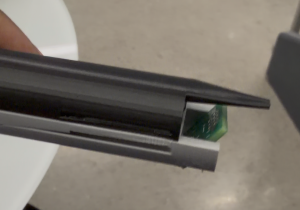
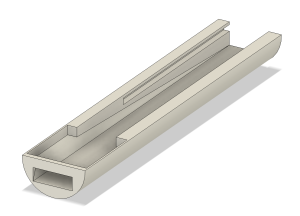
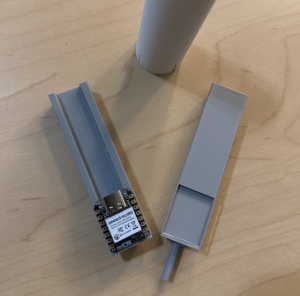
This week I worked on beginning to physically integrate the force sensing resistor and optical sensor into the stylus housing. I extended the end of the stylus housing to include supports for mounting the optical sensor at an angle. For the FSR, I decided the optimal place for it is on the top of the USB-C port on the MCU. My progress is on schedule, and this next week, I plan to have a sliding-push tip mechanism in place for physically pressing the FSR.

For verification, since we have functionality for taking in data from the MCU and displaying writing on our canvas, I will work with Jamari to develop a testbench that measures the latency between when our data is received on the OS to when a line drawing appears on our canvas application. In addition, I will make a testbench that measures the amount of power draw from our lithium ion battery and gives an estimate of how much wireless writing time is left. For the 3D housing, I will weigh it with and without the internal components to verify it meets our requirements.

Tsairus’s Status Reports for 4/4/26

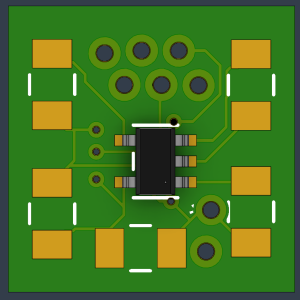
This week I managed to work on the PCB design fixes and submit a new order request for the new updated PCB. Here is the new PCB:
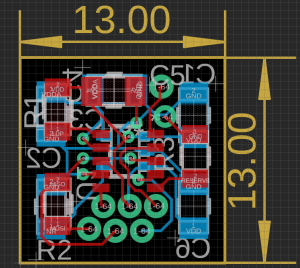
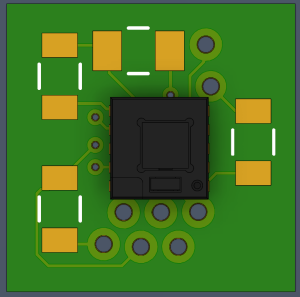
My progress is on schedule and next week I hope to have received the new PCB and solder all of the components onto it. I also want to finish the physical testing of the PCB so that I can focus more on integrating it with the other components.

Week Specific Item

My primary responsibilities are the optical flow PCB, the IMU functionality, and the microcontroller data pipeline. Here are the tests I am thinking about using for verification:

For the optical flow PCB I plan on first doing some physical testing like making sure none of the traces are shorted and all the connections are correct. Then I will run some communication test to ensure the SPI communication is working so I will read the hardcoded product ID of the sensor and make sure the microcontroller receives it correctly.  Finally I will run some accuracy test where I will move the PCB 1 inch on a surface and try this with different CPI settings (400, 800, 1200, etc.) and make sure that the sensor outputs the correct number of counts per inch. For example, at 400 CPI when I move the sensor in the x-direction 1 inch the deltaX value should equal around 400.

For the IMU functionality, one test that I already ran is testing how accurate the IMU tilt is so tilting the IMU 0, 30, 45, and 90 degrees and checking what the IMU output was. The IMU tilt was usually within ~3-5 degrees of the tested angle. Another test I was thinking about running was testing how much the IMU drifts using the current smoothing filter we have so if I leave the IMU stationary on a surface for a few minutes I can record how much the IMU angle fluctuates.

For the microcontroller data pipeline, one test I was planning on doing was inputting hardcoded dummy data and eventually real data into the microcontroller and test how well the dynamic CPI function works. For example at a 60 degree tilt and baseline target CPI of 400 the math should be 400/cos(60) which is a new target CPI of 800 so from that I will verify that the microcontroller correctly sends the correct CPI value to the optical flow sensor. I will also run some latency test to make sure all if this processing happens under the time constraint.

Jamari’s Status Report for 3/28/26

This week, I worked to finalize the bluetooth implementation. With Christian’s help, we found a way to execute code for a general computer to recognize our digital pen as a bluetooth device and connect. This will likely be our permanent communication solution moving forward. Our software has been fixed to clamp the cursor at the edge when the pen goes out of the window, but it is creating some bounding issues that I will look more into.

For next week, I will be helping put together our scripts and materials for our interim demo. After the demo, I will move to setting up testing and validation execution since most of the software is complete. I want to start with setting up timing modules and checking in with Christian to confirm plans for measuring CPI & pen accuracy.

Jamari’s Status Report for 3/21/26

This week, I did some experimenting with bluetooth and helped to finalize the canvasing application. Our implementation currently utilizes built-in functions for tracking mouse events and updating the canvas cursor through changes of the pen location. We also added the draw/move mode functionality on the software side to simulate the use of a button or pressure sensor (through we are waiting to add that to our current housing design).

For the next week, I will be working to finish our bluetooth plan and preparing resources for the interim demo. Once our PCB is ready, we will incorporate it into the physical design, and I can adjust the software side of the code as necessary.

Tsairus’s Status Reports for 3/28/26

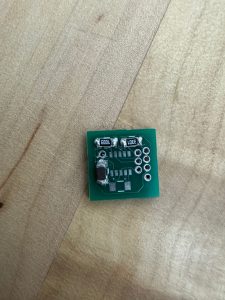
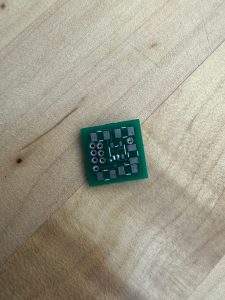
This week I managed to receive the PCB and the components that go with the PCB. After testing, I realized that one of the footprints on the PCB was flipped so the optical flow sensor cannot be solder there else it will destroy the chip. So I will need to most likely reorder the PCB for the final demo and finish the physical testing. Here is the PCB:

I also worked on the code for the integration between the IMU, optical flow sensor, and the MCU so that when the PCB is fully done everything can be easily integrated and tested.

My schedule is behind since I have to reorder the PCB. The actions I will take to catch up is finish fixing the PCB this weekend then reorder it on Monday so that towards the end of the week I can solder it and test it again. Next week I hope to have the PCB fixes done and hopefully have the new PCB received and ready for further testing.

Team Status Report for 3/28/26

The most significant risk right now is that we have to reorder our PCB for our optical sensor. Changes to the PCB are currently being made, and the risk is being managed by shifting our focus towards integrating our parts from the top down rather than bottom up from the sensor. This way, we can ensure our integration flow is working well and the sensor can be easily integrated once our new PCB is in.

No large scale changes have been made to the design of the system, just small scale optimizations and fixes.

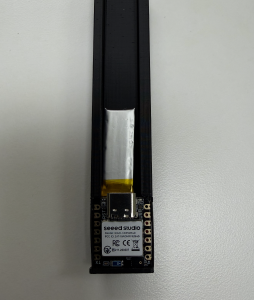
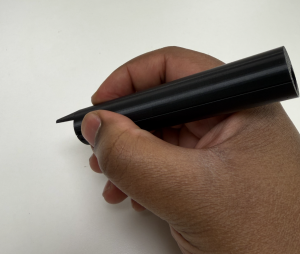
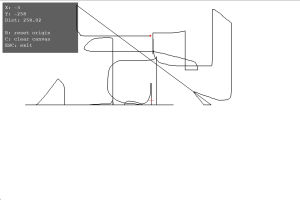
Here is a picture of our current physical stylus with the MCU and battery integrated, and a screenshot of how writing on our canvas currently looks with using dummy data from the IMU rather than optical sensor data.

Christian’s Status Report for 3/28/26

This week I worked on more iterations for our stylus housing, connected our battery to the MCU, and did the first testing of our conversion module with MCU data.

I did a lot more refining of the stylus housing this week to account our PCB wire placement, battery connection, and USB-C wire length. I created more  openings for wires and hollowed out the internals to make more room for the slack that the battery wire connection made.

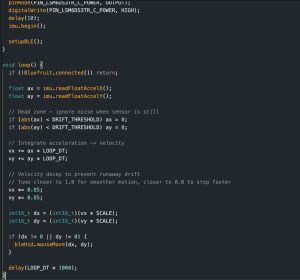
Since we had some trouble with our sensor PCB, I’m using IMU data from the MCU as dummy dx/dy values, using the BLEHID Adafruit library to feed these values into the OS, and using these values in a largely unchanged conversion module.

My progress is on track, and for next week I hope to help with integrating the optical sensor into our data flow.

Tsairus’s Status Reports for 3/21/26

This week I managed to further test the IMU rotation and tilt for the pen to ensure that it is properly calibrated for the user to comfortably hold the pen. I also spent time thinking through some of the math for how to convert the titled version of the X and Y data from the optical flow sensor into a non-tilted version so that we can properly pass this data to the computer without any discrepancies. Here is the math for that:

Compensated dX = Sensor output dX / Cos(θ)
Compensated dY = Sensor output dY / Cos(Ψ)

My progress is still on track since the PCB and its components should arrive this Monday or Tuesday and I can spend time this week soldering the PCB together. My deliverables for next week is to solder the optical flow sensor PCB together, do some physical testing of the PCB to make sure it is functional, and look more into dynamic CPI adjustment based on how the user tilts the pen to ensure maximum accuracy.

Christian’s Status Report for 3/21/26

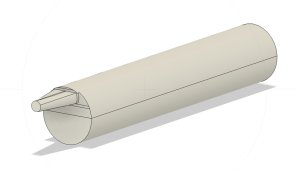
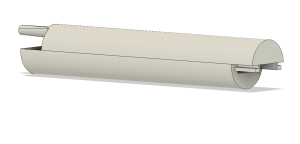
This week I did more refining on our stylus housing. I allocated a bit more room for the internal components since the fit was tight on the last iteration, and I also changed the tip shape to resemble more of a pencil shape. I also added a sliding latch on the back of the pen so that the two halves of the stylus can be held together better, and I extended the length to have a more comfortable hold. My goal right now is to make sure that all components fit well and the writing feels comfortable, then I will reduce the weight of the housing by hollowing out some of the material.

This week I focused more on iterating the housing since we’re still waiting on the optical sensor and pressure sensors to arrive. Both sensors should be in by early next week, so by the interim demo I will have basic functionality of the conversion module with the physical optical sensor and pressure sensor ready. I will take a step back from working on the housing when our sensors and PCB are in, since that is our most major delay.

Team Status Report for 3/21/26

The most significant risk at the moment is the time needed to integrate and test all of our components when our sensor PCB gets in. The rest of our component functionality more or less depends on how well the optical sensor works, and we still need to receive and bring up the PCB. Once this is done though, we should be able to make significantly more progress in the next week and be ready for the interim demo. As stated before our contingency plan is that we have multiple components for our sensor and MCU, and should something not go as planned, we will at least have basic functionality by the interim demo, and time after that to address any issues.

No design changes or schedule updates have been made since last week.

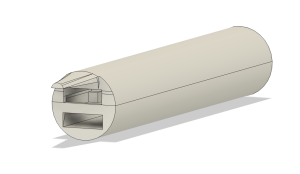
Here are a couple iterations for our stylus housing and MCU fit that we are still iterating.