Jamari’s Status Report for 2/14/26

This week I completed I did more research on the software side of our project. I found documentation online for setting up and rewriting to a canvas with mouse strokes, as well as integrating bluetooth into javascript. This gives us a good idea of how we want to format data (x & y position, z pos or isPressed). We will continue forward with using javascript + html for our software functions & try to see the differences between hosting locally and on a browser. Progress is relatively on point with a few strides needed to formally define the software architecture for our design presentation.

This week I plan to complete the software architecture and look at the interface between MCU controller and reaching the computer with saved code examples for later use.

Team Status Report for 2/14/26

The most significant risks is obtaining a sensor that can effectively track motion across a surface. We are still thinking of using an optical mouse sensor for our pen to track the surface but we have been having a hard time finding vendors that sell them. Our team is currently talking to a vendor that sells them and we are waiting for a response from them to receive a datasheet to see if what they have will work for us. These risks are being managed by looking into multiple different types of motion sensors to see which ones are available and would work best for our product. One contingency plan we have currently is to try an use the IMU we have in order to track motion across the surface but we will have to sacrifice some accuracy if we decide to go with this plan. We have also found some other motion sensors through vendors like Amazon and Tindie but they are a little bigger than ideal and after reading datasheets we would have to test them first to see if they are worth using in our product.

At the moment, we do not have any changes to our design but if we are unable to obtain our original motion sensor then we could possibly have some design changes in the future.

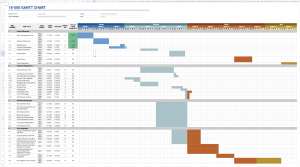
We slightly updated our schedule to push PCB stuff back by a couple of days: 18-500 Gantt chart – Gantt Chart


Week-Specific Items

A was written by T’sairus Beasley, B was written by Christian Cherry, and C was written by Jamari Toussaint.

Part A (Health, Safety, Welfare):  For welfare, the project is designed to be an easily accessible and essential digital tool that breaks down the current economic barriers that restrict digital literacy and prevent people from having access to convenient technology. Since we were able to engineer a device that works on any surface at a very low-cost (<$50) compared to other expensive options out there, we are able to support the welfare of under-resourced young professionals and artists by providing affordable access to an industry-standard digital tool that will help them in their day to day life. Furthermore, for safety we ensure that the physical design of our product prioritizes user safety through a fully enclosed, non-toxic 3D-printed case that secures the LiPo battery and other electrical components away from harmful encounters to make the device safe for daily use in many environments. For health, our product will maintain a lightweight structure (~25 grams) and will have the weight balanced throughout the entire pen. This will ensure that users will be comfortable with the product and not have to strain their hands or arms through daily use of our product causing unnecessary health problems

Part B (Social Factors): Just as tablet artist and tablet student notetakers became distinctive within the population of artists and students respectively, our Versatile Stylus has the potential to create another group of people who are marked by using our product with their computers rather than a laptop. This can generate a social group of people who dynamically collaborate with each other with larger screens. In addition, it will bring those who cannot afford a tablet into the realm of being able to draw or write digitally. We do recognize the possibility that, since our product is meant to be affordable, this social group may become isolated from those who see having a tablet paired with their stylus as a more premium option or status. On the other side of the coin, given further development time and a wider range of compatibility and features beyond our MVP, our product could replace the specific stylus-tablet dependence of certain tablet products, integrating the tablet and computer social groups with usability that benefits both communities.

Part C (Economic Factors): Considering economic factors, we are looking to design the versatile stylus with robust performance whilst increasing the affordability compared to a usual pen/tablet combo. Our microcontroller and components are relatively available, the only exception being our camera motion sensor. This would require some additional considerations when thinking about moving our product to larger scales. Our communication (bluetooth) is widely used and available for integration with scaffolding available online. Finally, we are looking into using a reusable battery within our design so users will not spend additional costs on upkeep for switching dead batteries. As our stylus is looking to be accessible, we want to include accessible parts for simple use and easy maintenance.

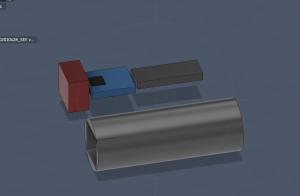
Christian’s Status Report for 2/14/26

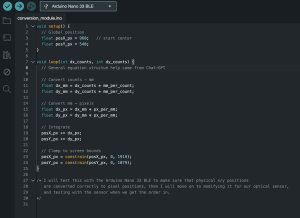
This week I completed the first draft iteration of our stylus parts housing, and started on the conversion module for our physical distance to pixel distance software module.

For the stylus housing, I imported a 3D CAD for the MCU we are using and formed a 3D block dimension for the MCU’s board. Since we are still leaning towards using the optical motion sensor rather than relying only on the IMU, I included a block for the PWM optical sensor that accounts for the ~1mm clearance needed for the sensor to work. I also included a block for our rechargeable Li-ion battery. I then formed the first iteration of our stylus housing around the dimensions of these parts.

For the conversion module, I started on the basic math needed to take x-y data from an external controller and convert it to distance on a computer screen with bounding boxes. The actual steps needed to implement this conversion are quite simple, so the real challenge will come from tuning these equations when we test with whichever motion sensor we order.

Progress this week is a bit behind because I needed to get used to using Fusion360 again after about a year. I will ensure I’m caught up by cutting the 3D CAD iteration time in half by potentially using multiple 3D printers at a time if resources allow for it.

In this next week I plan to test the fit of our initial housing iteration with some similarly sized MCU and sensor parts, and I further improve and iterate the design by adding sections for buttons and slots to more firmly hold our parts together. I will also test the current conversion module with an Arduino Nano microcontroller to make sure that the baseline equations work well before we move on to the optical sensor.

Tsairus’s Status Reports for 2/14/26

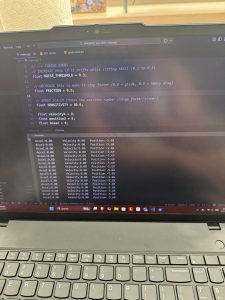
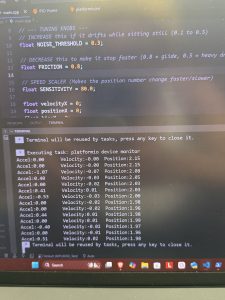
This week I decided to look into the PCB Schematic and look more into the motion sensor trying to find vendors that sell them. Originally I wanted to have the PCB schematic and layout done but I first need to find a vendor for the motion sensor we want before I can finish doing this. I am currently speaking with a vendor to arrange a part order for a particular motion sensor. So instead of sitting around waiting for that I decided to also test the IMU functionality to see if it would be possible to implement our entire pen’s motion just with the IMU. After testing, the IMU did not work that well at detecting position as we would have hoped so we are thinking of sticking to our original design of using an optical motion sensor. Here is some photos of the IMU temporarily being setup and tested using an STM32 board until we get our XIAO MCU:

:

My progress is a little behind since I was hoping to have the PCB stuff done and ready to order by the end of this week. The actions I plan on taking to catch up is continue talking to the vendor I am hoping to buy from and get the datasheet from them so that way I can start building the schematic and laying everything out by the next status report. By next week, I hope to finally have the motion sensor decided and ready to order. In addition, I am hoping to have the PCB schematic and layout for the motion sensor completed as well.

Jamari’s Status Report for 2/7/26

This week I worked to define the use case for our project so we can easily map out our use case requirements. I also contributed to solidifying the technical challenges for the versatile stylus and thinking about what testing methods we can use to ensure our hardware and software are functioning properly. With the next week, I am looking to research and experiment with the canvasing capabilities using JavaScript & HTML, with some rudimentary code to understand how we want to setup our conversion module.


Christian’s Status Report for 2/7/26

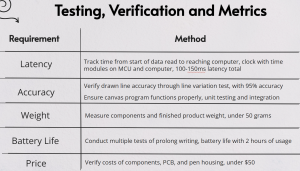
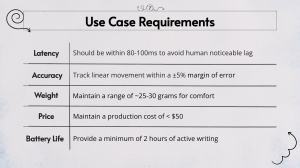
This week I helped specify use case requirements for our project to ensure that our MVP is indeed viable, including tallying up the weight, price, and helping estimate the latency requirements to look towards how usable our product will be. In addition to this, I planned out our semester work schedule in the gantt chart, and recently edited it to account for our shifted work schedule.

Within the next week, I hope to have a rough draft of both the physical position to digital position conversion module and the 3D print housing CAD done. As long as I start on these two things this weekend, I should be on schedule.

Team Status Report for 2/7/26

The most significant risk at the moment is trying to find a motion sensor for our pen. We have been searching for vendors online but have been struggling to buy and find the one that we had originally wanted. We are talking to our TA and faculty member to hopefully find trustworthy vendors to search for the needed part. The contingency plans is we have backup sensors that we could try to look for in order to replace the current one if we cannot find it. We will find backup vendors for other sensors just in case.

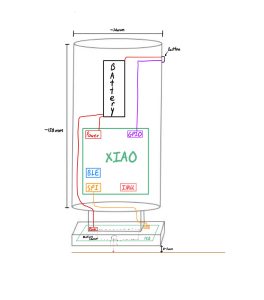
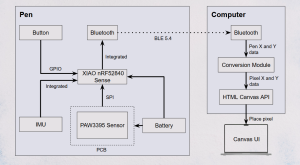
There have not been any changes to our design of the system since the proposal presentation on Wednesday. Here is our current design we are thinking of implementing:

This week we have spent time searching for all of our components plus vendors to buy those components from and compiled them all into a spreadsheet: Components – Sheet1

We updated our schedule dates a little bit to account for the time it took to design our slides for the proposal presentation and look for parts for the design so we are pushing back the PCB and CAD design by a week. Here is the updated schedule: 18-500 Gantt chart – Gantt Chart

Tsairus’s Status Report for 2/7/26

This week I managed to come up with a diagram to properly show how all of the components in our product comes together and draw out a visual representation of what I think the pen should look like. I also took the time to take measurements of the components to help figure out the dimensions that the pen should be and looked into the specs of the motion sensor to make sure it could accomplish the tasks we need from it. In addition to this I spent time coming up with technical challenges and some risk mitigation strategies to counteract what we think our technical challenges are.  I think my progress is on schedule since I was able to come up with a reasonable hardware design and pretty much finished looking for the parts we want.

For next week I am hoping to complete the first round of the PCB schematic and layout for the motion sensor so we can send that to the fab and test it soon to make sure there are no errors.