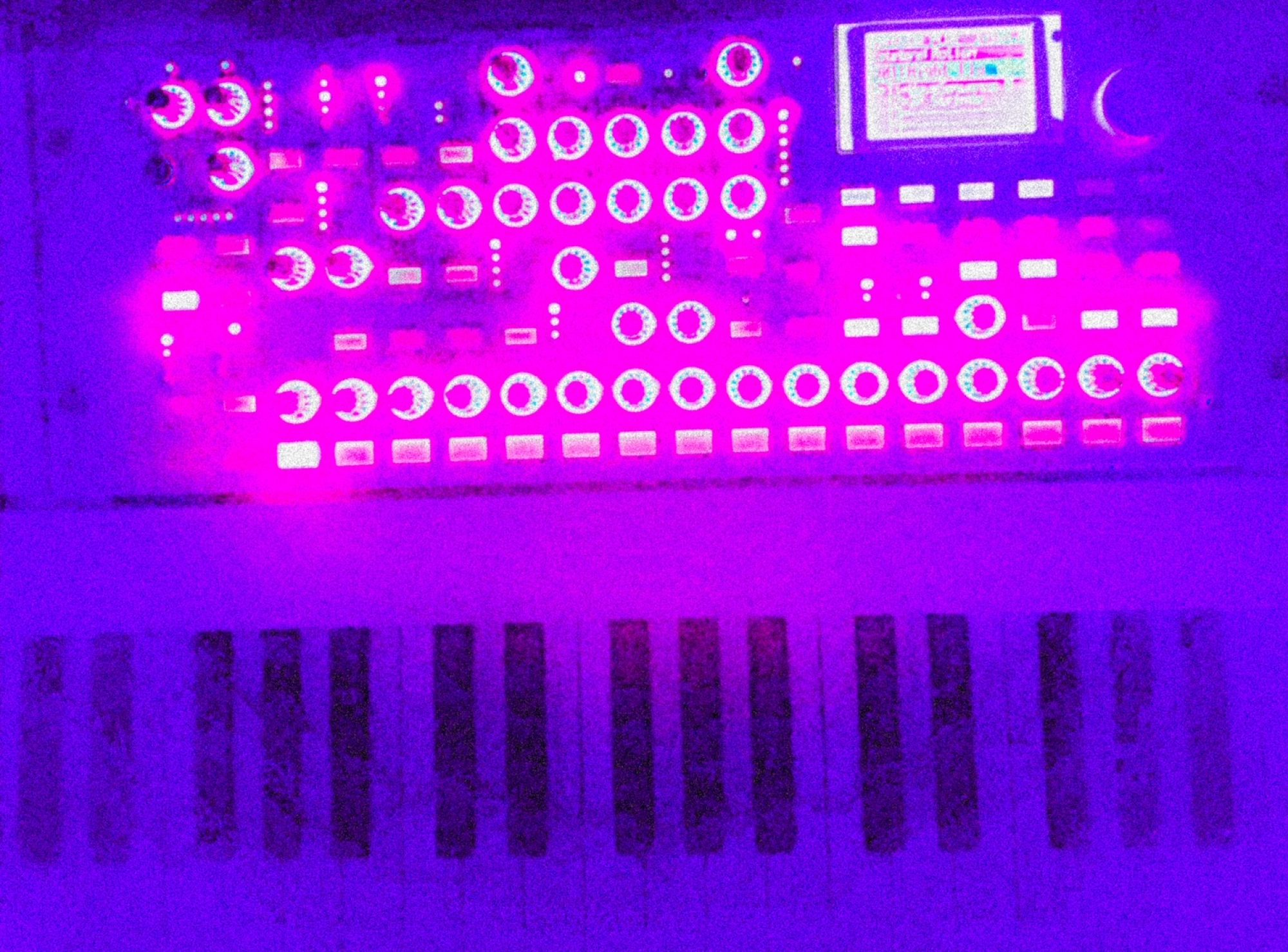
Video
Daniel’s Status Report for 04/25
This week, I am aiming to get the HPS sub-system fully squared away. It turns out that there was a corruption in my flashing of a slightly more souped-up Linux system image to an SD card which rendered it unmountable and unbootable media.
Now, having caught this mistake, I can likely finish getting the keyboard to work natively without a relay by the end of the day.
I now aim to finalize the serial communication mechanisms for Waveshaper control and add a visualization output byte stream.
I performed the latency unit test. This was an end-to-end test of the entire I/O. I used real hardware with a trigger-mode oscilloscope.
Shayaan’s Report 4/25
This week, I finished synthesizing all the SystemVerilog needed to create a fully functioning polyphonic digital synthesizer. Currently, the controls are mapped to the FPGA’s onboard I/O, such as buttons and switches, but Daniel is working on transferring these controls to the keyboard interface. Once everything is integrated with the keyboard, the core system will be complete.
To go beyond a basic synthesizer, we are considering adding features that make the output sound more expressive. One potential improvement is applying an envelope to the cutoff frequency so it evolves over time. Adding this feature would produce a richer and more realistic sound.
I have also started developing an algorithm that takes an input audio signal and decomposes it into coefficients that can be used by the FPGA to reconstruct the sound. While I do not expect to have a fully working version by demo day, my goal is to achieve reasonably accurate polyphonic sound reconstruction using only the oscillators, envelopes, and filters available on our board. So far, I have implemented an algorithm that extracts an envelope from a given sound with about 80 percent accuracy, and I am continuing to refine it.
Team Status Report 4/18
This week, Shayaan finished writing and verifying all of our SystemVerilog modules. Much of the design has also been synthesized, leaving only the final pipeline synthesis remaining. Our completed signal chain will follow the structure: Oscillators -> Filters -> Envelope -> Effects. Once the full pipeline is synthesized, we will evaluate how many voices our FPGA can support given resource constraints.
We are also planning to enhance the system by adding an envelope to modulate the filter cutoff frequency, which should produce a more dynamic sound. In addition, our MIDI keyboard recently arrived, and Jake and Daniel have begun working on transmitting MIDI commands to the FPGA. We are currently encountering some difficulties sending commands directly, so we may need to use a computer as an intermediary.
Daniel is also working on developing a GUI on a computer that will provide detailed control over the synthesizer and offer a more intuitive visualization of our pipeline. The interface will feature a drag-and-drop block diagram, allowing users to easily add and configure effects, filters, and envelopes within the signal chain.
This week, we also performed final verification of our synthesizer. We measured the frequency of the waveforms generated by the FPGA and compared them to the desired target frequencies. We also computed FFTs of our oscillator outputs to evaluate how closely the generated waveforms match their ideal forms. For example, we analyzed the FFT of a square wave to confirm the presence of only odd harmonics. While it is easy to hear whether a filter behaves as a high-pass or low-pass filter, we additionally used FFT analysis to quantitatively examine how the filter affects different frequency components.
Finally, we organized a session where friends will use our FPGA synthesizer to provide validation data. We plan to discuss both the results and the evaluation methods in our presentation.
Shayaan Status Report 4/18
This week, I made significant progress in writing and synthesizing our effects set. At this point, all of our SystemVerilog modules have been written and verified against our MATLAB pipeline using bit-by-bit verification. This process involves generating an expected hex file from the MATLAB pipeline and ensuring that the SystemVerilog output matches it exactly.
I have written and tested the Delay, Echo, Reverb, Redux, and Distortion modules, and I have successfully synthesized Delay, Echo, Redux, and Distortion. I plan to synthesize Reverb shortly. There is still a small bug in our Envelope module that I am actively working to resolve.
The next step is to integrate all of these components into a final top-level module and evaluate how many voices we can support given the FPGA resource constraints. Another major aspect of our project, which we discussed earlier in the year, is developing a program that takes an input sound and determines how to recreate it using our FPGA synthesizer. This includes identifying the appropriate frequencies, filters, envelopes, and effects needed to approximate the original sound. Once the top module is complete, I will focus on building this program and aim to bring it to a presentable state before demo day.
One of the most important lessons I learned during this project is the value of thorough verification. There are many approaches to verification, but using bit-by-bit comparison with a golden model proved especially effective. When issues arose during synthesis, this method allowed us to quickly isolate and identify the source of the problem because we had high confidence in the correctness of verified components.
I also gained experience working with proprietary IP, which can be quite cumbersome. Since we are using an Intel FPGA, we rely on Quartus IP blocks to drive the DAC for audio output. Integrating and understanding these components took significantly longer than expected due to the complexity and limited transparency of the documentation. Additionally, my team is working on interfacing with a MIDI keyboard, which may require further interaction with proprietary IP. Navigating documentation and implementing even basic functionality often required substantial time and effort.
Shayaan Status Report 4/4
This week, we successfully synthesized the oscillators on the FPGA. One of the primary issues we encountered involved the DAC logic: although the documentation indicated a two’s complement input, the DAC is wrapped in Intel IP that requires Offset Binary logic. Once we adjusted for this, we were able to produce clean sawtooth, square, and triangle waveforms. We also discovered that the DAC cannot handle a square wave that swings rail-to-rail, as it requires additional headroom to account for higher-order harmonics.
I am still troubleshooting the sine wave generation via a Lookup Table (LUT). I loaded a ROM with a sine .mif file and confirmed that the system is reading the values correctly by verifying them on the Hex display. However, the resulting output is very noisy; while it retains a sinusoidal shape, the source of the noise remains unclear.
Additionally, I synthesized a Chamberlin State Variable Filter (SVF), which features integrated LPF, HPF, and BPF outputs. I have verified the filter’s mathematical correctness through our MATLAB pipeline and completed the SystemVerilog implementation. Despite this, the filter is not yet behaving as expected when running on the FPGA.
Verification is an important step that I take before synthesis on the FPGA and is the reason we have implement a MATLAB pipeline. To use the MATLAB pipeline, I generate a .hex file with our theoretical values. This .hex file in then read in a SystemVerilog testbench and I check after each timestep whether my SystemVerilog output is the same as the hex. This has been very useful in debugging and verifying the filter.
Shayaan’s Status Report 3/28
This week, we worked on synthesizing the oscillators on the FPGA to produce a real audio output signal. This required correctly driving the DAC and initializing I2C communication with it. Ultimately, we were successful in driving the DAC using our previously developed oscillators. However, we noticed some issues with the periodicity of certain waveforms, as well as with the sine wave lookup table (LUT).
While working on fixing the oscillators and synthesizing a filter onto the FPGA, I encountered an issue accessing my account on the HH machines. Whenever I try to log in, I am redirected back to the username page. This has prevented me from synthesizing additional modules on the FPGA and continuing my work.
The next steps are to determine why I cannot access my account on the HH machines and then resume synthesizing modules such as filters and envelopes so we can move on to implementing effects.
Team Status Report 3/21
This week the team continued to work on the SystemVerilog implementation and Matlab pipeline. We have successfully completed the oscillators, mixer, envelope, and filter modules in both SystemVerilog and Matlab, marking a major milestone in the core signal path development. With these components in place, our focus is now shifting toward implementing the full filter set and verifying the correctness and stability of the overall pipeline. On the Matlab side, only the effects stage remains to be integrated to complete the end-to-end model.
In parallel, we worked with Quartus to synthesize an online example project onto the Intel DE-10 FPGA, gaining familiarity with the toolchain and deployment process. We are still working on establishing communication between the HPS core and the programmable logic (PL) fabric. Additionally, we made initial attempts to produce audio output from the FPGA, though this is still a work in progress.
At this stage, achieving reliable audio output from the FPGA is one of our top priorities, as it is essential for validating the full signal chain in real hardware and ensuring real-time performance. We will continue focusing on debugging the audio interface and establishing a stable connection between the processing pipeline and the output hardware. In parallel, completing the Matlab pipeline is equally critical, as finalizing the effects stage will provide a full reference model for formal verification. This will allow us to systematically compare outputs between Matlab and SystemVerilog, ensuring correctness before full hardware deployment.
Shayaan’s 3/21 Status Report
Unfortunately this week I was unable to make as much progress as I would have liked. This week I started to create the SystemVerilog Filter and MATLAB filter files for the simulator. The filter we have chosen is a second order infinite impulse response filter.
A second-order infinite impulse response (IIR) filter is a discrete-time filter defined by a difference equation that uses both past inputs and past outputs, allowing it to achieve complex frequency responses with only a few coefficients. It is the lowest-order filter capable of producing resonance, making it especially useful for shaping audio signals in digital synthesizers. It is computationally efficient and well-suited for real-time and hardware implementations, while still providing flexibility through tunable parameters such as cutoff frequency and Q factor.
Next week, I will use waveform analysis to verify the SystemVerilog implementation, integrate the filter with the other system modules, and connect the MATLAB code into the overall simulation pipeline