
PublicDemo_PosterTemplate_S26.pptx PublicDemo_PosterTemplate_S26
Final Report
Final Video
Eddie’s Status Report 04/25
This week, I focused on testing the integrated EKF pipeline with the data collected from the moored weather balloon test. I helped review the logged IMU and visual data and checked how the filtering pipeline behaved when the visual feature extraction became unreliable due to cloud cover.
I found that the EKF pipeline can still process the sensor data, but the visual updates are less useful when the star detection pipeline fails or produces poor measurements. This showed that we need stronger filtering or masking before passing visual measurements into the estimator.
My progress is on schedule. Next week, I will help finish the final report, poster, and video, and include the testing results from the balloon experiment.
Team Status Report 04/25
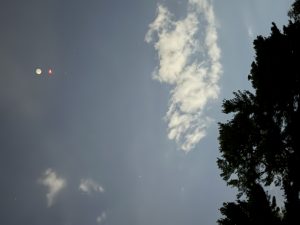
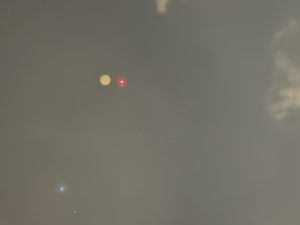
This week, we launched a moored weather balloon in an effort to collect data at night on a moving aerial platform. The test was partially successful, in that we collected data but the feature extraction pipeline broke in the presence of clouds. We are working on post-processing the logs in order to address this.
This week, our focus is primarily on the poster, video, and final report.
Julius Status Report 04/25
This week, I designed, constructed, and launched a moored weather balloon. I scavenged necessary parts and 3D-printed the gondola, and conducted the flight test at Schenley Park after filing a NOTAM and in accordance with Part 101. The balloon flew successfully, though unfortunately there were issues with power delivery onboard and the Raspberry Pi continued to reboot. More problematic was the weather – though the forecast had forecasted <10% cloud cover, the cloud cover above the test site was above 50%. Useful data was collected, and results demonstrated that feature extraction breaks in the presence of clouds. The balloon ascended to a maximum of 500FT AGL and 1km away. I am working to address this by blurring and thresholding the image to mask out clouds. I will re-evaluate results after this is completed.
Team Status Report 4/18
This week, we focused on integrating the full system and evaluating performance. We connected the EKF pipeline with the IMU and visual components and began running end-to-end tests using real collected data.
We also collected trajectory data and compared results against GPS ground truth, seeing significant improvements over pure IMU dead reckoning. Overall system metrics are within our design targets, including position accuracy, timing, and power.
We are on schedule. The remaining work is final testing and preparing for the demo.
Eddie’s Status Report 4/18
This week, I implemented the attitude and position EKF modules and connected them to the IMU and visual pipelines. I also tested the data flow between nodes and began running end-to-end tests using recorded data.
For verification, I checked that the attitude EKF produces stable roll, pitch, and yaw when combining IMU and visual inputs, and that the position EKF propagates motion correctly and updates toward visual position measurements. Initial results show the system is behaving as expected.
In the process, I had to learn more about EKF design, coordinate frame transformations, and how to structure ROS nodes for modular systems. I mainly learned this through documentation, online resources, and testing small examples before integrating everything together.
My progress is on schedule. Next week, I plan to run more tests and evaluate accuracy against ground truth.
Julius Status Report 04/18
This week, I focused on collecting more data and tuning the estimation pipeline. I mounted the setup atop a vehicle and drove it while collecting data over the course of a 942m long trajectory. I was able to achieve low-frequency attitude rate estimation by cross-matching celestial features found across adjacent camera frames, akin to VIO, which improved trajectory accuracy against GPS ground truth over IMU dead reckoning from >300m to 14m – a large achievement.
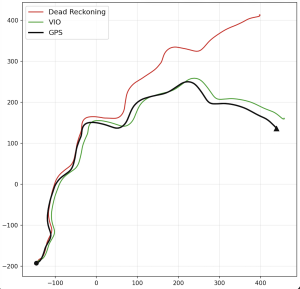
I tested celestial global positioning as well and achieved considerable improvements in accuracy, with a median positioning error of 2.1km and p95 at 6.8km.
Rachel’s Status Report 4/18
This week I focused on the final presentation, building out the slides, prepping my delivery since I’m the presenter, and double-checking every number in the deck against our raw data to make sure nothing is off.
We’re on schedule. All results are under threshold: 2.1 km median position error (target 10 km), 0.32 px reprojection error, 500 μs time sync (target 50 ms), 4.5 W power draw (target 10 W). Only two things left: the moored balloon experiment and demo day!