
PublicDemo_PosterTemplate_S26.pptx PublicDemo_PosterTemplate_S26
Final Report
Final Video
Team Status Report 04/25
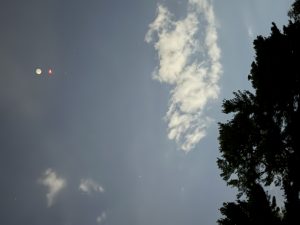
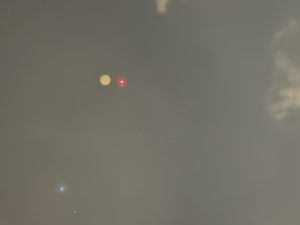
This week, we launched a moored weather balloon in an effort to collect data at night on a moving aerial platform. The test was partially successful, in that we collected data but the feature extraction pipeline broke in the presence of clouds. We are working on post-processing the logs in order to address this.
This week, our focus is primarily on the poster, video, and final report.
Team Status Report 4/18
This week, we focused on integrating the full system and evaluating performance. We connected the EKF pipeline with the IMU and visual components and began running end-to-end tests using real collected data.
We also collected trajectory data and compared results against GPS ground truth, seeing significant improvements over pure IMU dead reckoning. Overall system metrics are within our design targets, including position accuracy, timing, and power.
We are on schedule. The remaining work is final testing and preparing for the demo.
Rachel’s Status Report 4/18
This week I focused on the final presentation, building out the slides, prepping my delivery since I’m the presenter, and double-checking every number in the deck against our raw data to make sure nothing is off.
We’re on schedule. All results are under threshold: 2.1 km median position error (target 10 km), 0.32 px reprojection error, 500 μs time sync (target 50 ms), 4.5 W power draw (target 10 W). Only two things left: the moored balloon experiment and demo day!
Rachel’s Status Report 4/4
This week, I upgraded the celestial positioning pipeline with ASTAP as the primary plate solver (1–2s vs 10–60s for astrometry.net) with automatic fallback when ASTAP can’t solve. I replaced attitude extraction with direct rotation matrix extraction. I alidated end-to-end by plate-solving a real iPhone star photo and a synthetic FITS image from NASA.
Next week I need to test the full pipeline on the Pi with the existing camera calibration and live IMU/mag data to get an actual lat/lon fix with ground truth comparison.
I am on track. The core math is all implemented and tested, camera calibration is done, and sensor data is validated. The remaining work is Pi integration and accuracy evaluation.
Team Status Report 04/04
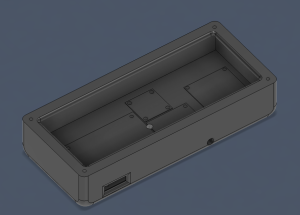
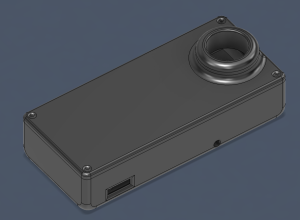
This week, our major progress points were in developing the hardware enclosure for all components and dealing with unforeseen corruption in the Linux install on the Raspberry Pi, which required re-installing the OS and re-configuring the device from scratch. We are in the process of 3D printing the enclosure, and are now set up for data collection this Tuesday when the forecasts show clear skies.
The designs for the enclosure are shown below with and without the top cover:
For validation, we plan to compare our system outputs against known references, including comparing IMU and visual attitude estimates and later comparing position estimates to GPS.
Julius Status Report 03/28
This week, the majority of my time was spent on preparing the interim demo. I brought up the camera calibration pipeline for display, and prepared slides on the software stack, calibration processes we developed, and the schedule for the next 3 weeks.
Team Status Report 03/28
This week, the bulk of our preparation went into preparing the interim demo. We conducted further fine tuning of the complimentary filter, and brought up the camera calibration pipeline for demo’ing.
We continue to be blocked by lack of clear skies for testing, though forecasts indicate that this will come in the next 2 weeks.