Team Status Report 04/25

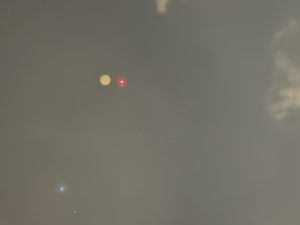
This week, we launched a moored weather balloon in an effort to collect data at night on a moving aerial platform. The test was partially successful, in that we collected data but the feature extraction pipeline broke in the presence of clouds. We are working on post-processing the logs in order to address this.

This week, our focus is primarily on the poster, video, and final report.

Julius Status Report 04/25

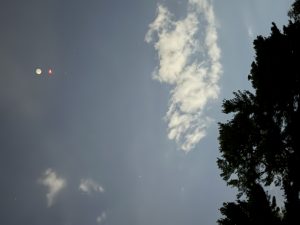
This week, I designed, constructed, and launched a moored weather balloon. I scavenged necessary parts and 3D-printed the gondola, and conducted the flight test at Schenley Park after filing a NOTAM and in accordance with Part 101. The balloon flew successfully, though unfortunately there were issues with power delivery onboard and the Raspberry Pi continued to reboot. More problematic was the weather – though the forecast had forecasted <10% cloud cover, the cloud cover above the test site was above 50%. Useful data was collected, and results demonstrated that feature extraction breaks in the presence of clouds. The balloon ascended to a maximum of 500FT AGL and 1km away. I am working to address this by blurring and thresholding the image to mask out clouds. I will re-evaluate results after this is completed.

Team Status Report 4/18

This week, we focused on integrating the full system and evaluating performance. We connected the EKF pipeline with the IMU and visual components and began running end-to-end tests using real collected data.

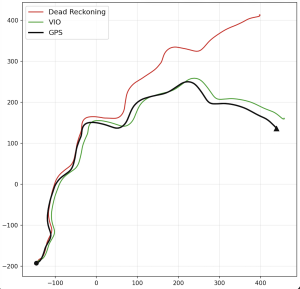
We also collected trajectory data and compared results against GPS ground truth, seeing significant improvements over pure IMU dead reckoning. Overall system metrics are within our design targets, including position accuracy, timing, and power.

We are on schedule. The remaining work is final testing and preparing for the demo.

Eddie’s Status Report 4/18

This week, I implemented the attitude and position EKF modules and connected them to the IMU and visual pipelines. I also tested the data flow between nodes and began running end-to-end tests using recorded data.

For verification, I checked that the attitude EKF produces stable roll, pitch, and yaw when combining IMU and visual inputs, and that the position EKF propagates motion correctly and updates toward visual position measurements. Initial results show the system is behaving as expected.

In the process, I had to learn more about EKF design, coordinate frame transformations, and how to structure ROS nodes for modular systems. I mainly learned this through documentation, online resources, and testing small examples before integrating everything together.

My progress is on schedule. Next week, I plan to run more tests and evaluate accuracy against ground truth.

Julius Status Report 04/18

This week, I focused on collecting more data and tuning the estimation pipeline. I mounted the setup atop a vehicle and drove it while collecting data over the course of a 942m long trajectory. I was able to achieve low-frequency attitude rate estimation by cross-matching celestial features found across adjacent camera frames, akin to VIO, which improved trajectory accuracy against GPS ground truth over IMU dead reckoning from >300m to 14m – a large achievement.

I tested celestial global positioning as well and achieved considerable improvements in accuracy, with a median positioning error of 2.1km and p95 at 6.8km.

Rachel’s Status Report 4/18

This week I focused on the final presentation, building out the slides, prepping my delivery since I’m the presenter, and double-checking every number in the deck against our raw data to make sure nothing is off.

We’re on schedule. All results are under threshold: 2.1 km median position error (target 10 km), 0.32 px reprojection error, 500 μs time sync (target 50 ms), 4.5 W power draw (target 10 W). Only two things left: the moored balloon experiment and demo day!

Rachel’s Status Report 4/4

This week, I upgraded the celestial positioning pipeline with ASTAP as the primary plate solver (1–2s vs 10–60s for astrometry.net) with automatic fallback when ASTAP can’t solve. I replaced attitude extraction with direct rotation matrix extraction. I alidated end-to-end by plate-solving a real iPhone star photo and a synthetic FITS image from NASA.

Next week I need to test the full pipeline on the Pi with the existing camera calibration and live IMU/mag data to get an actual lat/lon fix with ground truth comparison.

I am on track. The core math is all implemented and tested, camera calibration is done, and sensor data is validated. The remaining work is Pi integration and accuracy evaluation.

Eddie’s Status Report 4/4

This week, I focused on verifying the IMU attitude estimation after calibration updates. I reran the complementary filter on recorded data and analyzed the roll, pitch, and yaw outputs using plots and a 3D viewer.

The results show improved stability, especially in yaw, after fixing the magnetometer issue. This verifies that the IMU subsystem is producing reliable orientation estimates.

I also wrote up the code for the position esitmation node but I might need some testing with the visual pipeline once we have that data.

My progress is on schedule. Next week, once we have a good day I will test all the estimations together.

Eddie’s Status Report 3/28

This week, I worked on integrating the IMU attitude estimation with the rest of the estimator and preparing for the interim demo. I refined the complementary filter pipeline and continued testing using recorded data and visualization tools.

My progress is on schedule. The main goal was to ensure the IMU attitude estimates were stable for use in the system.

Next week, I planned to begin integrating position estimation.

Team Status Report 04/04

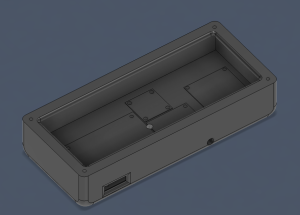
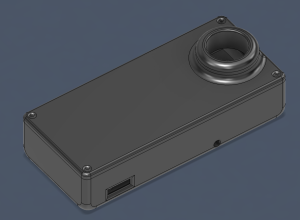
This week, our major progress points were in developing the hardware enclosure for all components and dealing with unforeseen corruption in the Linux install on the Raspberry Pi, which required re-installing the OS and re-configuring the device from scratch. We are in the process of 3D printing the enclosure, and are now set up for data collection this Tuesday when the forecasts show clear skies.

The designs for the enclosure are shown below with and without the top cover:

For validation, we plan to compare our system outputs against known references, including comparing IMU and visual attitude estimates and later comparing position estimates to GPS.