Rachel’s Status Report 4/4

This week, I upgraded the celestial positioning pipeline with ASTAP as the primary plate solver (1–2s vs 10–60s for astrometry.net) with automatic fallback when ASTAP can’t solve. I replaced attitude extraction with direct rotation matrix extraction. I alidated end-to-end by plate-solving a real iPhone star photo and a synthetic FITS image from NASA.

Next week I need to test the full pipeline on the Pi with the existing camera calibration and live IMU/mag data to get an actual lat/lon fix with ground truth comparison.

I am on track. The core math is all implemented and tested, camera calibration is done, and sensor data is validated. The remaining work is Pi integration and accuracy evaluation.
Eddie’s Status Report 4/4

This week, I focused on verifying the IMU attitude estimation after calibration updates. I reran the complementary filter on recorded data and analyzed the roll, pitch, and yaw outputs using plots and a 3D viewer.

The results show improved stability, especially in yaw, after fixing the magnetometer issue. This verifies that the IMU subsystem is producing reliable orientation estimates.

I also wrote up the code for the position esitmation node but I might need some testing with the visual pipeline once we have that data.

My progress is on schedule. Next week, once we have a good day I will test all the estimations together.

Eddie’s Status Report 3/28

This week, I worked on integrating the IMU attitude estimation with the rest of the estimator and preparing for the interim demo. I refined the complementary filter pipeline and continued testing using recorded data and visualization tools.

My progress is on schedule. The main goal was to ensure the IMU attitude estimates were stable for use in the system.

Next week, I planned to begin integrating position estimation.

Team Status Report 04/04

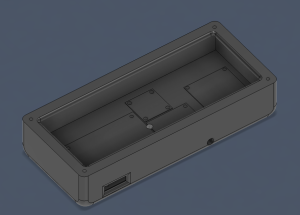
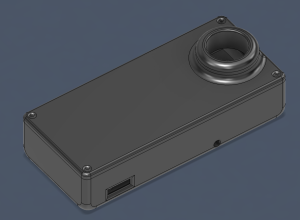
This week, our major progress points were in developing the hardware enclosure for all components and dealing with unforeseen corruption in the Linux install on the Raspberry Pi, which required re-installing the OS and re-configuring the device from scratch. We are in the process of 3D printing the enclosure, and are now set up for data collection this Tuesday when the forecasts show clear skies.

The designs for the enclosure are shown below with and without the top cover:

For validation, we plan to compare our system outputs against known references, including comparing IMU and visual attitude estimates and later comparing position estimates to GPS.

Julius Status Report 04/04

This week, I developed the CAD the hardware enclosure for our components and began 3D printing it. I also set up sensor streaming from the GNSS module, though we identified that our specific module requires an antenna the unit did not come with; we will order it this week.

Our Raspberry Pi Ubuntu installation appears to have become corrupted over the past week, so I invested time in re-flashing and re-configuring it as well.

The enclosure design is shown here with and without the top cover:

Julius Status Report 03/28

This week, the majority of my time was spent on preparing the interim demo. I brought up the camera calibration pipeline for display, and prepared slides on the software stack, calibration processes we developed, and the schedule for the next 3 weeks.

Team Status Report 03/28

This week, the bulk of our preparation went into preparing the interim demo. We conducted further fine tuning of the complimentary filter, and brought up the camera calibration pipeline for demo’ing.

We continue to be blocked by lack of clear skies for testing, though forecasts indicate that this will come in the next 2 weeks.

Team Status Report 3/21

This week, we made progress on both the IMU and visual pipelines. The IMU attitude estimation improved after calibration, and the complementary filter is now producing more stable results. On the visual side, we continued improving the consistency of the plate solving and attitude estimation.

We also attempted to collect new nighttime data, but weather conditions made it difficult to get usable images.

Overall, we are on track. Next, we plan to integrate the IMU and visual attitude estimates and begin testing the full system together.

Eddie’s Status Report 3/21

This week, I worked on refining the IMU attitude estimation and starting integration with the rest of the estimator. I also adjusted the architecture so that the complementary filter outputs Euler angles, which will be used together with visual attitude estimates. I also continued testing using recorded data and improved visualization tools to better understand the filter behavior.

My progress is on schedule. The main goal this week was to get stable IMU-based attitude estimates and integrate the IMU and visual attitude estimates and start testing the combined system.

Next week we will add the position estimates into the system.

Rachel’s Status Report 3/21

This week, I focused on improving the robustness of the attitude estimation pipeline and validating its consistency across different image inputs. I refined the integration between the plate solver output and our calibrated camera model, which helped reduce inconsistencies in the computed orientations.

I need to begin connecting the attitude outputs to the next stage of the pipeline and figure out how to convert these orientations into preliminary latitude and longitude estimates. This is is critical for meeting our system accuracy goals.

We verified our subsystem by testing star detection robustness under noise, blur, and occlusion, and by validating plate solving and attitude estimation using known WCS outputs, measuring angular residual errors and solve success rates. For validation, we use ground-truth datasets from NASA SkyView and Stellarium to compare estimated boresight RA/Dec against known values and compute angular and position error relative to the ≤10 km requirement.