
Team Status Report
For the week of September 20th–26th, we worked on bringing up the embedded software platform, grounding the mechanical design in a reputable six-axis reference model, refining the Iteration 1 parts list, and preparing the CAD and presentation materials needed for the next stage of the project.
Project Risks & Management Strategies
The biggest risk was figuring out the structural requirements of our manually inferred dimensions on our previous CAD model, as we didn’t have a good basis to figure out if the links would sustain the weight of the joints.
We are managing this risk by comparing our measurements now against Universal Robots’ UR3e, and we aim to calculate the joint torques using the selected components’ estimated masses, and prepare some comprehensive SolidWorks motion and load simulations before printing the final links for this iteration.
Another risk we’ve identified is the integration between the CAD model, ROS2 coordinates, computer vision, and the physical arm. We are attempting to reduce that risk through developing the Jetson software environment early; this week, we’ve already set it up and ran it, and we’re collaborating on defining the CAD workspace and joint constraints before we print the pieces.
System Design Changes
We chose to use the UR3e as reference for dimensions and kinematics, instead of deriving all link lengths and joint placements from scratch which would require continuous testing, and this mechanical specs can get a bit complicated when isn’t the primary expertise or focus of our group. We imported the UR3e STEP model into SolidWorks and recorded its links, joint placement, proportions, and reachable workspace.
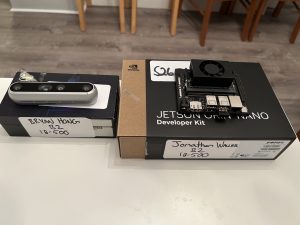
We also set up and installed the OS on our NVIDIA Jetson Orin Nano with JetPack 7 Ubuntu and ROS2. This would give us a physical development platform for testing ROS2 nodes and preparing the coordinate-frame and motion-planning architecture before we assemble the complete arm, so we could allow time extra time for adapting the reference links and joints and configuring the Jetson.
Project Schedule Status
The project remains mostly on schedule. The Jetson environment, initial ROS2 publisher/subscriber test, UR3e reference-model import, early test printing, and preliminary CAD work were completed this week. The Iteration 1 CAD, joint-limit definition, surface modeling, and torque/workspace analysis are scheduled through October 3rd and remain in progress. The parts list and the remaining calculations need to be finalized promptly so that the team can place the hardware order and begin manufacturing without consuming the integration buffer later in the semester.
Team Progress & Highlights
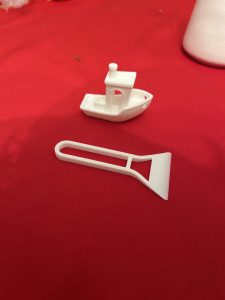
The team successfully configured the Jetson Orin Nano from scratch, installed JetPack 7 Ubuntu and ROS2, and verified the environment with ROS2 publisher and subscriber nodes running simultaneously. We also established an initial 3D-printing environment and completed some basic test prints to estimate manufacturing time and evaluate print settings.
Week-Specific Considerations
Part A: Public Health, Safety, and Welfare
Written by Bryan Hong
When it comes to public health, safety, and welfare, our project may not appear at first glance to directly impact any of the three. However, by placing the means of production into the hands of the artist, we have helped the latter avoid employing the services of a third-party manufacturing company that may rely on unethical labor practices and/or unsafe working conditions. By enabling artists and creators to reproduce their work in-house, our system reduces the reliance on these morally-questionable third party manufacturers, and thus indirectly improves global health, safety, and welfare, ensuring that the physical manifestation of art does not come at the cost of others’ health.
Part B: Social Factors
Written by Aaron Tang
Our robot arm is intended to be used primarily by digital artists, students, and researchers who want to transform a digital line drawing into a physical drawing on curved surfaces.
In order to make this design accessible for social and educational settings, our 1. web interface shouldn’t require experience with robotics, CAD, or any sort of electrical/software engineering. Users should be able to submit a drawing on our interface, select a marker color, and follow the robot’s status and receive clear feedback.
This would make the system valuable for classroom demonstrations and creative environments where artists who don’t have engineering backgrounds can safely and easily reproduce their art. It would also take into consideration people who have difficulty drawing manually on large, elevated, or unusually positioned surfaces.
We have also considered some concerns that robotic drawing tools could replace human creativity. Our goal is to create a tool to assist artists, not replace them: the user should ultimately still be responsible for their own artwork and creative decisions, while the robot simply transfers that work exactly stroke by stroke to a physical surface. The system should also respect ownership and consent by reproducing only artwork that artists consent to, and keeping submitted drawings under the user’s control.
Part C: Economic Factors
Written by Jonathan Waller
Our 6DOF drawing robot addresses economic factors in production and consumption by providing a low-cost, accessible alternative to expensive industrial machinery. By utilizing standard off-the-shelf smart servos, 3D-printed structural components, and open-source software, our design significantly reduces the bill of materials. This allows the 6DOF arm to be affordable relative to its capabilities. The system was designed with independent creators and digital artists in mind, allowing them to produce small batches of custom physical works directly from their digital art. Instead of relying on costly third-party manufacturing services or full-scale assembly lines, artists can preserve their preferred digital workflow, fine-tune their designs locally, and economically handle low-volume production without a heavy financial investment.