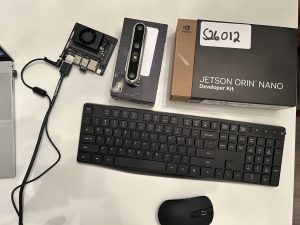
For this week, I dedicated my time toward structuring our ROS2 repository on the Jetson Nano, developing custom kinematic and torque analysis scripts in Python, and helping finalize our hardware parts list for Iteration 1. A major milestone for this week was creating a comprehensive mathematical simulation model of our 6DOF arm to verify that our selected serial bus servos can handle expected joint loads across our workspace (see below).
On the software and simulation side, I expanded our ROS2 environment on the Jetson Nano by installing necessary development utilities, creating our team’s official GitHub repository, and laying out the core software framework for our project. To validate our mechanical design before 3D printing, I wrote a dedicated Python robot class to process our arm’s link lengths, joint limits, and component masses. Using this class, I implemented forward kinematics, Jacobian matrix calculations, and inverse kinematics solvers, sampling various coordinate points across our 3D workspace. By coupling these kinematic transformations with static load physics equations, I confirmed that our calculated joint torques fall comfortably within the operating limits of our smart serial bus servos for Iteration 1 (see below for graph of workspace points tested).
Beyond simulation, I collaborated with the team to finalize our master hardware parts list for Iteration 1 so we can get all necessary servos, bearings, and power components ordered. We also wrapped up the remaining CAD design details for Iteration 1. While finalizing the CAD model took longer than anticipated and pushed the start of 3D printing to this weekend, we now have a solid design ready to manufacture.
I am mostly on track with my individual software and analysis tasks, though as a team we are slightly behind schedule on physical assembly for Iteration 1, so we will need to pick up the pace once parts finish printing and hardware arrives.
For next week, I plan to:
- Clean up and document the Python torque and workspace calculation scripts.
- Expand our ROS2 software framework and construct a preliminary URDF model to visualize the robot arm in RViz2.
- Begin setting up the initial
tf2frame tree structure for coordinate transformations between the robot base and end-effector. - Collaborate with Bryan on 3D printing execution and begin physical assembly of Iteration 1 as motor hardware arrives.