Team Report 3/28

Project Progress Summary

This week, our team achieved a major milestone: we successfully deployed the integrated CPU and PPU onto the Arty Z7-20 platform and achieved real-time execution of Donkey Kong, with the game rendering correctly on the screen. To reach this, we standardized a new debugging workflow that compares log traces from software emulators against our hardware simulation to quickly resolve behavioral divergences.

On the hardware front, we finalized the NES controller interface. This involved soldering a custom DC voltage regulator to allow the FPGA to safely drive the 5V controller logic and mapping those inputs to the PPU registers. We also integrated sprite-zero hit logic, enabling accurate split-screen scrolling. Finally, the APU is now roughly 50% validated, passing half of its functional test suite.

Significant Risks & Management

The most significant risk currently is the remaining 50% of APU functional tests.  Ensuring cycle-accurate audio timing for triangle and noise channels is complex and could jeopardize the authentic experience use-case. To manage this, we are isolating APU development and using automated test cases to verify individual audio components before full system integration.

Design Changes

We have no new design changes to the system.

Schedule

Our project remains on schedule. With local single-player gameplay now functional on hardware, we are well-positioned for the interim demo. Our focus next week shifts to integrating the UDP network stack for the remote multiplayer component. 
Michael’s Status Report for 3/28

This week, I focused on hardware integration and synchronizing the rendering pipeline with the CPU core. I worked on integrating the PPU’s sprite-zero hit logic with Bert’s 6502 CPU core. This is a critical timing feature that allows the software to detect when the first sprite, which is typically part of the status bar, is rendered, enabling the split-screen scrolling effects seen in games like Super Mario Bros. 

On the physical hardware side, I soldered a DC voltage regulator  to our NES controller interface. This modification allows the Arty Z7-20 to safely and directly drive the controller’s 5V logic levels from the FPGA’s 3.3V I/O pins. Following this, I collaborated with Jacob to map the controller input states to the specific OAM and PPU registers in the Programmable Logic via the AXI-Lite interface. 

I am currently on schedule, and for the following week, I will finalize the PPU scrolling logic to handle mirroring, which is required for different game cartridges. I will also conduct stability testing on the visual debug overlay to ensure it does not interfere with the main rendering timing during the interim demo. 

Jacob’s Status Report for 3/28

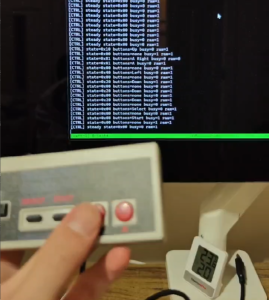
Established a new testing/debugging workflow, standardizing the log traces of software emulation reference and hardware simulation to catch behavior divergences.

Pushed CPU and PPU correctness further. Successfully synthesized the design and programmed the board. The latest design is able to advance to the game demo after the title screen, matching the behavior of a software emulator.

I am currently on schedule. Next week, aside from the interim demo, I’ll proceed to integrate the UDP button state sending implementation with the current status, and try to integrate the APU if time allows.

Bert’s Status report 3/28

This week, I focused on the implementation and validation of the APU. I completed a substantial portion of the APU design and successfully passed approximately half of the functional tests, indicating correct behavior for several audio components.

In parallel, I worked on system integration and demonstration. I successfully deployed the current CPU and PPU implementation onto the FPGA platform, achieving real-time execution of Donkey Kong, with the game rendering correctly on screen.

Next week, I will continue refining and completing the APU implementation, with a focus on passing the remaining test cases and ensuring timing accuracy. I will also begin implementing the memory mapper to support more advanced cartridge functionality and improve overall system compatibility.

Team Report 3/21

Project Progress Summary

This week, our team moved into the integrated testing phase. We hit a major milestone with the completion of the hardware controller interface. Now, our processing system can read real-time button states from the controller. On the rendering side, we have implemented a visual debug overlay that provides a view of palette RAM and internal PPU registers, which is very valuable for debugging the PPU’s MMIO interface. We also initiated the audio processing unit (APU) development.

We also dedicated some effort on the ethics assignment. Beyond the individual assignments, our team met together and had a discussion regarding the worst case scenario for our product. We followed this with a breakout session during the ethics lecture where we engaged in a red teamming exercise.

Significant Risks & Management

The most significant risk at this stage is network jitter and latency within our remote syncing protocol. As we begin sending controller signals via UDP, any inconsistent packet arrival could cause the local and remote game states to diverge. To mitigate this, we are implementing a frame gating logic that will stall the emulated world if required inputs from the network have not arrived. 

Design Changes

We have made no design changes in the past week.

Schedule

Our project remains on schedule. We are now transitioning to verification of full-system synchronization. Our goal for the next few weeks will be a completed one FPGA imlementation of the NES for the interim demo.

Bert’s Status report 3/21

This week I focused on the RTL implementation of the PPU modules, successfully coding the pattern table fetching logic and the OAM evaluation state machine. I established the memory-mapped I/O interface between the CPU and PPU, ensuring that the 6502 core can correctly access PPU registers within the allocated address space.

I also began researching the functional architecture of the APU, specifically looking into the frame counter and the pulse channel dividers. I have started the initial implementation of the APU’s pulse wave generators and the mixer logic to handle basic digital-to-analog signal summation.

Next week I will continue implementing the remaining APU channels, such as the triangle and noise generators, while focusing on debugging the PPU’s background rendering. I will also work on synchronizing the APU’s timing sequences with the master clock to ensure accurate audio interrupts.

Michael’s Status Report for 3/21

This week, I focused on the ethics assignment and discussion, and also the development of the visual debug overlay. After we finished our individual ethics assignments, our team gathered together and discussed the ethics questions regarding the worst case scenario of our project. And on Wednesday, I went to the ethics lecture and further discussed the potential ethics problems related to our project.

On the technical side, I drafted and implemented the RTL for the visual debug overlay. The PPU now has a secondary rendering layer that can be toggled to display the current 32-byte palette RAM and key register states. This will be used to verify the XY scrolling logic. I also began assisting with the initial integration of the controller interface to the FPGA.

I am currently on schedule, and for next week, I will focus on integrating the PPU’s sprite-zero hit logic with Bert’s CPU core. I will also solder a DC voltage regulator to the controller to allow the FPGA to directly drive the controller. I will then help Jacob to map the controller to the PPU’s OAM and registers.

Jacob’s Status Report for 3/21

Completed controller implementation. Implemented a controller demo that allows the PS to read the PL for the state of the controller and print to uart. Started on the remote syncing protocol implementation that builds upon the existing controller demo to send the controller signals to a remote board through UDP.

I am currently on schedule, and I will finalize the basic control signal syncing next week, ideally completing a demo with two uart sessions monitoring two boards, and pressing buttons on one board will show signals on both sessions.


Team Report 3/14

Project Progress Summary

This week, we have transitioned to our new Arty Z7000 FPGA platform, resolving previous board-specific issues. We have achieved full verification of the 6502 CPU core, and established a high fidelity validation workflow for the PPU. Our progress has moved from individual module logic to physical output. In addition, all team members completed the individual ethics assignment, and had a team discussion on the potential ethical risks in our project concept.

Design Changes

Following our hardware testing in the last few weeks, we have officially moved from the Zedboard to the Arty Z7000 platform. While the core architecture remains the same, this change ensures better compatibility with our target peripherals and simplifies the ROM loader implementation.

Risk & Management

The primary risk is still achieving perfect synchronization between the CPU and PPU modules. We are managing this by using open source tests as golden models for cycle by cycle comparison during integration.

Schedule

The project remains on schedule. We have met our milestones for standalone CPU and PPU verification. Next week, we will begin the phase of full system integration. 

Michael’s Status Report for 3/14

This week, I have done work on both technical development and the individual ethics assignment. For the ethics assignment, I read all the source materials, answered the questions, and analyzed the trade offs between public health, safety, and welfare for our NES project.

On the hardware side, I have mainly on the VGA-to PPU coordinate mapping. I can display a static test pattern from the pattern table on a physical monitor. Additionally, I worked on the implementation of the XY scrolling logic.

I am currently on schedule, and I will begin drafting the RTL for the visual debug overlay, which will give us debugging toos in the palette data and PPU register states during execution.