Jieun’s Status Report for 3/7/2026

For this week, the main focus was figuring out how to manage the signals  between the 2 ESP32s by the ESP-NOW protocol. There was also research done to see if the ESP-NOW protocol was enough to handle the proposed signals from our design review, which was another crucial part to this week’s update: I wanted to follow the feedback we got as well as write out the full report with the new updated information. I created a new updated diagram with our proposed design in order to better fit what we now want to create as our pillbox, along with corresponding datapath. Based on this, it is clear that the ESP-NOW is not enough, but it would be useful for individual testing as part of our prototype process. I am and continuing to look at the alternative Bluetooth option provided for the ESP32 Nanos. It was also important to gather the material I do already have in my possession for simulation and testing with first the fundamental proposed materials that we have for our overall project on the electrical end.

Progress is behind on ordering the parts, but that will be handled as soon as we are back online from break. The time-heavy portions would be the mechanical and coding parts for both hardware and software, so actual manufacturing/combining of all parts is set later as a priority in comparison.

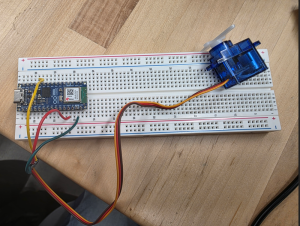
I will start by creating a prototype with just the electrical components (some of which aren’t going to be official parts), starting with a basic servo (as depicted below) connected to a ESP32 so that the servo-testing can commence with wireless connection using the ESP-NOW protocol first, then shifting over to the bluetooth feature already included on the ESP32 Arduino Nano which I already have in my position to see if there would be a greater efficiency than the simpler ESP-NOW protocol which can’t handle complex data packets.

Here is the image of a personal ESP32 Nano Arduino with a test-use servo (no where close to the 20kg, but the connection works regardless).
updated datapath:
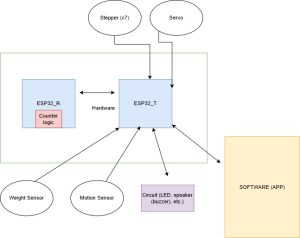
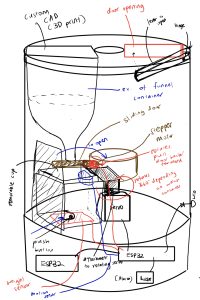
updated diagram:
Jieun’s Status Report for 2/14/2026

This week, I worked on creating the datapath for the Design Review as well as confirming the CAD design finalizations so that the datapath make sense and flows with the general idea. Through this, I also concluded that a FPGA actually is not necessary for this project’s specifications that we decided on based on our MVP, which is still being fully finalized. There’s still an internal datapath diagram that is not completed with better view of the signal communication that is intended for this project, so it will not be attached below, but that is another work in progress from this week. I am also currently working on how to design the opening of the pillbox mechanically versus electronically, from the original idea being servos each independently working remotely to open. But there can be a mix of the two with a button and servo combination without the remote option, as well as a simple machine system involving a series of levers instead which fits better with the offline functionality. All of this will be continued/finalized in the design presentation which will be conducted in the following week.

Our schedule/progress is currently a little behind in terms of finalizing our MVP so that our planning has a clear connection between the research we are conducting for the design decisions, etc. We are currently conducting the research and will be done by the time of our design presentation, which is due on Sunday (in one day). We will also be finishing ordering our items once we finalize on the plan after feedback on our design presentation.

I hope to complete the datapaths as well as start creating a prototype for the lever system vs. button and servo system with my personal ESP32 so that we can continue to build a working overall prototype with soon-to-be ordered items.

Team Status Report for 2/7/2026

Our three biggest concerns and risks are:

Risk1: ensuring the pills are dispensed with no waiting at the scheduled dose time.

Mitigation: For the timing, we are aiming to manage it through having our system simply start a couple of minutes ahead of the arranged consumption time.

Risk2: defining the caregiver’s goal in a way that does not create a reliability dependency

Mitigation: Missed dose handling will first prioritize on device alerts to the user, and only use a caregiver notification when a phone connection is available. We aim to research even further on prior medical reports/data that is available to the general public, etc., so that we can get an accurate measurement of how often our target audience requires consumption, so we can have an exact number of pills our device should be supporting in total. 

Risk3: ensuring the device continues to dispense, alert, and log doses even when the phone/app is unavailable.

Mitigation: for the separate functionality of our device, we are going to research further into having an offline server (though this might be another obstacle on its own as none of us has strong server creation experience ) for our device as well as experimenting further with our microcontrollers and FPGA along with more basic circuit additions (such as a button or LED) to see whether we can simply store data and coding that functions without an outer signal.

Design Changes:

As mentioned previously, the system may need to have additional circuit elements, such as a button, buzzer, and LED, in order to have the offline functionalities that we wish to include in our new and finalized MVP, which we aim to have by the end of the weekend. There shouldn’t be a big change in total costs, as those materials are extremely cheap, so there are no worries about cost mitigation on this so far.

Schedule Update:

Our schedule still remains the same, except for the additional goal of having a finalized MVP by the end of this weekend (so by the end of 2/8/2026).

Jieun’s Status Report for 2/7/2026

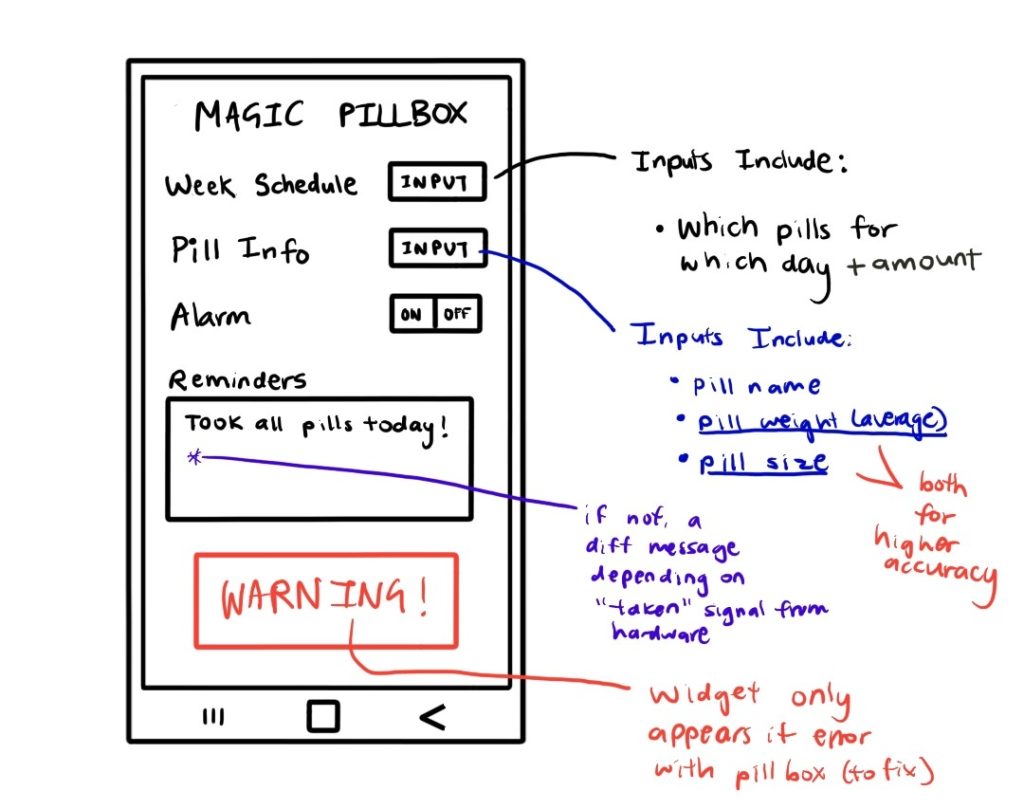
This week, my primary focus was on helping with the proposal as well as preparing on how to present it to other teams during the proposal presentation days. I focused on creating and helping with the majority of the proposal, including drawing out a detailed diagram of our proposed physical hardware design and the app (as attached below).

I also helped in editing our MVP, which we will be including in our team status report. We are working on creating a solid and foundational MVP so that once we go deeper into designing our device and starting on physically implementing it, we would run into minimal issues and have a set clear path on what needs to be accomplished.

Our progress is on schedule, as we were able to pick up our FPGA (borrowed from inventory), which is the primary item we were worried about procuring. We will be ordering parts once we get final approval on our MVP before the end of Monday so we can start with the programming and general official design this week.

Proposal Design:

App Design: