Carolyn’s Status Report for 4/25/26

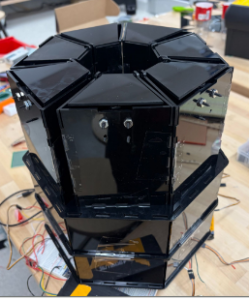
This week, I finished up the basic design, cutting, and assembly of the pill box. I designed the base attachment to the collection tray and printed it out.  Most of my time this week was focused on getting ready for the final presentation.  I collected testing data and synthesized the work we had done into slides and a script to share.

I think we are mostly on schedule, except for the integration of the software and electrical components.  We are planning to finalize that this weekend.  Then, do our remaining testing, which shouldn’t take too long.  In the next week, I hope to help finish the integration of the electrical and software.

Tests (both unit and overall) that have been/being accomplished: individual testing for motion sensor accuracy, weight sensor accuracy, timing accuracy when tracking which compartment to go to, web-app sending/storing the data that needs to be sent to the hardware end, the push-to-open accuracy/strength required, number of pills collected correctly, timing/day tracking on the software end being fully accurate, and overall run-through of the entire system working on a mock setup schedule. So far, the motion sensor + weight sensor accuracy isn’t very high (ranging from 40-70% depending on the number of servos in use, with an average of around 60%). The timing/tracking is still being tested as different power sources/pin arrangements are done during the debugging process. Push to open currently has around 7-8 on a scale of 10 for difficulty, something which needs to be adjusted down. The software end still needs to be fully tested with integration with the mechanical/hardware, which will be done in the coming days.
Team’s Status Report for 4/25/2026

The main risk is the integration- we need this fully debugged before overall testing, which is important to our project/final report. This will be focused on in the days leading up to demo (hopefully done fully by Monday so we can get overall testing started and done way beforehand).

No other changes other than slight adjustments in hardware (requiring soldering because of spacing issues) and software edits (using WiFi for communication, for example) for smoother integration with hardware/software.

Schedule is similar to before.

Tests (both unit and overall) that have been/being accomplished: individual testing for motion sensor accuracy, weight sensor accuracy, timing accuracy when tracking which compartment to go to, web-app sending/storing the data that needs to be sent to the hardware end, the push-to-open accuracy/strength required, number of pills collected correctly, timing/day tracking on the software end being fully accurate, and overall run-through of the entire system working on a mock setup schedule. So far, the motion sensor + weight sensor accuracy isn’t very high (ranging from 40-70% depending on the number of servos in use, with an average of around 60%). The timing/tracking is still being tested as different power sources/pin arrangements are done during the debugging process. Push to open currently has around 7-8 on a scale of 10 for difficulty, something which needs to be adjusted down. Software end still needs to be fully tested with integration with the mechanical/hardware, which will be done in coming days.

Jieun’s Status Report for 4/25/2026

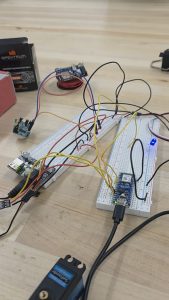
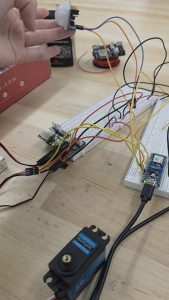
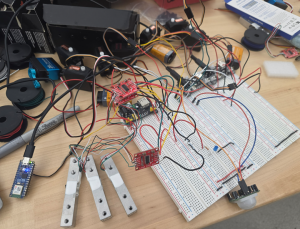
This week has been finalizing work for singular testing for the final presentation as well as continuing debugging multiple servo/signal implementation along with software integration. All of the weight sensors and servos are connected across two ESP32s, along with the PIR motion sensor. However, with the much larger complicated setup, there are still some bugs that need to be fixed timing-wise and accuracy-wise. However, at least one full compartment setup is fully working and tested (in time for the final presentation) along with individual component testing. This will continue to be worked up up till the demo day. I will continue working on getting the timing right for all 7 compartments, servos, and soldering to account for the wiring spacing for the mechanical-hardware integration. I will also be working on getting the web-app data successfully as part of hardware-software integration.

Progress is on schedule, getting ready for demo by taking out all the bugs, re-wiring so that it’s much neater, and debugging the re-wiring/integration as well.

We hope to be entirely done and functional to MVP with little to no bugs with entire system implementation smoothly finished.

Our full system implementation across hardware/mechanical for now (still needs to be cleaned up/debug-ed but the essential integration/movement is successfully completed/being tested).

Team’s Status Report for 4/18/2026

The most significant risk is the integration of hardware, mechanical, and software. We will be working on this together tomorrow as our individual components are either done or in the debugging phase.

For testing, we will be first testing individual processes, running trials on each component (ie. schedule signal generation from software app, sensor detection integrity/accuracy from the circuit’s end, and door opening accuracy for mechanical, etc.). We will be putting all of our individual testing results into a google spreadsheet and calculating the average accuracy. As of right now, the idea is to organize our results into quartiles so we know which aspect to focus debugging/improving first. Nothing has changed from this initial testing idea other than us recruiting our fellow classmates as well as some professors for user-testing. We will also decide on the handicap to best simulate our testing once our implementation is functional – this will be included at the very least for our final report.

Changes made is that 2 ESP32s will be used should the debugging be unsuccessful with one by tomorrow, as that appears to be the main issue, with the second ESP32 being powered by Vin instead, with mitigations being handled by handling one issue at a time so no components are accidentally damaged.

Our schedule is around the same.

Jieun’s Status Report for 4/18/26

Personally this week has been quite a lot: first the code was tested with the weight sensors, which required a lot of soldering, all of which has been completed with some re-soldering required during the final setup tomorrow/in the coming days before the final demo. Currently, all seven servos, the motion sensor, LED indicator, and most of the strain gauges have been implemented along with some starter code to connect with the software once the MQTT protocol to connect the two has been completed. My current work is to debug the issues once more than 2 servos have been implemented, which is that despite the multiple power sources, something is being connected improperly/ the servos are not functioning. I will be working on this remainder of the weekend to figure this out before the presentation.

Progress is right on track, though the debugging is worrisome as it was expected after 2 servos are working, 7 should work just as well. However, time will be dedicated to solving this issue as well as recruiting my other teammates as soon as possible should I not be able to find the issue by tonight.

I hope to complete the implementation of all 7 servos as well as integrating fully with the mechanical by tomorrow. With the software, it might need more debugging but hopefully that is completed by the final presentation. Worst case, it will be done before the final demo.

I had to learn more about the Arduino IDE and ESP32 Nano configuration- I have used Arduinos in the past but this is my first experience with the Nano as well as the GPIO pin configuration system, which was a learning curve. I looked at online forums with certain bugs (such as why a servo didn’t work with a digital pin- this turned out to be a GPIO pin number issue) as well as consulted AI tools such as Claude and ChatGPT for faster as well as more efficient answers, both of whom that I wasn’t too familiar with outside of simple conceptual questions prior to this semester. It was another learning curve to ask prompts that gave me the answer that I was looking for: for example, I was confused by my nano kept showing a red light and at first the AI believed I was talking about a different power indicator. After narrowing down my wordy explanations, it finally gave me the true issue: something was being grounded that wasn’t supposed to be.

Carolyn’s Status Report 4/4/26

After making our prototype pill box, I realized that I had not sized the pill box compartments correctly.  So I had to redesign the compartments.  I now have them as trapezoids, which will allow the space to be used more effectively than squares.  Furthermore, I have been working on the push to open, so I can install them soon.

Our progress is a bit behind due to the parts we delayed.  Not having all the acrylic made it especially hard for me to finish the physical pill box.

In the next week, I should have the new compartments finished and added to the pill box.  As well as finish up the CAD designs of the funnels for each pill compartment.

For my portion of the project, there are two main things I will need to verify.  I will verify that the compartments do indeed hold up to a 30-day supply, 3 times a day, of any pill type.  I will verify this by ordering empty pill capsules online and filling them into the compartments.  I will use the largest pill size for the test to make sure the compartments will hold any pill size.  If the compartments can’t close with 90 pills of the largest pill size without damaging any of the pills, they will not pass the test.

Next, I will verify that all the user access doors can be accessed in 30 seconds or less.   I will have to install the push-to-open on each of the doors before I do this. This will ensure that all the access doors can be used by someone with dexterity issues easily.  I will have someone time me opening each door for 5 trials.  I will need to open each door within 30 seconds at least 4 out of the 5 trials.

Team Status Report for 4/4/2026

The most significant risk is the integration of hardware, mechanical, and software. We weren’t able to fully integrate it all in time for interim demo, focusing instead of finishing critical individual parts. Though it still fits in our timeline, this means that we need to stay extremely on pace till the final presentation. We will first remedy the missing parts we discovered during the implementation process, taking time over carnival to do so, and then we will move forward into the integration and testing process.

For testing, we will be first testing individual processes, running trials on each component (ie. schedule signal generation from software app, sensor detection integrity/accuracy from the circuit’s end, and door opening accuracy for mechanical, etc.). We will be putting all of our individual testing results into a google spreadsheet and calculating the average accuracy. As of right now, the idea is to organize our results into quartiles so we know which aspect to focus debugging/improving first.

Changes made are that we are currently working with a web app for software for now, stepper motor is no longer being used as it is not compatible with the ESP32, additional power sources were needed as the servos drew way too much power for one breadboard supply to handle, and we require more acrylic due to the newer design being larger than expected. These costs are being mitigated by being more cautious with our calculations before implementing them to conserve material (nothing should break).

Our schedule is around the same.

Jieun’s Status Report for 4/4/2026

This week, I have gotten the servos to work and waiting on getting our new power modules in order to have enough power for all 7 servos to work with incorporation with the app. The motion sensor is now fully implemented with the servos as well as the LED indicator. I also created some rudimentary files with the ESP-NOW protocol as I realized that one Arduino is certainly not enough due to the limitations on the GPIO/Digital pin allocation. Moving forward, there will be two Arduinos with the main arduino programmed with the still-testing/developing Bluetooth module IDE code.

For testing, I put into my code print statements showing when the pill is supposed to be dispensing. This will be first tested individually with the two type of sensors we are using: first, for the motion sensor, it will be tested by having various pills fall in front of the sensor and marking whether or not the serial monitor prints out that it was dispensed. This trial test will take place at least 50 different times so that a percentage of correctness can be calculated. It has already been briefly tested a total of 20 times in one trial run, with 12 out of 20 hitting correctly. Sensitivity will be adjusted, and hopefully with the weight sensor implemented, the overall accuracy can be improved on whether a pill dropped is correctly detected or not.

Progress is behind on the strain gauge end- we’re still waiting on the part arrival but will be working Monday which is when we expect to have them. Otherwise, everything is on track though it would be impertinent to fast forward a bit on the integration as currently we don’t have the mechanical part integrated either.

I hope over carnival I am able to finish the full hardware implementation with all 7 servos, which shouldn’t be too difficult considering how one set of motors is fully working, along with the weight sensing mechanism, which is the bigger challenge but also isn’t as difficult as our final step: integrating the hardware with the software app.

Jahnvi’s Status Report for 3/28/26

This week I built the frontend of the Magic Pillbox web app and made significant progress on the main user flow. I implemented the core pages including landing page, home dashboard, setup page, setup guide, logs page, signup age and login page along with a shared navigation bar to connect them all together. The setup page allows the user to add, edit, delete and clear medications while enforcing valid compartment assignments. The assignments make sure that caregivers/anyone filling up the pillbox can only assign pills to compartments 1 to 7 and prevent duplicate compartment use. The guide page includes the full step by step loading instructions for the pillbox. The home dashboard currently shows

  1. device status
  2. next dose
  3. countdown
  4. reminder information
  5. streaks
  6. refill alerts
  7. compartment status
  8. configured medications.

I also added a calendar style logs page with date-based summaries and detailed adherence records as stated by our use case requirements. I also added in app reminder banner and notification support.

There were some issues that i came across with time formatting, mock data consistency, page routing but was able to solve the after thorough debugging. Overall, the main frontend structure of the app is now built. This is on schedule with what our group had originally planned for our interim demo.

The goal for the coming weeks is to correctly integrate the software system with hardware and backend logic.


Weekly Status Report for 3/28/26

The most significant risk is there not being enough acrylic due to a measurement issue as well as our converter for the strain gauge possibly not being enough/not compatible with it. We plan to do the outer design with wood or another material that is easier to find/procure instead of acrylic if it comes to being not enough. For the strain gauge, we will try to use the 8bit with the alternative and see if there is any difference, worst case we will ensure our motion sensor works well and use the strain gauge as a less accurate but still efficient secondary drop sensor.

The stepper motor is no longer being used due to compatibility issues with the Nano that was not discovered till later, it is now replaced with an extra 20kg servo. We did have an extra cost for the new converter for our strain gauge, but that is more worth it should there be a secondary check to our motion sensor. For now, only one ESP32 is being used for simplicity, but this will be changed once we integrate the software-hardware interfacing after the demo.

Schedule is same as last week.