Jieun’s Status Report for 4/25/2026

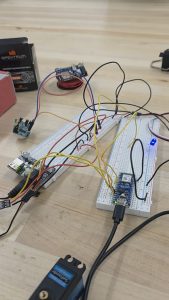
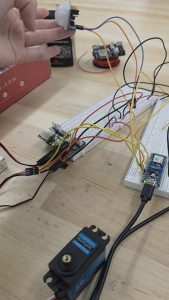
This week has been finalizing work for singular testing for the final presentation as well as continuing debugging multiple servo/signal implementation along with software integration. All of the weight sensors and servos are connected across two ESP32s, along with the PIR motion sensor. However, with the much larger complicated setup, there are still some bugs that need to be fixed timing-wise and accuracy-wise. However, at least one full compartment setup is fully working and tested (in time for the final presentation) along with individual component testing. This will continue to be worked up up till the demo day. I will continue working on getting the timing right for all 7 compartments, servos, and soldering to account for the wiring spacing for the mechanical-hardware integration. I will also be working on getting the web-app data successfully as part of hardware-software integration.

Progress is on schedule, getting ready for demo by taking out all the bugs, re-wiring so that it’s much neater, and debugging the re-wiring/integration as well.

We hope to be entirely done and functional to MVP with little to no bugs with entire system implementation smoothly finished.

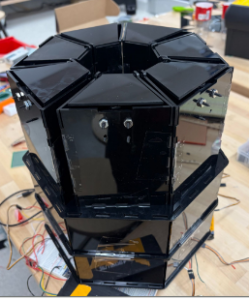
Our full system implementation across hardware/mechanical for now (still needs to be cleaned up/debug-ed but the essential integration/movement is successfully completed/being tested).
Jieun’s Status Report for 4/18/26

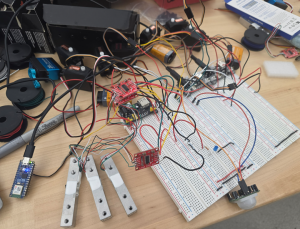
Personally this week has been quite a lot: first the code was tested with the weight sensors, which required a lot of soldering, all of which has been completed with some re-soldering required during the final setup tomorrow/in the coming days before the final demo. Currently, all seven servos, the motion sensor, LED indicator, and most of the strain gauges have been implemented along with some starter code to connect with the software once the MQTT protocol to connect the two has been completed. My current work is to debug the issues once more than 2 servos have been implemented, which is that despite the multiple power sources, something is being connected improperly/ the servos are not functioning. I will be working on this remainder of the weekend to figure this out before the presentation.

Progress is right on track, though the debugging is worrisome as it was expected after 2 servos are working, 7 should work just as well. However, time will be dedicated to solving this issue as well as recruiting my other teammates as soon as possible should I not be able to find the issue by tonight.

I hope to complete the implementation of all 7 servos as well as integrating fully with the mechanical by tomorrow. With the software, it might need more debugging but hopefully that is completed by the final presentation. Worst case, it will be done before the final demo.

I had to learn more about the Arduino IDE and ESP32 Nano configuration- I have used Arduinos in the past but this is my first experience with the Nano as well as the GPIO pin configuration system, which was a learning curve. I looked at online forums with certain bugs (such as why a servo didn’t work with a digital pin- this turned out to be a GPIO pin number issue) as well as consulted AI tools such as Claude and ChatGPT for faster as well as more efficient answers, both of whom that I wasn’t too familiar with outside of simple conceptual questions prior to this semester. It was another learning curve to ask prompts that gave me the answer that I was looking for: for example, I was confused by my nano kept showing a red light and at first the AI believed I was talking about a different power indicator. After narrowing down my wordy explanations, it finally gave me the true issue: something was being grounded that wasn’t supposed to be.

Jieun’s Status Report for 4/4/2026

This week, I have gotten the servos to work and waiting on getting our new power modules in order to have enough power for all 7 servos to work with incorporation with the app. The motion sensor is now fully implemented with the servos as well as the LED indicator. I also created some rudimentary files with the ESP-NOW protocol as I realized that one Arduino is certainly not enough due to the limitations on the GPIO/Digital pin allocation. Moving forward, there will be two Arduinos with the main arduino programmed with the still-testing/developing Bluetooth module IDE code.

For testing, I put into my code print statements showing when the pill is supposed to be dispensing. This will be first tested individually with the two type of sensors we are using: first, for the motion sensor, it will be tested by having various pills fall in front of the sensor and marking whether or not the serial monitor prints out that it was dispensed. This trial test will take place at least 50 different times so that a percentage of correctness can be calculated. It has already been briefly tested a total of 20 times in one trial run, with 12 out of 20 hitting correctly. Sensitivity will be adjusted, and hopefully with the weight sensor implemented, the overall accuracy can be improved on whether a pill dropped is correctly detected or not.

Progress is behind on the strain gauge end- we’re still waiting on the part arrival but will be working Monday which is when we expect to have them. Otherwise, everything is on track though it would be impertinent to fast forward a bit on the integration as currently we don’t have the mechanical part integrated either.

I hope over carnival I am able to finish the full hardware implementation with all 7 servos, which shouldn’t be too difficult considering how one set of motors is fully working, along with the weight sensing mechanism, which is the bigger challenge but also isn’t as difficult as our final step: integrating the hardware with the software app.

Jieun’s Status Report for 3/28/26

This week, I worked on creating a full simulation/working prototype of the electrical part of our device, and I am still working on debugging issues by simplifying to one set of motors instead. They seem to work well in sync with each other, however the algorithm with the motion sensor is not clear yet so that requires more coding/debugging. However, it will be resolved way before the demo day. There has been a change to our design due to my discovery that we are missing a converter for the stepper motor, but it would be better anyways to use our extra servo motors instead, so the stepper is a potential add-on rather than an official part of our full prototype.

My schedule is on track as of right now- I just need to debug the servo connections, but luckily my already-written code works well even with the 20kg servo, which was an initial worry but that has been resolved.

My goal is to move on to expanding to the 6 other motors we are going to have (which shouldn’t be an issue once one is working) as well as soldering once the whole electrical hardware has been completed as well as our converter for the strain gauges arrive- we realized that the converter that was already ordered was an 8bit and not sufficient for the strain gauge we got from Adafruit.

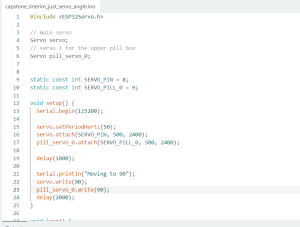
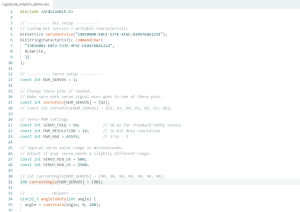
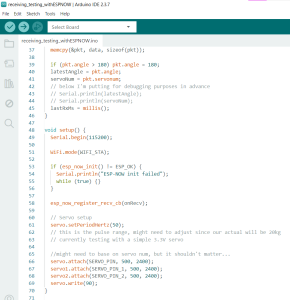
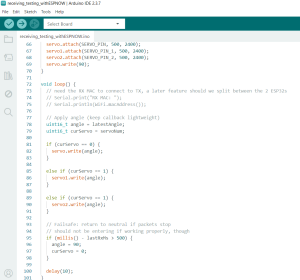
Just servo code snippet:

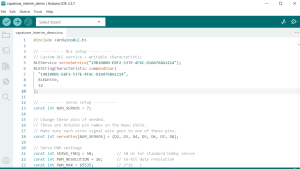
With bluetooth (for future implementation after demo) practice code:


Jieun’s Status Report for 3/21/26

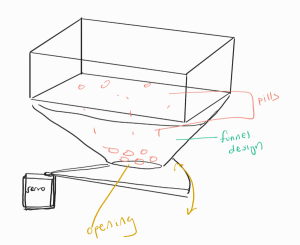
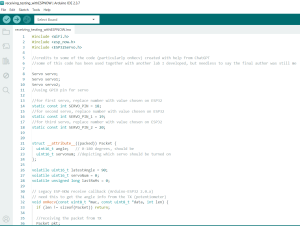
For this week, I have continued on working on the electrical portion of our project- focusing yet again on the research/coding as our parts have not arrived yet due to an ordering mistake. One pivot I decided on was to change our design for getting the pills the fall into the compartment- instead of a forward-backward motion using a pulley or gear system, a more clear-cut movement of side to side (rotational movement to create the necessary gap for pill(s) to fall through, as seen below). There is a potential slight but significant pivot in the plans for the hardware aspect- as of right now, once all parts are in, we are only able to use one ESP32 as there was an error in ordering parts. For now, I’ll be combining RX and TX, keep bluetooth as an option as we’ll need it anyways, and trying out different codes, both with help from AI for different perspectives and combining with my own knowledge (example of one such code below).

We are still waiting for the parts to come in, so the building-aspect of my progress is not on the range I wanted it to be. I was very heavily-loaded this week from other projects and classes which did not bode well for getting ahead in my progress. However, I will be using a good part of the weekend to catch up not only on this course but others as well so that the upcoming week can be used to focus on finishing both the build and coding for the electrical/hardware portion of our project.

By the end of next week, the entirety of the hardware should be built and ready to demo at the interim demo. I will be using set hours throughout the next week to make this a priority, hence will be using this weekend to finish most of the work due earlier than later.

Jieun’s Status Report for 3/14/2026

This week has been hectic due many time conflicts, with it following right after spring break, however a new personal schedule has been made to tackle all objectives before heading into our first demo. We were told that we needed to get our individual portions working, and therefore so far there is a working servo code, as attached below. I also worked on organizing and helping to order the main hardware parts which we will need for testing later. I will be continuing to work out the bugs as well as make a final decision on the design between the two microcontrollers: originally, our plan was to make it only have the main ESP32 handle all hardware signals, with just counter calculation being done in the other ESP32. If we run into issues regarding the complexity of the packets being sent due to ESP-NOW in the near future, this split will be undone and the potentiometer reading will be directly inputted into this RX ESP32. I’m moving forward into researching whether stepper motors can be addressed in the same way and going to move into individual testing. Overall hardware design is, however, similar to last week’s photo/design.

I am currently a bit behind as I don’t have the parts that we need to build the actual prototype yet and working with, as noted last week, a significantly weaker servo motor and potentiometer/ESP32s from either loans or personal collection. However, I will be catching up through lab work in the upcoming days.

I already am researching about the stepper motors, and starting on the code for it, but hope finalize coding and to be able to start testing with our ordered parts when they arrive. By the end of next week, I should have a completed hardware prototype in one way or another with the corresponding code.

Jieun’s Status Report for 3/7/2026

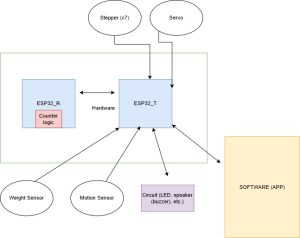
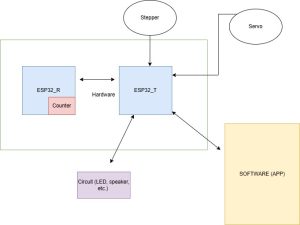
For this week, the main focus was figuring out how to manage the signals  between the 2 ESP32s by the ESP-NOW protocol. There was also research done to see if the ESP-NOW protocol was enough to handle the proposed signals from our design review, which was another crucial part to this week’s update: I wanted to follow the feedback we got as well as write out the full report with the new updated information. I created a new updated diagram with our proposed design in order to better fit what we now want to create as our pillbox, along with corresponding datapath. Based on this, it is clear that the ESP-NOW is not enough, but it would be useful for individual testing as part of our prototype process. I am and continuing to look at the alternative Bluetooth option provided for the ESP32 Nanos. It was also important to gather the material I do already have in my possession for simulation and testing with first the fundamental proposed materials that we have for our overall project on the electrical end.

Progress is behind on ordering the parts, but that will be handled as soon as we are back online from break. The time-heavy portions would be the mechanical and coding parts for both hardware and software, so actual manufacturing/combining of all parts is set later as a priority in comparison.

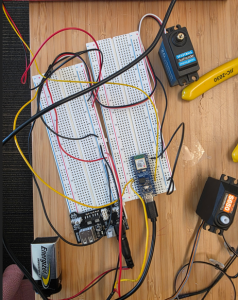
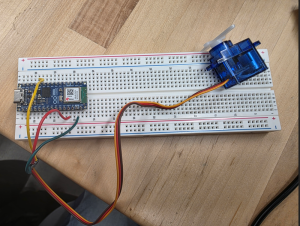
I will start by creating a prototype with just the electrical components (some of which aren’t going to be official parts), starting with a basic servo (as depicted below) connected to a ESP32 so that the servo-testing can commence with wireless connection using the ESP-NOW protocol first, then shifting over to the bluetooth feature already included on the ESP32 Arduino Nano which I already have in my position to see if there would be a greater efficiency than the simpler ESP-NOW protocol which can’t handle complex data packets.

Here is the image of a personal ESP32 Nano Arduino with a test-use servo (no where close to the 20kg, but the connection works regardless).

updated datapath:

updated diagram:

Jieun’s Status Report for 2/21/2026

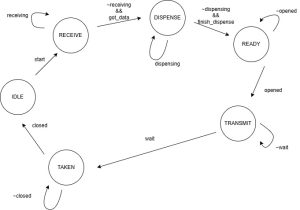
This week, I created the datapath (as seen below) and formed the FSM logic (which can be translated into ESP32 Arduino logic as the signals should function the same) for the design presentation. Through this, I was able to discover and further research into the actual hardware needed for this project: instead of using a FPGA (a point which was rightfully questioned by our TA), it would be much more feasible and helpful if we used an ESP32 microcontroller. That way, we would be able to take advantage of an already-implemented protocol, ESP-NOW, on the Arduino ESP32s. I also helped in re-designing our original mechanical design, focusing on the issue where if there were too few pills left in the compartment.

Our progress is a little behind on ordering parts, but I plan to curate the needed electrical components to send/ready to order.

Also, I have started and will continue in coding/making a simple prototype using the ESP-NOW protocol in the next week for the electrical components in order to get us much more up to speed especially as spring break is rapidly approaching.


Jieun’s Status Report for 2/14/2026

This week, I worked on creating the datapath for the Design Review as well as confirming the CAD design finalizations so that the datapath make sense and flows with the general idea. Through this, I also concluded that a FPGA actually is not necessary for this project’s specifications that we decided on based on our MVP, which is still being fully finalized. There’s still an internal datapath diagram that is not completed with better view of the signal communication that is intended for this project, so it will not be attached below, but that is another work in progress from this week. I am also currently working on how to design the opening of the pillbox mechanically versus electronically, from the original idea being servos each independently working remotely to open. But there can be a mix of the two with a button and servo combination without the remote option, as well as a simple machine system involving a series of levers instead which fits better with the offline functionality. All of this will be continued/finalized in the design presentation which will be conducted in the following week.

Our schedule/progress is currently a little behind in terms of finalizing our MVP so that our planning has a clear connection between the research we are conducting for the design decisions, etc. We are currently conducting the research and will be done by the time of our design presentation, which is due on Sunday (in one day). We will also be finishing ordering our items once we finalize on the plan after feedback on our design presentation.

I hope to complete the datapaths as well as start creating a prototype for the lever system vs. button and servo system with my personal ESP32 so that we can continue to build a working overall prototype with soon-to-be ordered items.

Jieun’s Status Report for 2/7/2026

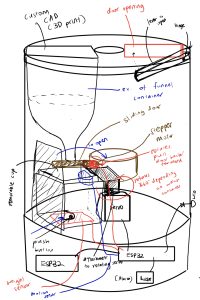
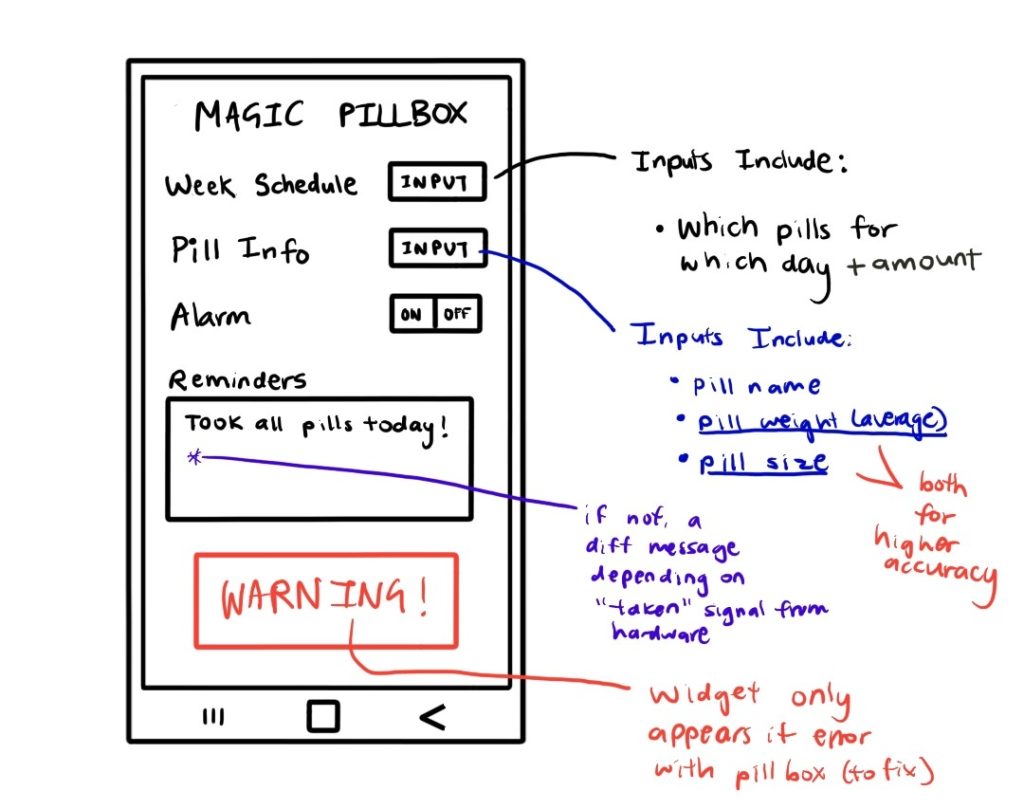
This week, my primary focus was on helping with the proposal as well as preparing on how to present it to other teams during the proposal presentation days. I focused on creating and helping with the majority of the proposal, including drawing out a detailed diagram of our proposed physical hardware design and the app (as attached below).

I also helped in editing our MVP, which we will be including in our team status report. We are working on creating a solid and foundational MVP so that once we go deeper into designing our device and starting on physically implementing it, we would run into minimal issues and have a set clear path on what needs to be accomplished.

Our progress is on schedule, as we were able to pick up our FPGA (borrowed from inventory), which is the primary item we were worried about procuring. We will be ordering parts once we get final approval on our MVP before the end of Monday so we can start with the programming and general official design this week.

Proposal Design:

App Design: