Jahnvi’s Status Report 02/21

This week I designed the full app layout and created visuals for the design presentation. The app flows like: sign-up/login to guided medication set up to homepage showing next dose and quick status. The app also has a logs and calendar feature to review taken vs pending doses and adherence history. Added a lightweight motivation progress tracking feature and defined notification behavior. Additionally, I identified some key risks with our system and mitigations for them. This touched upon multiple pills dropping at the same time, no pills dropping due to low pill count and weight sensor drift. Also, I refined our key user use cases and distilled them into 5 clear, testable use case requirements that the pill box must support. Lastly, I presented our updated design in the capstone design presentation.

We are slightly behind schedule because our design plan changed a lot over the past few weeks. This next week, our priority is to finalize and lock the design so we can start ordering parts and building immediately. I am aiming to begin app development soon, while we can catch up on the items we are behind on. We definitely need to get back on schedule so tasks dont pile up later

Carolyn’s Status Report for 2/21/26

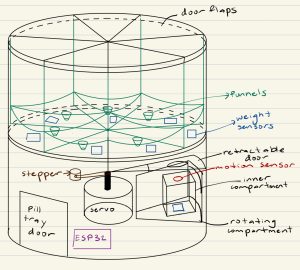
I have been working to update our design based on the feedback we have received from our design presentation.  We need to figure out how the user will reset the device when there is a misdropping of a dose.  I will continue working through this with our TA and prof during our upcoming meeting.  For now, we will set an alarm in the app if a dosage was dropped incorectly which will instruct the user to take the dose out of the tray for it to be readministered.  I also made a diagram of our proposed pill box design.

We are mostly on schedule.  Yet we are a bit behind schedule for ordering the parts our project will need.  I didn’t realize how much we would tweak our plan after every meeting and presentation, so the exact parts we need have been continuously changing.

Next week, I plan to make updates to the laser-cutting file design for the box and print it out.  So we can have the physical pieces as soon as possible.  As well as finalize parts lists and put in orders.

Jieun’s Status Report for 2/21/2026

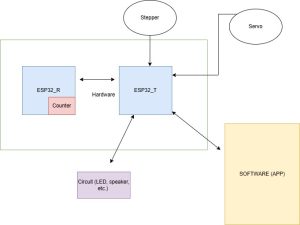
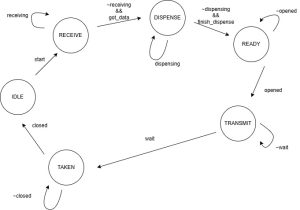
This week, I created the datapath (as seen below) and formed the FSM logic (which can be translated into ESP32 Arduino logic as the signals should function the same) for the design presentation. Through this, I was able to discover and further research into the actual hardware needed for this project: instead of using a FPGA (a point which was rightfully questioned by our TA), it would be much more feasible and helpful if we used an ESP32 microcontroller. That way, we would be able to take advantage of an already-implemented protocol, ESP-NOW, on the Arduino ESP32s. I also helped in re-designing our original mechanical design, focusing on the issue where if there were too few pills left in the compartment.

Our progress is a little behind on ordering parts, but I plan to curate the needed electrical components to send/ready to order.

Also, I have started and will continue in coding/making a simple prototype using the ESP-NOW protocol in the next week for the electrical components in order to get us much more up to speed especially as spring break is rapidly approaching.


Team Status Report for 2/21/26

What are the most significant risks that could jeopardize the success of the
project? How are these risks being managed? What contingency plans are ready?

At our Design presentation, we received helpful feedback from the audience that exposed additional risks in our product.  The first was what will the pill box do when the wrong pill is dispensed?  We had already established that we would use the weight and motion sensors to make sure the correct pills are dispensed.  So when we know the wrong pill/number of pills were dropped, we send a warning to the user through the app that that dosage is incorrect.  Yet we still need to think about the next steps.  What will the user do with the pills? How will the box be reset? We plan on having it so that an alarm will be set up on the app within a set amount of time (for now, we aim to have the user set the time in the app as medications vary in terms of within how much time it should be taken in), warning the user or their caregiver to take the pills and reset/re-allocate the pills as necessary.  Another question we received was how we will test if our pill box works, since our target audience is elderly people with dexterity issues.  We plan to contact some elder care facilities to see if any volunteers would be willing to test our product.  Or if the staff at the facilities can give us feedback on our project as well.

• Were any changes made to the existing design of the system (requirements,
block diagram, system spec, etc)? Why was this change necessary? What costs does the change incur, and how will these costs be mitigated going forward?

We have made the change of going from using a FPGA and ESP32 microcontroller to using two ESP32 microcontrollers for two main reasons: firstly, we did not want to overcomplicate the process as the communication between two microcontrollers would be a challenge in itself to have an almost perfect accuracy rate, and secondly, for bluetooth, there is a more reliable ESP-NOW protocol available for communication between two ESP32s, which would allow for cleaner and less error-prone connections. This would actually lower the technical cost of our project as a FPGA is much more costly than an ESP32 Arduino Nano (which is the specific microcontroller we wish to use for this project for both size and price).

• Provide an updated schedule if changes have occurred.

Our schedule remains the same as a whole.

Team Status Report for 02/13/2026

Overall Progress Update:

Our significant risks remain pretty much the same as last week, though another has been added since: we are concerned with how to handle when there are only a small handful number of pills left and if our program will be able to account for that when letting multiple pills fall. Our idea right now to handle that is to add funnels to our overall design that allows for pills to flow down regardless of orientation. Now, another risk this may have is that our sizing of the pillbox may increase significantly. We plan on first sticking with this initial prototype to have a working design first then adjust afterwards as needed.

The system has changed in the sense that we no longer have motors controlling the opening of the pillboxes, rather to allow for a better offline functionality, it will be handled through a simple lever or button system so that it’s still accessible and easier to use than normal pillboxes but without the additional wireless electrical motor system that can cause more issues than necessary. We are also adding funnels to make a better guarantee of the last remaining pills falling when we don’t have many pills left in the compartment.

Our schedule remains the same as a whole.

Additional Individual Team Update:

Part A written by Carolyn Alex:

Our smart pill box promotes public health, safety, and well-being by improving medication adherence for individuals with limited dexterity and cognitive decline, especially memory issues.  Most existing pill organizers require opening small containers, which is difficult for users with shaky hands.  Which is why our pill box will have push to open compartments, which is easier to do mechanically.  Next, most products on the market to help keep track of dosages are apps that require a user to confirm doses in an app, which becomes unhelpful with incorrect logging. Our devices will confirm doses automatically when pills are physically removed using a weight sensor.  Additionally, by dispensing medications automatically at set times, our product reduces the work needed by the user to ensure they are taking their medications on time, hence increasing the likelyhood if taking them even when the user is tired.

Overall, our product in reducing unintended and missed dosages.  From a welfare perspective, the design supports independent living forthe elderly, especially those with memory and mobility limitations.  By lowering burden and increasing reliability of routines, our product supports phisyocal well being and confidence in managing medications.

Part B written by Jahnvi Shah:

Our product is a smart pillbox designed to support aging-in-place for community dwelling older adults (65+). It helps by reducing the day-today dependence on others for medication management. By making the pill dosing more automatic and keeping the core workflow usable, the system allows users to maintain their independence and autonomy in their routines. This is especially important socially because it shifts it helps older adults handle their medicines on their own, instead of relying on a caregiver or a family member.

Our design also aims to reduce the stress and conflict in family and caregiver relationships. Taking medication often creates tension with repeated reminders that feel like nagging. Additionally, there is uncertainty about whether a dose was taken which can lead to misunderstandings or guilt. Our product has clear dose status like taken vs pending or missed which provides clarity and reduces the need for constant checking. This makes support feel less intrusive and more respectful. Further, the product is intended to be equitable across living situations. It works for older adults living alone or in multi-generational households or with rotating caregivers because the essential functions do not rely on someone being present. Lastly, as an added benefit, features like reminders and a simple streak can give user a bit of daily structure and motivation.

Part C Written by Jieun Lim:

The smart pillboxes that we have found online that have similar functionalities are priced on average around $150. As a note, this is also without all the features we plan on implementing. As a whole, in the current economy, this might be too high-priced for households who are reliant on healthcare, especially for the elderly. That’s why our design focuses first on laser cutting with cheaper but still durable acrylic as well as minimizing the number of microcontrollers. The biggest reasoning for removing the FPGA and replacing with the ESP32 is also due to the cost: an arduino ESP32 costs on average around twenty dollars while the FPGA which we wanted to use for the original design is over a hundred dollars. To make it more accessible during the production, there is necessity for using cheaper components that simply require extra logic.

There is also consideration for the distribution of this items: we wanted to make a more compact design than in previous iterations, keeping it close to the already available and smaller-sized counterparts while also incorporating it with greater functionality. This would allow for to be distributed at once, reducing transportation costs overall. Additionally, this would allow for more to be consumed/sold in stores on the shelves too, with again the lower price making it more affordable as a whole. Overall, we hope to have this device be the size of a portable coffee machine at most at half or more than half the cost. This would raise consumption as well as distribution to match the consumption levels.
Carolyn’s Status Report for 2/14/26

This week, my primary task was to update the design of our pill box based on the feedback we received from our TA and professor.  The opening mechanism of the compartments was improved upon with push to open, as well as the compartments themselves. In our original design, we realized that the last pills would not have been dispensed if they were sitting in a corner of the area.  I have updated the design to form each compartment in a way that forces all pills to be dispensed, with a funnel-like shape.  Additioanlly we are adjusting the size of each pill compartment to fit a 90-day supply of the largest average pill size we are accommodating.  I redrew our design based on these specs, as well as updating the tasks we will have to accomplish for the new design and our Gantt chart.

We are currently on schedule with the project timeline.  We updated our design plan based on feedback from our professor.  After our design presentation, we will receive plenty of feedback, using that, hopefully, we will make final adjustments and start implementing strongly.

Next week, I plan to draw the laser-cutting file design for the box and start printing it out.  I want to have the physical peieces are soon as possible so see if the design needs to be iterated.

Jieun’s Status Report for 2/14/2026

This week, I worked on creating the datapath for the Design Review as well as confirming the CAD design finalizations so that the datapath make sense and flows with the general idea. Through this, I also concluded that a FPGA actually is not necessary for this project’s specifications that we decided on based on our MVP, which is still being fully finalized. There’s still an internal datapath diagram that is not completed with better view of the signal communication that is intended for this project, so it will not be attached below, but that is another work in progress from this week. I am also currently working on how to design the opening of the pillbox mechanically versus electronically, from the original idea being servos each independently working remotely to open. But there can be a mix of the two with a button and servo combination without the remote option, as well as a simple machine system involving a series of levers instead which fits better with the offline functionality. All of this will be continued/finalized in the design presentation which will be conducted in the following week.

Our schedule/progress is currently a little behind in terms of finalizing our MVP so that our planning has a clear connection between the research we are conducting for the design decisions, etc. We are currently conducting the research and will be done by the time of our design presentation, which is due on Sunday (in one day). We will also be finishing ordering our items once we finalize on the plan after feedback on our design presentation.

I hope to complete the datapaths as well as start creating a prototype for the lever system vs. button and servo system with my personal ESP32 so that we can continue to build a working overall prototype with soon-to-be ordered items.

Jahnvi’s Status Report for 02/14

This week I focused on making the dispensing mechanism more reliable by doing research about pill-dimension data. I looked at capsule size specification charts from LFA Capsule Fillers and Capsuline. From this, I got the standard external diameters for common capsule sizes. I also references FDA guidance on pill shape/size considerations. Using this, our team decided to design our pillbox such that the stepper motor supports a small set of discrete gate-opening positions mapped to the common capsule sizes.

Additionally, I defined the MVP app concept at the UI level so we can have the software scope directly tied to the device workflow. The app starts with a simple signup/log in page, scheduling that maps pill types to compartments and dispense times, a step by step filling guide, dose logs with a calendar view for taken vs pending and a streak feature to encourage use of the product. I also created a visual depiction of this to make the requirements concrete and reviewable. This provides a direct blueprint of how our app would look and function.

I also helped make the design proposal presentation in terms of defining our use case more deeply and then basing our user requirements based on that.

Status: on schedule. The app coding needs to begin this week to avoid falling behind. The only reason we have been holding off is because a few design details have not been finalized yet. We plan to lock these down early this week and start implementation right after.

Carolyn’s Status Report for 2/7/26

This week my primary task was to gather our ideas to prepare for the testing, tasks and schedual part of our proposal.  I refined the testing ideas/metrics  I made in our abstarct.  They needed to be usedated based on the feeback we recieveved on our MVP from Theophilus and Amelia.  The updates MVP also changed what was most important we test for.  Furthermore I worked with my teamates to figure out a task breakdown that worked for us given our skills.  Then I detailed the indiculas steps we each should be taking for our project and created a Gannt chart.  Then I worked to create a list of items we will need.  The most expensive of which was the FPGA which we need to configure to control all the gate motors we will use.  Since FPGAs cost so much I knew it would be better if we could borrow one from the inventory, so I filled out an inventory item request form.

We  are on scheduale, after much iteration with Theophilus we have gotten to a place where our defined MVP is satisfactory and well alligned to our use case.  Our inventory request was also processed and so we have the FPGA we need.

In the next week I mainly want to work on finializing our parts list.  Doing so will force me to account fo everything we need so we are adequaltly prepared.  Additioanlly I want to start CADing our pill box design.  As I know mechanical design is often very time consuming since prototypes need to be created to testing things out, this is not a task that can be pushed to later.

Jahnvi’s Status Report for 02/07

This week I helped revise and narrow the MVP to a clear use case for our smart pillbox. The target user requirements were strengthened through research and published U.S. data. NHANES and MEPS findings indicated that adults 65+ take about 4.3 medications on average. The refill model and capacity assumptions were made also more explicit, along with a concrete definition of what a missed-dose means. I mapped the state transitions: dispensed, pending, taken and escalation if not taken. Additionally, the online/offline behavior was made more concrete.

One key user requirement was defined: since each compartment stores one type of pill, multi-pill doses require sequential dispensing. If the dispense process begins about 2 minutes before the scheduled time, there would be enough time for pills to dispense in the tray before the scheduled time of the dose. The tray would then open at scheduled time. Such an approach would prevent any delays or waiting on the user end. Lastly, I helped with making the proposal presentation. 

Status: on schedule. Next week’s focus is to lock in all minute requirements in detail, finalize design decisions and tighten the app workflow.