Carolyn’s Status Report for 3/28/26

I have finalized the laser cutting files for our pill box.  The design went through many iterations as I had to balance several constraints, including pill size, number of pills, and width of the pill box.  Mapping out the dimensions was also time-consuming.  I have included a PDF version of one of the more complex pieces  COMPARTMENT_LAYER_cutouts.

Then I tested and laser cut all the parts in TechSpark.  Finally, I assembled the whole box.  I realized we do not have enough acrylic to print out the whole pill box, so I ordered more.

When meeting with Jieun, we realized we needed to adjust our pill box design because the servo sizing did not meet expectations.  So I had to adjust the laser cuts I made one more time.  I also realized we will need something to hold up the servos, so we ordered styrofoam.

I think I am a bit behind because I didn’t finish making the pill box since we ran out of acrylic.  I will have all the files ready, so when the acrylic comes, I can print it right away

Next week, I hope to have the CAD files for the funnels finalized.

Jahnvi’s Status Report for 3/28/26

This week I built the frontend of the Magic Pillbox web app and made significant progress on the main user flow. I implemented the core pages including landing page, home dashboard, setup page, setup guide, logs page, signup age and login page along with a shared navigation bar to connect them all together. The setup page allows the user to add, edit, delete and clear medications while enforcing valid compartment assignments. The assignments make sure that caregivers/anyone filling up the pillbox can only assign pills to compartments 1 to 7 and prevent duplicate compartment use. The guide page includes the full step by step loading instructions for the pillbox. The home dashboard currently shows

  1. device status
  2. next dose
  3. countdown
  4. reminder information
  5. streaks
  6. refill alerts
  7. compartment status
  8. configured medications.

I also added a calendar style logs page with date-based summaries and detailed adherence records as stated by our use case requirements. I also added in app reminder banner and notification support.

There were some issues that i came across with time formatting, mock data consistency, page routing but was able to solve the after thorough debugging. Overall, the main frontend structure of the app is now built. This is on schedule with what our group had originally planned for our interim demo.

The goal for the coming weeks is to correctly integrate the software system with hardware and backend logic.


Weekly Status Report for 3/28/26

The most significant risk is there not being enough acrylic due to a measurement issue as well as our converter for the strain gauge possibly not being enough/not compatible with it. We plan to do the outer design with wood or another material that is easier to find/procure instead of acrylic if it comes to being not enough. For the strain gauge, we will try to use the 8bit with the alternative and see if there is any difference, worst case we will ensure our motion sensor works well and use the strain gauge as a less accurate but still efficient secondary drop sensor.

The stepper motor is no longer being used due to compatibility issues with the Nano that was not discovered till later, it is now replaced with an extra 20kg servo. We did have an extra cost for the new converter for our strain gauge, but that is more worth it should there be a secondary check to our motion sensor. For now, only one ESP32 is being used for simplicity, but this will be changed once we integrate the software-hardware interfacing after the demo.

Schedule is same as last week.

Jieun’s Status Report for 3/28/26

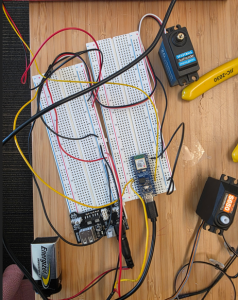
This week, I worked on creating a full simulation/working prototype of the electrical part of our device, and I am still working on debugging issues by simplifying to one set of motors instead. They seem to work well in sync with each other, however the algorithm with the motion sensor is not clear yet so that requires more coding/debugging. However, it will be resolved way before the demo day. There has been a change to our design due to my discovery that we are missing a converter for the stepper motor, but it would be better anyways to use our extra servo motors instead, so the stepper is a potential add-on rather than an official part of our full prototype.

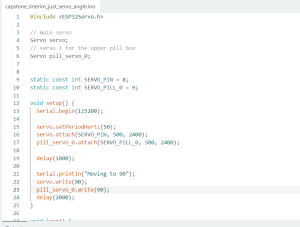
My schedule is on track as of right now- I just need to debug the servo connections, but luckily my already-written code works well even with the 20kg servo, which was an initial worry but that has been resolved.

My goal is to move on to expanding to the 6 other motors we are going to have (which shouldn’t be an issue once one is working) as well as soldering once the whole electrical hardware has been completed as well as our converter for the strain gauges arrive- we realized that the converter that was already ordered was an 8bit and not sufficient for the strain gauge we got from Adafruit.

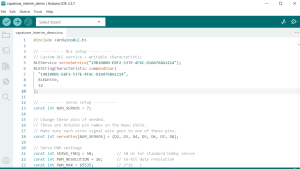
Just servo code snippet:

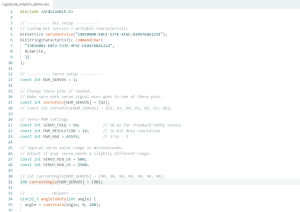
With bluetooth (for future implementation after demo) practice code:


Jahnvi’s Status Report for 3/21/26

This week after the ethics lecture and red teaming discussion, our team reflected on an important risk in our design. One major issue we realised is that if a caretaker enters the medication schedule or plls incorrectly, it could create serious health hazards for the user. To solve this problem, we decided that the app should include a feature where the prescribing doctor can review or verify the entered schedule before it the pill dispenser starts dispensing. This is something I plan to add on to the software design. On the software side, I have been spending time learning Typescript and practicing it before fully starting the app development. I have completed the initial set up and now preparing to build out the core app parts.

I aim to finish the basic features by the end of the week so that the software part is ready for the interim demo. Overall, in terms of the timeline, it is looking fine.

As a team, we aim to finish the hardware and software separately and integrate it post the interim demo.

Carolyn’s Status report for 3/21/26

This week I have been making the laser cutting file for the pill box.  I focused on refining the mechanical design of the pill dispensing system.

Progress is on schedule. Current work aligns with planned milestones, and design decisions are now converging toward final selections.

I will also continue refining the CAD design and contribute to the next report deliverables.

Team’s Status Report for 3/21/2026

Significant risk right now is the scheduling/actual build itself for interim demo- we have our parts arriving much later than we expected due to an ordering error on both ends. We are working on researching/coding aspects (both software and hardware) first to mitigate it, as software does not require any of the parts. We are also planning on utilizing meeting times more carefully so that as a team we can catch up even with this unexpected delay in build plans. We aim to have at least all of the coding completely done and tested by interim demo, which is just as we discussed with our TA.

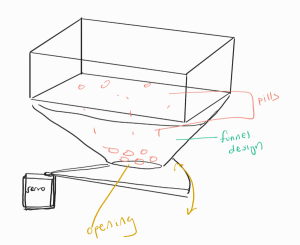
The existing design did alter a bit- we will for now be testing with one ESP32, again with an ordering miscommunication on our end (which we will be noting strongly moving forward as communication is important) which should be fine as our original design didn’t utilize the RX arduino except for 1 singular signal- which can be adjusted by adding in a better delay algorithm or manually adding in delays to have the right signals at the right times (though this might incur timing issues down the line, our main goal is to have it working). We also will be changing how we create the opening for pills to fall down-instead of a sliding door, it will be rotational door opening mechanism (more detail in Jieun’s status report’s diagram). This was necessary as a sliding forward/backward door is more prone to unnecessary error due to requiring a pulley or gear system due to the design of the servo motor we want to use. No cost change- if anything we were able to get more leeway with our budget.

Schedule isn’t updated as our main goal remains the same- complete our individual components. It’s just that we need to utilize our time that we allotted already better this week to be ready for interim demo.

Jieun’s Status Report for 3/21/26

For this week, I have continued on working on the electrical portion of our project- focusing yet again on the research/coding as our parts have not arrived yet due to an ordering mistake. One pivot I decided on was to change our design for getting the pills the fall into the compartment- instead of a forward-backward motion using a pulley or gear system, a more clear-cut movement of side to side (rotational movement to create the necessary gap for pill(s) to fall through, as seen below). There is a potential slight but significant pivot in the plans for the hardware aspect- as of right now, once all parts are in, we are only able to use one ESP32 as there was an error in ordering parts. For now, I’ll be combining RX and TX, keep bluetooth as an option as we’ll need it anyways, and trying out different codes, both with help from AI for different perspectives and combining with my own knowledge (example of one such code below).

We are still waiting for the parts to come in, so the building-aspect of my progress is not on the range I wanted it to be. I was very heavily-loaded this week from other projects and classes which did not bode well for getting ahead in my progress. However, I will be using a good part of the weekend to catch up not only on this course but others as well so that the upcoming week can be used to focus on finishing both the build and coding for the electrical/hardware portion of our project.

By the end of next week, the entirety of the hardware should be built and ready to demo at the interim demo. I will be using set hours throughout the next week to make this a priority, hence will be using this weekend to finish most of the work due earlier than later.

Carolyn’s Status Report 3/14/26

I finalized our parts list based on our design and put in most the the parts orders.  I also reviewed our feedback from design presentation and worked on filling the gaps that were addresses.  This primarily consisted of doing research to justify some of our design choices, or deciding they were unjustified and removing them.  I have also been working on the laser cutting file for our design.  This has been going through much iteration, But I believe the work is worth it as it is the whole structure of our project and without a proper structure the mechanical components will not function correctly.  Part of this process has also been maping out the exact measurements needed to satisfy all out use cases.

We are generally on schedule but we need to be making significant progress leading up to the demo.

If the acrylic comes in time I hope to print out the pill box design and assemble it.


Jahnvi’s Status Report for 3/14

This week  I focused on planning the software side of our project which is the app for the system. I relooked at the main features we need the app to support namely medication setup, scheduling, reminders, dose logging and displaying the next scheduled dose. A major part of this week was comparing the different languages and framework options for the app. Initially, I was considering using Flutter. However, after weighing development speed and ease of use as well as what would fit our capstone timeline best, I decided that Typescript with React Native and Expo is the best choice for our project. This kind of stack would allow the app to support cross-platform development and do all the things it need to be able to do.

I also planned the order in which the app is built so that I can focus on the features that are most important. I created a personal schedule in order to stay on track for the interim demo. I also outlined the MVP around the core workflow which is medication setup, home screen, next dose display, reminders and dose logging.

Based on this, the first thing I will start building is the basic app structure. I will begin setting up the project on VS Code, creating the main screen skeletons and building the medication setup flow.

In terms of the overall schedule, I think there is enough time for our team to build all individual components as assigned in order to have something concrete for the demo.