Carolyn’s Status Report for 4/25/26

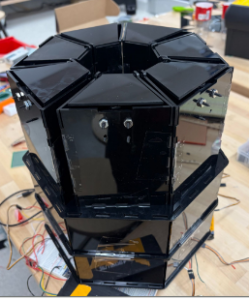
This week, I finished up the basic design, cutting, and assembly of the pill box. I designed the base attachment to the collection tray and printed it out.  Most of my time this week was focused on getting ready for the final presentation.  I collected testing data and synthesized the work we had done into slides and a script to share.

I think we are mostly on schedule, except for the integration of the software and electrical components.  We are planning to finalize that this weekend.  Then, do our remaining testing, which shouldn’t take too long.  In the next week, I hope to help finish the integration of the electrical and software.

Tests (both unit and overall) that have been/being accomplished: individual testing for motion sensor accuracy, weight sensor accuracy, timing accuracy when tracking which compartment to go to, web-app sending/storing the data that needs to be sent to the hardware end, the push-to-open accuracy/strength required, number of pills collected correctly, timing/day tracking on the software end being fully accurate, and overall run-through of the entire system working on a mock setup schedule. So far, the motion sensor + weight sensor accuracy isn’t very high (ranging from 40-70% depending on the number of servos in use, with an average of around 60%). The timing/tracking is still being tested as different power sources/pin arrangements are done during the debugging process. Push to open currently has around 7-8 on a scale of 10 for difficulty, something which needs to be adjusted down. The software end still needs to be fully tested with integration with the mechanical/hardware, which will be done in the coming days.
Team’s Status Report for 4/25/2026

The main risk is the integration- we need this fully debugged before overall testing, which is important to our project/final report. This will be focused on in the days leading up to demo (hopefully done fully by Monday so we can get overall testing started and done way beforehand).

No other changes other than slight adjustments in hardware (requiring soldering because of spacing issues) and software edits (using WiFi for communication, for example) for smoother integration with hardware/software.

Schedule is similar to before.

Tests (both unit and overall) that have been/being accomplished: individual testing for motion sensor accuracy, weight sensor accuracy, timing accuracy when tracking which compartment to go to, web-app sending/storing the data that needs to be sent to the hardware end, the push-to-open accuracy/strength required, number of pills collected correctly, timing/day tracking on the software end being fully accurate, and overall run-through of the entire system working on a mock setup schedule. So far, the motion sensor + weight sensor accuracy isn’t very high (ranging from 40-70% depending on the number of servos in use, with an average of around 60%). The timing/tracking is still being tested as different power sources/pin arrangements are done during the debugging process. Push to open currently has around 7-8 on a scale of 10 for difficulty, something which needs to be adjusted down. Software end still needs to be fully tested with integration with the mechanical/hardware, which will be done in coming days.

Jieun’s Status Report for 4/25/2026

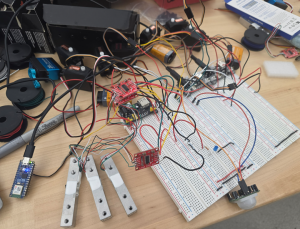
This week has been finalizing work for singular testing for the final presentation as well as continuing debugging multiple servo/signal implementation along with software integration. All of the weight sensors and servos are connected across two ESP32s, along with the PIR motion sensor. However, with the much larger complicated setup, there are still some bugs that need to be fixed timing-wise and accuracy-wise. However, at least one full compartment setup is fully working and tested (in time for the final presentation) along with individual component testing. This will continue to be worked up up till the demo day. I will continue working on getting the timing right for all 7 compartments, servos, and soldering to account for the wiring spacing for the mechanical-hardware integration. I will also be working on getting the web-app data successfully as part of hardware-software integration.

Progress is on schedule, getting ready for demo by taking out all the bugs, re-wiring so that it’s much neater, and debugging the re-wiring/integration as well.

We hope to be entirely done and functional to MVP with little to no bugs with entire system implementation smoothly finished.

Our full system implementation across hardware/mechanical for now (still needs to be cleaned up/debug-ed but the essential integration/movement is successfully completed/being tested).

Jahnvi’s Status Report for 4/25/26

This week I focused on more backend development and full system integration as well as software testing. I worked on connecting the app with the backend device side flow so that schedule data, compartment assignments and device configurations can be transmitted correctly between the app and the esp32. We also began testing the system as an integrated app-backend-device pipeline.

For the software unit testing, i tested schedule management, compartment assignment, next-dose display, HTTPS communication and dose state logging. The completed tests so far show a 100% accuracy and I am planning to do the next set of tests this week like offline behavior, reconnection sync, and error notification. These are the last tests to do for software and depend more on full hardware software integration as well as end to end testing.

From the testing, one key finding was that the backend to device communication should stay minimal and structured so that the ESP32 receives only the configuration data it needs. Another finding was that the app logs and streaks should updated based on dose events and not just scheduled reminders. Based on this, i changed the design to separate scheduled dose display, confirmed dose logging and error state reporting. One difficulty we faced during integration was connecting ESP32 to Wifi. Since our school wifi uses individual login credentials and is not straightforward for embedded design connection, we had a lot of trouble getting a stable connection. To work around this, we tested our system using a personal hotspot so ESP32 and app could work on the same network with same name and password. This helped us continue integration testing and verify communication flow.

We have also decided to keep offline behvaior as a separate test category since the pillbox must support local reminders and scheduled dispensing even when the app is not synced.

Given that we have a week left till our final presentation, we need to focus the next couple days on thorough testing as well as human testing. We should be done in time if we keep up with out gantt chart.

Carolyn’s Status Report 4/18/26

A lot of progress has been made.  I finished redesigning the trapazoidal pill compartments, including making the base and lid.  The lid design went through many iterations, and getting the hinges to fit and function properly was very difficult. I also had to make adjustments to the compartment sides, as I realized I forgot to make holes through which the strain gauge wires can come out.  Then I installed the push-to-open latches.  Getting them installed took many iterations as the acrylic was breaking easily.  I also made a second base for each compartment to hold the funnels.  Then I made the funnel for 3 compartments.  I also designed and made the sliding door attachments.  I am especially proud of myself for this, as I got the sizing of the holes so they fit on the servos exactly.

We are definitely behind on integration.  We are planning to spend a significant amount of time getting that sorted tomorrow.
• What deliverables do you hope to complete in the next week?
In the next week, I hope to have funnels for all the compartments, which shouldn’t take too long.  As well as maybe figuring out a better way to do the compartment hinges so they don’t break as often.
As you’ve designed, implemented, and debugged your project, what new tools or new knowledge did you find it necessary to learn to be able to accomplish these tasks? What learning strategies did you use to acquire this new knowledge?

My CAD skills have definitely improved while making the funnels, as well as my CorelDRAW skills.  For CorelDRAW, I bothered the TechSpark employees often about how to do certain things and use the tools.  For CAD, my meche friends, as well as YouTube videos, were a good source for figuring out how to make a trapazoidal funnel.

Jahnvi’s Status Report for 4/18/26

This week I finalized the software architecture for the Magic Pillbox by working through various aspects of the backend design step by step. First I identified the core system requirements like structured medication and schedule data, reliable read and write operations between app and device a secure storage for our data, and a clean method to communicate with the ESP32.

Based on these requirements, I chose a relational SQL database because our system depends on strongly connected data such as users, devices, medications, schedules, and dose logs. After this, I compared various relational options and selected PostgreSQL as the best for due to its strong support for relational queries, data integrity and future adherence analytics. After this, I chose Supabase as a PostgreSQL platform because it provides authentication and secure user level access which aligns well with our Magic Pillbox requirements. After this, I finalized hybrid communication architecture in which the web app interacts with Supabase for user-facing data while the ESP32 connects over the Wifi using HTTPS requests to backend Route Handlers which then eventually reads from and writes to Supabase.

To make these design decisions, I had to learn and deep dive into backend system architecture, mainly the differences in databases, how webapps communicate with embedded hardware like ESP32 and I had to learn more about tools and concepts. To build this understanding, I used a mix of learning strategies rather than just using one website. I read some official documentation for the relevant platforms, which ones the industry prefers and uses and compared technical features as well as tradeoffs across options. This entire process helped me move from a broad understanding of possible software architectures to a more concrete and justified system design project.

I am a little behind schedule, I aim to finish most of the integration in the next 2 days so we can start testing. In terms of the overall schedule, I think we are on track for the final presentation, and we aim to start testing this week and complete all testing by mid next week, giving us enough time to write the report.

Team’s Status Report for 4/18/2026

The most significant risk is the integration of hardware, mechanical, and software. We will be working on this together tomorrow as our individual components are either done or in the debugging phase.

For testing, we will be first testing individual processes, running trials on each component (ie. schedule signal generation from software app, sensor detection integrity/accuracy from the circuit’s end, and door opening accuracy for mechanical, etc.). We will be putting all of our individual testing results into a google spreadsheet and calculating the average accuracy. As of right now, the idea is to organize our results into quartiles so we know which aspect to focus debugging/improving first. Nothing has changed from this initial testing idea other than us recruiting our fellow classmates as well as some professors for user-testing. We will also decide on the handicap to best simulate our testing once our implementation is functional – this will be included at the very least for our final report.

Changes made is that 2 ESP32s will be used should the debugging be unsuccessful with one by tomorrow, as that appears to be the main issue, with the second ESP32 being powered by Vin instead, with mitigations being handled by handling one issue at a time so no components are accidentally damaged.

Our schedule is around the same.

Jieun’s Status Report for 4/18/26

Personally this week has been quite a lot: first the code was tested with the weight sensors, which required a lot of soldering, all of which has been completed with some re-soldering required during the final setup tomorrow/in the coming days before the final demo. Currently, all seven servos, the motion sensor, LED indicator, and most of the strain gauges have been implemented along with some starter code to connect with the software once the MQTT protocol to connect the two has been completed. My current work is to debug the issues once more than 2 servos have been implemented, which is that despite the multiple power sources, something is being connected improperly/ the servos are not functioning. I will be working on this remainder of the weekend to figure this out before the presentation.

Progress is right on track, though the debugging is worrisome as it was expected after 2 servos are working, 7 should work just as well. However, time will be dedicated to solving this issue as well as recruiting my other teammates as soon as possible should I not be able to find the issue by tonight.

I hope to complete the implementation of all 7 servos as well as integrating fully with the mechanical by tomorrow. With the software, it might need more debugging but hopefully that is completed by the final presentation. Worst case, it will be done before the final demo.

I had to learn more about the Arduino IDE and ESP32 Nano configuration- I have used Arduinos in the past but this is my first experience with the Nano as well as the GPIO pin configuration system, which was a learning curve. I looked at online forums with certain bugs (such as why a servo didn’t work with a digital pin- this turned out to be a GPIO pin number issue) as well as consulted AI tools such as Claude and ChatGPT for faster as well as more efficient answers, both of whom that I wasn’t too familiar with outside of simple conceptual questions prior to this semester. It was another learning curve to ask prompts that gave me the answer that I was looking for: for example, I was confused by my nano kept showing a red light and at first the AI believed I was talking about a different power indicator. After narrowing down my wordy explanations, it finally gave me the true issue: something was being grounded that wasn’t supposed to be.

Jahnvi’s Status Report 4/4/26

This is week I just focused on fixing the app and making it ready for the interim demo. Most of the work went into improving stability and making sure the core workflows were in place. I also made sure they were smooth transitions between pages, and that time based features were correctly synced.

As we move into verification and validation, I mainly plan to test the app by running feature based tests for each of the major screen and user flow. This would include checking whether the medication setup saves and displays correctly, whether the Home page shows the right upcoming dose and countdown values, whether the logs appear with the correct status and whether the app handles issues like missing data or any other kind of errors. I will analyse the results by comparing the app’s actual output to the expected behavior for each requirement and noting which tests pass. This will also allow me to reveal bugs or any missing functionality. I will also test for structured test cases like expected user actions as well as edge cases. All in all, it will help show whether my software contribution meets the engineering and use-case requirements for reliability, clarity, and safe medication management support.

At the validation level, the app will be considered as part of the entire Magic Pillbox workflow rather than just an isolated sub-system. The key question here is whether the app supports our overall usecase of helping an older adult or caregiver safely manage medications. To evaluate this, we will look at whether the app makes it easy to set up medications, review the next scheduled dose and understand logs in a way that matches the goals for our project.

Currently, in terms of the schedule we are on track with the app. The only thing left is to integrate it with the software. I am currently researching methods that would be most ideal for such a system and will implement them by next week.

In terms of the overall schedule, we are slightly behind on the mechanical parts but should be caught up and ready by end of next week.

Carolyn’s Status Report 4/4/26

After making our prototype pill box, I realized that I had not sized the pill box compartments correctly.  So I had to redesign the compartments.  I now have them as trapezoids, which will allow the space to be used more effectively than squares.  Furthermore, I have been working on the push to open, so I can install them soon.

Our progress is a bit behind due to the parts we delayed.  Not having all the acrylic made it especially hard for me to finish the physical pill box.

In the next week, I should have the new compartments finished and added to the pill box.  As well as finish up the CAD designs of the funnels for each pill compartment.

For my portion of the project, there are two main things I will need to verify.  I will verify that the compartments do indeed hold up to a 30-day supply, 3 times a day, of any pill type.  I will verify this by ordering empty pill capsules online and filling them into the compartments.  I will use the largest pill size for the test to make sure the compartments will hold any pill size.  If the compartments can’t close with 90 pills of the largest pill size without damaging any of the pills, they will not pass the test.

Next, I will verify that all the user access doors can be accessed in 30 seconds or less.   I will have to install the push-to-open on each of the doors before I do this. This will ensure that all the access doors can be used by someone with dexterity issues easily.  I will have someone time me opening each door for 5 trials.  I will need to open each door within 30 seconds at least 4 out of the 5 trials.