Over the past two weeks, I finished the layout for the PCB, finalized all 39 parts that are being placed on it, and ordered it. After ordering, JLC reached out to me because there was one small issue with two of the three LEDs I selected. These LEDs were in a reverse-mount package, meaning they are placed on the board “upside down,” and also require a hole drilled through the board for their light to shine through. I did not realize this, and thought that they were just your normal 1206 SMD LEDs. After emailing JLC, I replaced the reverse-mount LEDs with normal ones.
Additionally, I worked with my team to complete our Design Report due before spring break. My contributions included detailing certain design decisions and tradeoffs we thought through, as well as calculating conservative estimates for Remigotchi’s power requirements. We concluded that Remigotchi would, at most, require a 2000 mAh 1S lipo battery to ensure a full day’s worth of power.
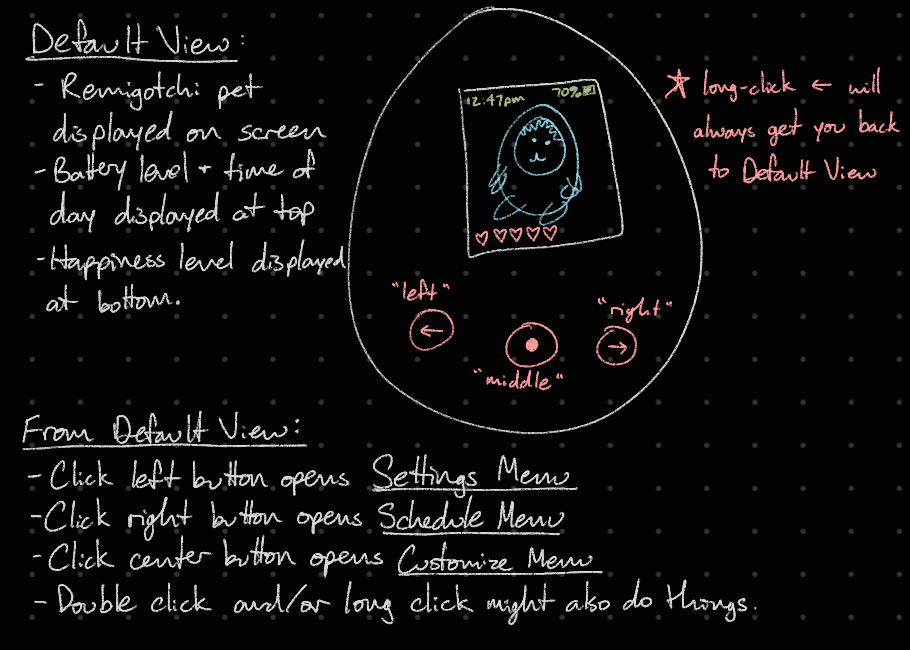
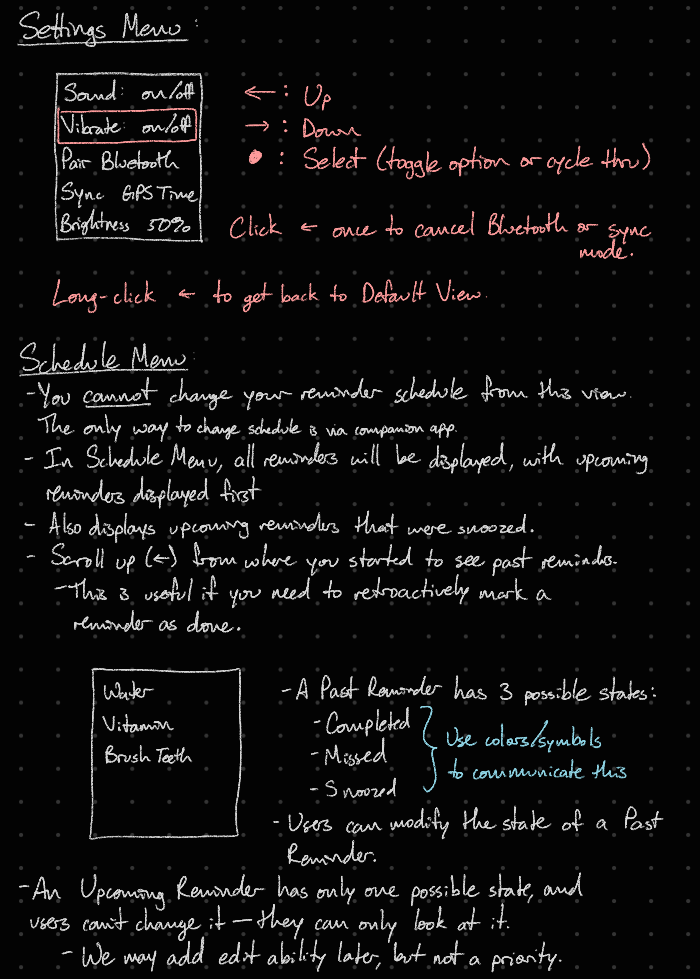
Also, I started drafting some ideas for what the menu options in Remigotchi are going to look like, and how users are going to navigate through them. Below are notes I wrote down. They are just a first draft, and are not set in stone.
According to the Gantt chart, all hardware development is on schedule. I achieved my deadline of ordering the PCB by the Friday before spring break. However, it’s possible I may fall behind schedule if the boards don’t arrive soon. I’m supposed to test the PCB next week, and I may have to push that back by a few days. At the time of writing this, manufacturing and PCBA has completed, and the boards are on their way to the JLC shipping center. I expect them to arrive sometime before next Friday. To catch up and keep this project on schedule, I will work on testbench firmware while I wait. This will start out as basic sample programs to ensure that the ESP32 can effectively communicate with the other sensors and devices onboard.
Deliverables I hope to have next week are a completed and finalized idea for menu architecture, to be discussed with Italia. Additionally, I’ll have a more detailed PCB test plan before the boards actually arrive. I’ll start out by simply testing electrical connections, then move onto testing it’s DC-DC conversion capabilities, make sure I’m able to flash the ESP32 onboard, then move onto running some sample firmware to make sure I mapped the pins correctly.