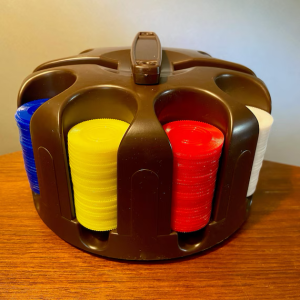
Sam’s status report for March 14th

This week less forward progress was made as the 3d printer was down. Much of my focus then was on reviewing and refining the centrifugal chip sorter design from last week rather than building the new components. After the transition from the vibration based sorter, I wanted to make sure I have this working consistently so I dont run into the same problems with the new design.

I worked on going back over the tolerances on the chip track to confirm that the dimensions are tight enough to reliably make the chips sequential without jamming. I also got some more magnets into the wheel to see how fast I can pick up chips. No major hardware was assembled but what exists was added to.

losing access to the 3d printer for a couple days was a big problem, its up now but I lost a week of new pieces. I am going to mitigate this by trying to get access to tech spark. My goal for the week is having the sorting system fully prototyped with new access to another printer.

Team Status Report for March 14th

The most significant risk this week was the 3d printer uptime. This risk is being managed by getting access to the tech spark printer, and not waiting until the last minute to print so downtime doesn’t hurt us.

The only change is the chip sorter moving from vibration to magnets to pull the chips into the system. It was necessary because the vibrations to the table messed with user experience and the only cost is cheap magnets and reprinting a few parts.

In addition the RFIDs are coming in this week.

No changes to schedule

Ben’s Status Report for March 14th

The CFR framework and subgame solver (depth currently = 1, but any deeper is unlikely to run locally on the raspberry pi) are done. I am working on getting arbitrary depth subgames to work as well. Training has also not passed CFR test cases, so I am working on debugging that.

Ben’s Status Report for March 7th

The ML framework itself is mostly complete. The base CFR mechanism, monte carlo simulation framework, and stochastic node selection are all done and work together. I am working on subgame solving, and will also need to review and potentially modify the APIs with which information can be added to the game in order to interface with physical components of the system.

Andrei’s March 7th Status Report

I have begun disassembling the autodealer to be able to control the dealing speed and actions based on the commands written by the raspberry pi. I have also looked into materials for the table. I need to decide whether to add the felt piece or not depending on the friction of the table.  We worked and the design report which helped fill in the gaps that we had in our description of the product. This design report helped me zone out exactly the necessary products based on our needs. This also  includes the implementation and the way to go about creating the product.

Team Status Report for March 7th

The most significant risk is that the new design for the centrifugal chip ordering. This could slow us down, and this is being managed by having work done over spring break to catch up during slack time.

The way that chips enter the system has changed. It was necessary because the vibration required for the previous design degraded the quality of the table as it was too loud and noticeable. This hasn’t changed the schedule.


Part A is written by Sam Istvan

Part A: Global factors really are only that the system will operate in a home environment that may include children, elderly users, and people unfamiliar with electronics. The user interface must require no technical knowledge to operate. The materials and components used must comply with standard consumer electronics safety expectations. The system should be designed for longevity to minimize electronic waste, using off-the-shelf components that can be individually replaced. This product intends to make social connection easier at well, giving access to a social game for people to bond over in their homes. Removing the table management from poker makes it easier to just be in the moment and connect with others around you.

Part B written by Andrei Da Silva

Part B: The Gambletron 9000 will not do well in places where gambling and games of chance are not popular or against moral values due to its association with Poker. That being said our game in itself is not a gambling game and there is no actual money involved. It is a game to provide those who want to play poker to enjoy a game against bots or friends while not having to keep track of game state. This game would likely not be allowed to be purchased in most religious states but if marketed correctly would be popular in most places where gambling isn’t a strong moral problem since it is more made to be a solo or family style game.

Part C written by Benjamin Berger: … with consideration of environmental factors. Environmental factors are concerned with the environment as it relates to living organisms and natural resources.

The Gambletron9000 has no significant environmental impact. Games of poker inherently do not leave an environmental footprint, and the replacement of traditional poker with gambletron does not change that. With respect to humans as living organisms, gambletron could be beneficial, as it encourages the in-person social aspect of poker, could replace online play for some groups, and makes live poker more available and reliable. In that case, it could be good for its playerbase, encouraging more social interaction which is healthy.
Sam’s Status Report for March 7th

This week I was stuck on the chip return as the original plan detailed in the last blog post.

The vibrations required to get the chips moving through the intake was enough to move the table, so I wanted to switch to centrifugal spinning to get the chips sequential. This is detailed in the design report as I found this out before the paper was written. The design I am testing right now is shown below. It spins the chips into a track that is the exact width and height of a chip so that only one passes through at a time.


Every inch there will be a magnet that attracts the metal cores of the chips so that they can be easily pulled off the wheel and shuttled into a track.

My progress is a little bit behind now that I’ve had to go backwards on the chip ordering. I have tried to catch up over spring break as this was added slack time in our schedule.

I hope to complete the centrifugal chip ordering in the next week.

Team Status Report for Feb 21st

This week we continue to each work on our part of the project. We also received the items we ordered at the end of the week, so we have escaped part of this bottleneck. Overall we are making good progress and finalizing the design as we try things and see if they work or not.

The chip return is taking shape with 3d models of the starting funnel and track with color sensing is being worked on.

The auto card dealer came in on Thursday and from initial tests seems to have the basic functionalities necessary for this project. Throughout this coming week we will be dismantling it and seeing if we can control the autodealers actions ourselves.

One of the most significant risks is how well the RFIDs work. We really need to have access to them to test, as if they do not meet our specs as expected, it could cause significant redesign. We are trying to build the chip return system in a way that it could work with only color, but RFID is needed to make everything run faster and smoother. We are also trying to mitigate this by doing this testing early, so if it doesnt work we can change designs pretty easily.

The ML framework on which to train the poker AI is in progress. The system to run Monte Carlo simulations is done, and we are working on implementing stochastic node selection for training.

Our schedule is overall the same, we are making good progress and haven’t hit any significant speed bumps

Andrei’s Status Report Feb 21st

After completing the design presenatation I finally recieived the auto card dealer and was able to test its basic functionalities. It works very well and has all the settings necessary that we could be using. I now have to dismantle it to see if I can slow down the dealing and manually control the start and stop of the dealer. This will be my goal for this coming week. In addition I am still attemtping to understand and figure out what rfid i will be using for the chips and cards at the moment. I will be speaking with Theo on monday to complete this sidequest. We will then complete the design report by friday before spring break.

Sam’s Status Report for Feb 21st

This week I’ve been finalizing the design for the chip system for our design report and the document we are writing to help outline how everything will work.

At the center of our table we will have a funnel that looks like the image above, I am actively 3D printing this. This puts the chips into a sequential order, which can then be fed into the color sensing that I showed last week. To gain height from the collection in the center of the table, I am also building a track that will act as a vertical conveyor belt. The chips have a metal weight inside them so I will be using magnets to pull them up along this track. At the top of this track the actual color sorting will happen with the use of gravity, into the container imaged below.

Behind each of these stacks I am working on putting a solenoid to push out individual chips onto each players return track.

Overall I think I am near on schedule. 3D design of all these unique parts has been taking longer than I want, but I haven’t done something requiring this much fabrication before so thats sort of expected. We have also had some things we ordered arrived finally, so we can start making progress on things like the RFID scanning and dealer.

This week I would like to have the funnel and color sensing working together.