Right now, the most significant risk is time management. Because the past week was Spring break, our team was a little bit behind our schedule. However, we are generally on track and will have the chance to make up for it in the following day or two. Also, the current stage revolves around the middle of the implementation of our two key modules — motor mobility and vision pipeline, so as long as we meet the deadline of these modules in a few weeks, we would still be on schedule.
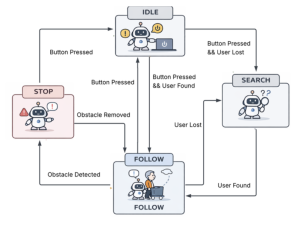
In the past week, we didn’t make any change to our design system, but to address some feedback we got in the design presentation, we chose to add a state diagram to better showcase and remind ourselves how our system works on a high level.
We didn’t make any change to our schedule because we are only a little bit behind our progress, which can hopefully be caught up by the end of this week, but we need to keep in mind that we must catch up to our current schedule by the end of next week. Otherwise, changes should be made.
A was written by Xinyu Li, B was written by Wuyang Li, and C was written by Xinyu Li.
Part A: Our SafeFollow system is designed as a low-cost indoor assistive robot that follows a user and carries items in a basket mounted on the robot. One global factor influencing our design is the increasing aging population in many countries, which creates demand for assistive technologies that help elderly individuals maintain independence. To address this need, we specifically designed the system around widely available and relatively inexpensive components such as a Raspberry Pi for computation, a camera for person detection using YOLO, and a differential-drive robot base. This hardware choice keeps the system affordable and avoids dependence on specialized infrastructure such as cloud computing or expensive sensors. As a result, the solution can be deployed in typical homes across different regions rather than only in well-resourced environments.
Part B: Cultural factors also influenced our design decisions, particularly the way the robot interacts with the user. In many communities, elderly individuals prefer to remain independent in daily activities while still receiving subtle assistance. Our SafeFollow robot supports this by automatically following the user and allowing them to easily access items stored in the robot’s basket. We also specified the basket height to be approximately one meter so that elderly users can comfortably reach items without bending down. This design consideration reflects the goal of maintaining dignity and independence while minimizing physical strain, and it avoids requiring users to learn complicated interfaces or wear additional devices.
Part C: Environmental factors were considered in how the robot navigates and operates inside typical household environments. The system combines camera-based person detection with ultrasonic sensors for obstacle detection so that the robot can safely move around furniture and other obstacles commonly found in homes. The design focuses on indoor operation on flat surfaces such as kitchens and living rooms, which reduces mechanical complexity and energy consumption compared to outdoor robotic platforms. By using lightweight hardware and an embedded computing platform, the robot operates with relatively low power requirements while still maintaining real-time perception and safe navigation within residential spaces.