Introduction
Person-following robots have the potential to provide hands-free assistance in a wide range of indoor environments, from personal mobility support to research and content creation. While commercial solutions exist, they are often expensive, closed-source, or optimized for narrow use cases. At the same time, many low-cost or academic prototypes focus heavily on specific algorithms without adequately addressing user safety, responsiveness, and reliability in real-world settings. This gap motivates the need for a carefully scoped, user-centered person-following system designed around clear, testable requirements rather than predetermined hardware or software choices.
This project aims to explore the design of an indoor autonomous robot that can safely and reliably follow a designated user at walking speed. By grounding the system in explicit use-case requirements and verification criteria, the project emphasizes usability, safety, and robustness as first-class design goals.
Project Summary
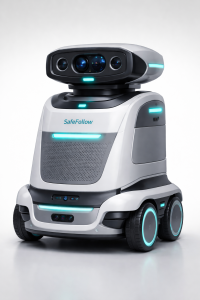
The goal of this project is to design and prototype an indoor person-following robot that autonomously tracks and follows a specific user while maintaining a safe distance and avoiding obstacles. The system is intended for indoor environments such as hallways, rooms, and laboratories, and targets users including elderly individuals, workers who need hands-free transport, and content creators or researchers conducting human–robot interaction studies.
Key system objectives include reliable person identification in multi-person environments, tolerance to temporary occlusion, real-time responsiveness, and continuous operation over realistic time spans. To keep the project appropriately scoped, the system explicitly excludes outdoor navigation, SLAM, voice interaction, and complex terrain handling. Success will be evaluated through requirement-driven testing that focuses on user behavior and system response, ensuring the final design meets practical user needs rather than merely demonstrating isolated technical components.