Felipe Status Report for 10/18/26

What was done

This week, I was focused on the design report, covering the system architecture and project management plan. I documented the signal path from the visual stimuli and EEG electrodes through the ADS1299, ESP32-S3, and mobile application. This included SPI data acquisition, embedded filtering and CCA classification, confidence-based command rejection, and BLE transmission for spoken output.

For project management, I outlined the development schedule, team responsibilities, integration milestones, preliminary budget, and fabrication plans. I also documented technical risks and mitigation strategies for EEG signal quality, PCB issues, and classification performance, including potential fallback approaches.

Alongside the report, I worked on ESP32-S3 firmware for BLE communication with the mobile application and the SPI software interface with the ADS1299. This work focused on supporting wireless command transmission and establishing the communication routines needed for ADC configuration and EEG data acquisition.

I also finished gathering models for 3D Printing and should have a headset prototype by end of week.

Next Week

I plan on helping with the PCB and getting an MVP of the mobile app done.
Felipe Perotti’s Status Report for 10/03/2026

Progress This Week

This week I was focused on the communication protocols we will use for transmission between the ADC and the ESP32 as well as from the ESP32 to the final end point device.

This week I focused on the communication protocols that will support data transmission between the ADS1299 ADC and the ESP32, as well as between the ESP32 signal-processing board and the final endpoint device.

Initial findings indicate that the system should be treated as two separate communication links. The ADS1299-to-ESP32 connection requires a deterministic, low-latency interface—most likely SPI—with careful synchronization using the data-ready signal. This link must preserve sample timing and prevent data loss during continuous EEG acquisition.

The ESP32-to-endpoint connection will require a balance between latency, bandwidth, range, power consumption, and reliability. Candidate interfaces include Bluetooth Low Energy, Wi-Fi, or a wired UART/USB connection, depending on the final endpoint requirements. Regardless of the selected technology, the transmitted data should include packet framing, sequence numbers, timestamps, signal samples, status information, and error checking.

The main communication risks identified so far are packet loss, timing jitter, synchronization errors, and increased latency. These factors could affect the quality and real-time performance of the BCI system. The next step is to benchmark the candidate protocols using end-to-end latency, packet-loss rate, throughput, and system resource usage as the primary evaluation criteria.

I also began 3D Printing the headset but have yet to find good files for spring mechanisms to keep tension  between electrodes and head. Will report further next week.

Next Week

For next week I plan on finishing the needs for the headset and to start identifying the low level software we’ll need for communication.

Schedule

I am on schedule.

Felipe’s Status Report for 9/26/26

Progress and Accomplishments

This week I was focused on three primary things, getting initial parts ordered so we can start some testing, looking into possible headset 3D files so we can have a consistent frame for our electrodes, and looking into the DSP and software interface skeleton of the project.

For parts we wanted to get the electrodes ordered and out of the way. We ended up going with the supplier for OpenBCI which is Florida Research Instruments.

For the headset, I found the 3D File OpenBCI uses for their headset and am working to get it sized correctly. I am also working on designing a spring loaded mechanism that will ensure electrodes maintain full possible contact with the scalp.

Lastly for the DSP and software interface, I was focused on the microcontroller aspect specifically the ADC->ESP32->Computer interface. I found some solid options on how to do it, and plan to work on it further next week.

Next Week

The main goal of next week will be to finalize plans for the ADC->ESP32->Computer pipeline and start drafting an MVP we can use for testing.

Felipe’s Status Report for 9/19/2026

Tasks/Accomplishments

This week was focused on researching the workings of BCI and looking for what could be potentially suitable parts  for the project.  I mainly focused on how we could get reliable electrodes that we could use for the project while not blowing up our budget. I began by looking at parts and costs from OpenBCI. However many of the parts or kits present were too expensive. Through some further research I was able to find the company that sources some of the parts for Open BCI and they provided more affordable options.

A good part, of my focus was on understanding the different types of electrodes available. The main two being cup electrodes and dry brush electrodes. Cup electrodes are the classic type which require a conductive gel to work properly and is often used in medical applications.  Meanwhile dry brush electrodes are completely dry and have much easier setup. Technically the gold cups have a better chance for better signals but unless the dry brush completely fails we won’t use it.

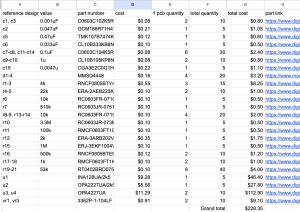
The other major task this week was creating and sourcing the initial bill of materials for the analog acquisition hardware. I built a BOM with reference designator, value, manufacturer part number, unit cost, per-board quantity, total quantity, total cost, and purchasing link. I individually sourced the passive components, protection diodes, amplifiers, and trimmers rather than estimating a generic PCB cost. The current BOM contains parts such as the INA128UA instrumentation amplifier, OPA2227/OPA4227 op-amps, MMSD4448 protection diodes, precision resistors, filter capacitors, and adjustment potentiometers. For the quantities currently entered, the BOM totals approximately $228.35. This also gave us a much more concrete view of where the prototype budget is going and which components dominate cost.

More work needs to be done to see if replacements and cheaper options are available

Plans for Next Week

For next week we will be focused on drafting the first iteration of our PCBs and ordering parts, as well as trying again to contact professors with experience in the field.

On Schedule?

We are on schedule.