
Team Status Report for 10/18/2026
Significant Risks of the Project
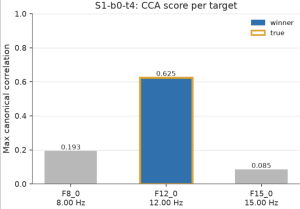
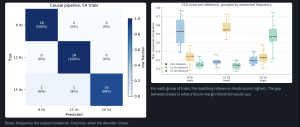
The biggest risk is still acquiring reliable EEG signals from our custom PCB for the reasons mentioned in the previous reports. We will still be addressing this the same way. Now that CCA work is also underway, another risk is meeting our accuracy and false-activation requirements on real users. Our CCA decoder achieved 96.3% accuracy on 54 trials from a public EEG dataset, but performance may differ with our own hardware and participants. We still have to calibrate confidence thresholds using recorded EEG and evaluate both intentional selections and periods without selection. If necessary, we will adjust the analysis window and rejection thresholds to prioritize reliable commands.
Design Changes
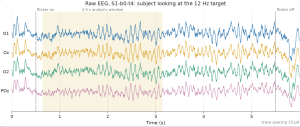
No design changes occurred, they were locked down for our design report and we have not had to make any pivots yet. The CCA analysis window was decided via experimentation to be 2.5 seconds which fits the buffer we accounted for in our latency requirement.
Schedule
We are behind on PCB fab, we plan on getting this done by Monday ASAP and get all the rest of the software work complete before getting our parts.
Progress
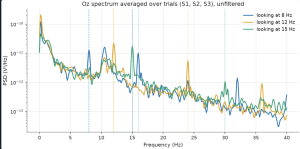
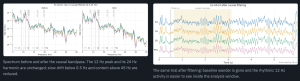
CCA work was further enumerated in individual reports, but here are some screenshots of progress.
Part A was written by Theodora Kwok. With millions of people worldwide experiencing speech-impairing disorders, effective BCIs are not easily accessible as this technology is expensive. By integrating low-cost components, such as the ESP32, ADS1299, we are lowering the cost of producing an effective EEG system that helps patients communicate in an alternative way. Our project makes the assistive communication technology more accessible to low income communities.
Our implementation is also user-friendly. For example, using a CCA classifier instead of complex ML models eliminates the need for calibration, making it easier for rural clinics or nursing homes to use it with minimal guidance. Powering the system with a single-cell battery and using BLE to operate the system also allows people from places that lack reliable power infrastructure to use the device.
Part B was written by Atharv Kashyap (atharvk):
SynapSys is designed to help individuals with severe motor and speech impairments communicate basic needs without relying on speech or physical movement. Communication needs vary across languages and cultures, so we chose three simple and universal commands: “yes,” “no,” and “help.” These commands can be translated into different languages through the mobile application without changing the EEG hardware or classification algorithm to accommodate other cultures. One concern to bring up is that cultural attitudes toward disability and assistive technology can also affect whether people are comfortable using such a device, especially in rural areas or areas where there might be less technological literacy. We still do not interfere with personal data in our solution to abide by any nations’ laws and SynapSys is noninvasive, relatively affordable, and simple to operate. We hope that these use-case requirements make it more accessible to users and caregivers from different backgrounds.
Part C was written by Felipe Perotti (fperotti):
Our design considers environmental factors through its use of a rechargeable battery and reusable electronics. Rechargeable operation reduces reliance on disposable batteries, while the reusable acquisition board and headset allow continued use without replacing the entire system. The planned custom, 3D-printed headset also allows us to fabricate the structure needed for the prototype.
The design still has environmental impacts associated with PCB manufacturing, electronic components, electrode consumables, and eventual electronic waste. To limit unnecessary material use, our project plan includes schematic and layout reviews before fabrication, helping reduce avoidable board revisions and discarded components. Maintaining the reusable hardware and replacing consumable or failed parts where practical can further reduce waste while preserving the product’s communication function.
Team Status Report for 10/03/2026
Significant Risks of the Project
Our biggest risk is still getting clean EEG from the custom PCB. Electrode contact, movement, electrical noise, or PCB issues could make the SSVEP signal difficult to detect. We will test this in stages with PCB acquisition first, then alpha blocking, then each SSVEP frequency individually, and finally three-command classification. This is what Theodora also presented in her presentation. Software development is happening in parallel using synthetic and prerecorded EEG so we can separate hardware problems from software problems.
If EEG acquisition is not reliable by our biological validation gate, our contingency is to pivot to facial EMG using the same general acquisition hardware or eye tracking.
Design Changes
We made two main changes. First, the ADS1299’s integrated programmable-gain amplifiers and 24-bit ADC mean we no longer need the separate high-gain analog amplification chain we originally considered. Most filtering will instead be done digitally after acquisition.
Second, we decided to run filtering, CCA, and rejection directly on the ESP32-S3 instead of the phone. Python is being used to develop and verify the algorithm first, after which it will be ported to C/C++ for the ESP32. These changes simplify the hardware and make the final system less dependent on the phone.
Schedule
The overall schedule has not significantly changed. Our immediate goals are to finish the PCB layout/BOM and send the board for fabrication, finish the design report, test CCA on prerecorded human EEG, and begin the ESP32 implementation. Software development will continue while the PCB is being fabricated.
Progress
Software side (further elaborated in individual post):
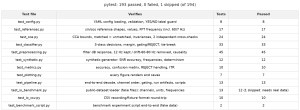
Tests are successfully run:
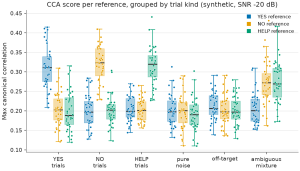
Synthetic outputs were created and tested with CCA:
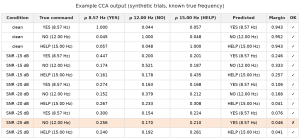
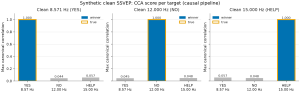
Noise was added too to check rejection:
Team Status Report for 09/26/2026
Our project depends largely on whether the PCB can successfully capture and amplify the brain signals. Since we have done some literature review and have seen successful circuits, we have a solid starting point. To ensure the correctness of our PCB, we will have to test extensively by running simulations that imitate brain signals. If the fabricated PCB is not able to effectively amplify signals, we will look into switching to EMG instead.
Initially, we planned to build a PCB that has an instrumentation amplifier, bandpass filter, and notch filter, and have each PCB process signal from one channel. However, as we started designing the circuit and thinking about how to get the most out of our tiny brain signals, we realized this implementation would create a lot of parasitic capacitances and thus degrade the SNR. We also realized that the ADC can provide sufficient gain without any external amplification at all, so that an instrumentation amplifier is not needed. We also decided that it is easier to process the digitized signal in software than in the analog domain, so we have decided to design a bigger PCB that can simultaneously process 8 channels.
We are on track to finish the PCB design by fall break. We might also want to start looking into programming microcontrollers, so that we can integrate the components as soon as we get the PCB fabricated.
Part A was written by Theodora: Our project aims to improve the lives of those who are affected by speech impairment and their caretakers. By allowing patients to express their needs through our EEG device, patients are able to get help much quicker, which prevents unmonitored medical distress or other emergencies. Psychologically, restoring communication can help restore patient agency, which can help reduce feelings of isolation and anxiety. At the same time, caretakers do not need to check in with the patient as frequently, reducing their stress. This gives more autonomy to both the patient and the caretaker.
Part B was written by Atharv Kashyap (atharvk): One of the most defining social characteristics of a human being is their ability to communicate with one another. For those who have lost this ability and cannot use conventional input methods like voice, touchscreens, and keyboards, Synapsys provides 3 commands: yes, no, and help. This allows them to participate in conversation with caregivers, family members, and others around them to a degree that they couldn’t previously, which means being able to have a voice and opinion in different social and political contexts where their input might have not even been considered earlier.
Another important feature is its accessibility and cost. Many EEG systems are expensive and require specialized equipment or trained operators, which limits who can realistically access them. Synapsys is therefore pursuing a $600 prototype cost target, using custom and open-source hardware, and sending selected commands to a standard phone for speech output rather than requiring specialized external equipment or surgery which is a benefit in an economic context. For more accessibility for a wider audience, the phone application is also intended to allow the displayed phrases and spoken output in different languages. This is beneficial in a cultural context.
Part C was written by Felipe Perotti(fperotti): Our product will be providing a far cheaper solution when compared to other EEG systems. However since the expected users for the project are a fairly small number of people the economic impact of SynapSys will be fairly low. At most it could lead into a future where people impacted by the lack of accessibility born from their disability are able to better interact with the world to the point of being able to request goods and services without assistance. This will also lighten the load on caretakers.
Team Status Report for 09/19/2026
Significant Risks of the Project
The largest project risk remains the custom EEG acquisition hardware. SSVEP signals are tens of µVs so excessive front-end noise, poor grounding/reference wires, electrode impedance, improper electrode placement, PCB layout problems all could cause poor SNR which, with weak signals, could prevent us from even observing a signal. If this happens, there is no project to build around.
We are managing risks by having a validation plan that tests each component thoroughly, following established research papers for circuit design, and buying high quality electrode components. If we cannot reliably measure a known EEG response by this point, our contingency is to use the same acquisition PCB to detect EMG signals from the eye blinks or jaw, which are substantially larger signals and reduce the analog-front-end requirements. Another possible pivot is to build a physical eye-tracker and maybe expand commands past the 3 available commands since there is no signals component anymore. It remains consistent with our use case.
A second risk is the PCB fabrication timeline. The board is the project’s critical path, and a failed first revision could leave insufficient time for another fabrication cycle. To manage this, schematic and layout work is being front-loaded before fall break, and the schedule we created assumes a second board revision.
Changes to System Design
Through research, we found our system design to remain largely consistent. It was more vague before but now we have concrete details on the signal acquisition and front-end PCB filters and amplifiers as well as a BOM. Another change is to work on signal-processing development separately and in parallel from the PCB development. We identified multiple public SSVEP datasets and will be using them to implement and evaluate CCA while the acquisition hardware is being designed. This reduces schedule risk because software development can happen before and during fabrication.