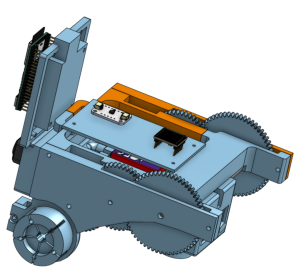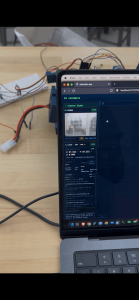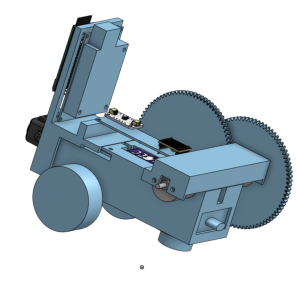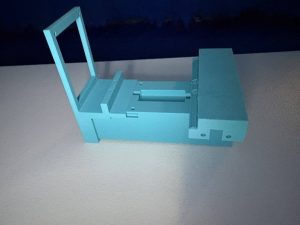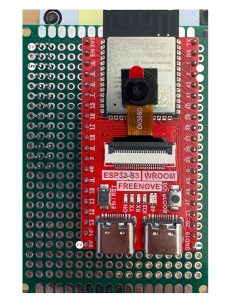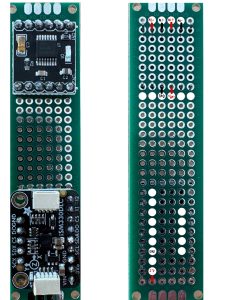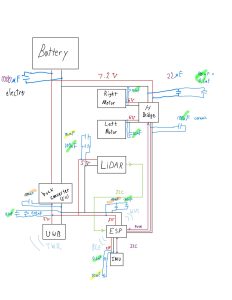
This week, our team was able to successfully integrate all the live sensors, ESP32 camera stream, and teleoperation onto the catombot (shown in the video link).We were very relieved to get the robot moving by slightly changing the physical design and gear size of the motor’s gear, so it has enough torque to spin the gears and hence the whole bot. Further details are explained in Josh’s status report. These physical improvements, combined with Brooks’s implementation of the motor-subscription logic for the ROS velocity topic, allowed us to verify a full control loop from the base station to the physical robot. Adrian further refined this experience by stabilizing the UWB position stream by implementing a stationary deadband to remove 5-10 cm of jitter and integrating the live ESP32 camera feed into the user interface.
Teleop robot with sensors and a camera with minimal jitter
While teleoperation is functional, the autonomous search algorithm and navigation framework still require significant tuning, specifically regarding IMU calibration to align LiDAR point clouds and prevent drift during goal-seeking. Looking ahead to next week, we will focus on scaling the system by printing and soldering a second robot, refactoring the UI and UWB code to support multi-robot communication, and finalizing the integration of autonomous frontier exploration.