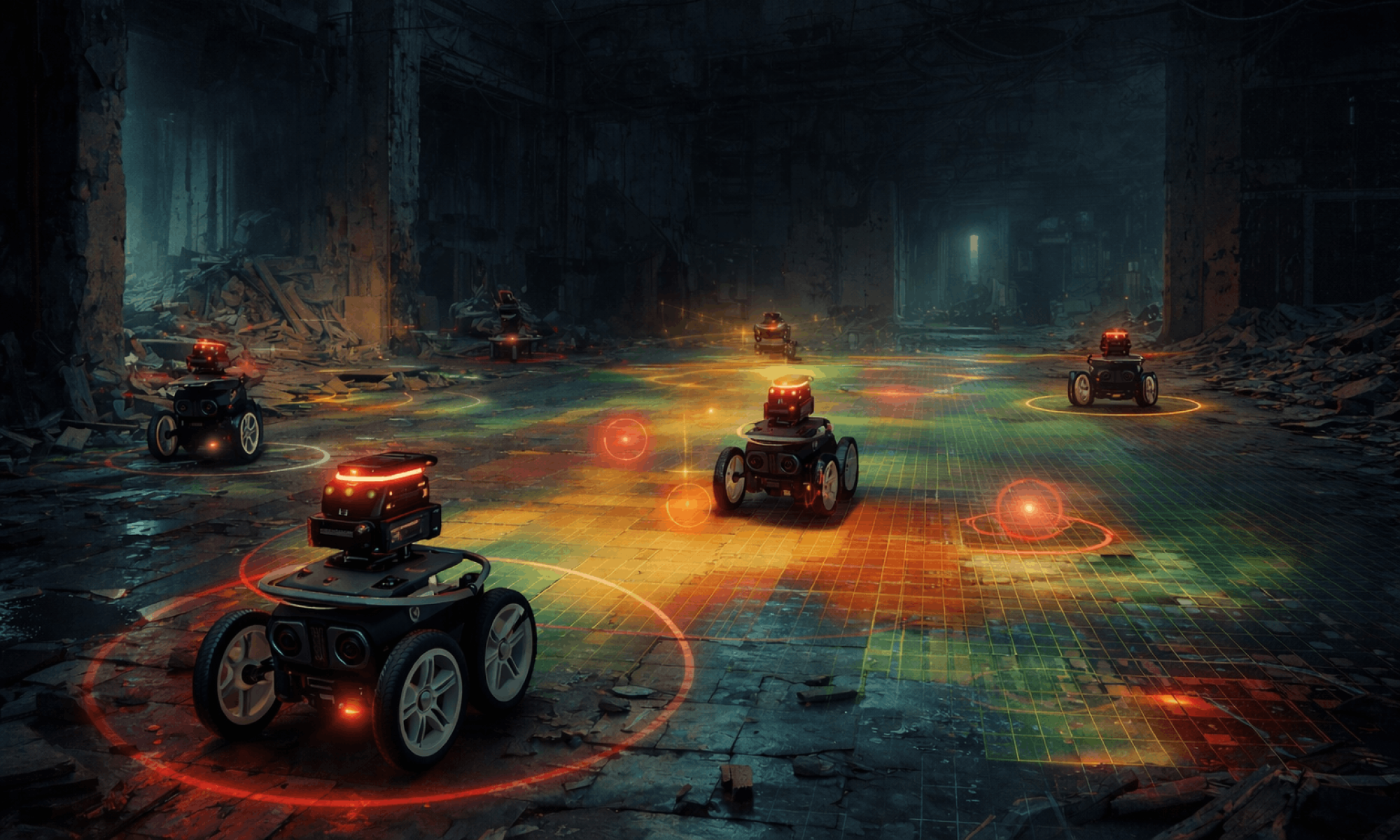
My plan this week was to wire Vector Field Histogram (VFH) into the live navigation loop and make frontier-based exploration visible on the tactical map so the operator can see both where coverage is growing and where the swarm is pushing next.
Across the four images, exploration grows from a small green pocket with a partial red wall outline to a fully mapped space whose OCCUPIED boundary cells form a complete red perimeter where LiDAR marks FREE interior and stamps OCCUPIED where rays hit the map edge. Teal trails stay in free space and skirt those red cells because VFH turns the global heading toward each frontier centroid into a locally safe steering angle via a polar obstacle histogram, then kinematics plus grid collision keep bots out of walls. The heatmap blooms track visit density and pile up at the leading edge of the dark UNKNOWN region, matching frontier detection (FREE cells next to UNKNOWN cells); as the frontier collapses, the map fills with green and the bright coverage fades, showing frontier-following exploration with obstacle-aware motion end to end. Once the entire map is covered with labeled/colored cells, the bots return to the base station without hitting OCCUPIED cells along the way.


VFH is implemented in src/exploration/vfh.ts, which builds a 72-sector polar obstacle-density histogram from nearby OCCUPIED cells, thresholds sectors into a blocked mask, finds contiguous free “valleys,” and picks a steering heading that stays aligned with the global goal while avoiding obstacles. The simulator (mockDataSimulator.ts) now uses this on every step: for each bot, it computes the heading toward the assigned frontier centroid, runs computeVfhHeading, then projects a short virtual waypoint along vfh.steeringHeading so the existing proportional kinematics controller tracks a VFH-safe direction. Map polygon bounds and grid-based collision resolution still apply after the move, so local avoidance and global feasibility stay consistent. Unit tests in vfh.test.ts cover histogram construction, valley finding, and end-to-end computeVfhHeading behavior.

Note that currently, the full histogram is not drawn as a separate UI panel; it powers motion in the sim. Exposing a small polar plot or debug overlay would be optional follow-on work.
Frontier logic is unchanged in principle, but the store now carries explorationGrid and frontierClusters each tick, and MapCanvas.tsx layers them so the algorithm is visible:
Status & next steps
Integration is on track: VFH is in the control loop, frontiers are fed from the same grid the sim uses, and the map reflects both. Next: optional debug visualization for the live histogram, tighter tests between VFH + multi-bot assignment under clutter, and (if needed) performance tuning of sector count / active radius for the target update rate.