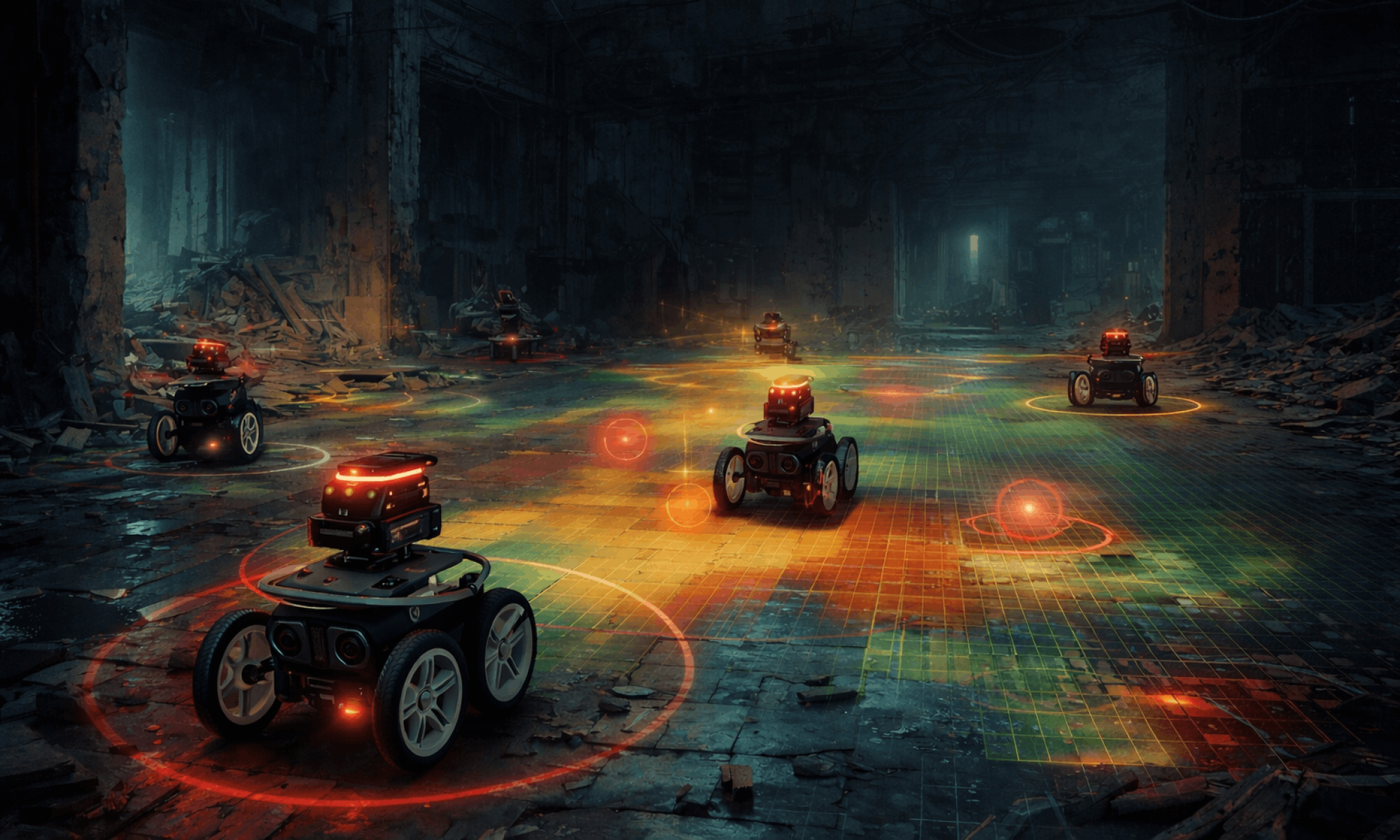
This week, I shifted focus from the visual dashboard to the exploration logic, building out the 2D simulation and test suite that will eventually drive real bot behavior. The goal was to extract the navigation brain from the simulator written before into testable modules and to validate that the full pipeline (sense → reason → move) actually produces growing map coverage in the environment.
The simulator’s BFS coverage loop was replaced with a proper frontier-based exploration stack, split into four independent modules:
lidar.ts: Simulates a 2D LiDAR scan from a bot’s current position. Casts 72 rays at 0.35m increments out to an 11m range. Each ray marks traversed cells FREE in the occupancy grid and stamps the last in-map cell OCCUPIED when the ray exits the map boundary, giving the grid a sense of walls.
frontiers.ts: A frontier is any FREE cell that has at least one UNKNOWN 4-connected neighbor still inside the map boundary, which represents the edge of explored space. This module detects all frontier cells, then groups them into 8-connected clusters via BFS (sorted largest first). It also computes an information gain score for each cluster by simulating a read-only LiDAR cast from the cluster centroid and counting how many unseen UNKNOWN cells would be revealed if a bot navigated there. This drives the “go where you’ll learn the most” behavior.
targetSelection.ts: The assignment layer. Each bot is scored against every eligible frontier cluster using the formula distance / (1 + informationGain), which naturally biases bots toward high-yield frontiers nearby. A shared claim map prevents two bots from targeting the same centroid. The swarm-level assignFrontiersToBots function sorts clusters by information gain descending, then greedily assigns the nearest unassigned bot to each, ensuring coordinated coverage without communication overhead.
navigation.ts: A proportional heading controller. Given a bot’s current pose (x, y, θ) and a target position, it computes a new heading and position for one timestep with a turn rate cap. Collision resolution is handled by the existing resolveMapCollision utility from mapLayout.ts.
Test Suite Execution
 Terminal output from npm run test showing 7 test files (24 tests) passing in 483ms: mapLayout, frontiers, integration, lidar, navigation, smoke, and targetSelection.
Module High-level Architecture
The diagram shows how each test suite maps directly to its extracted module, all of which feed into the mockDataSimulator. The simulator is now a thin consumer of these modules rather than the place where logic lives, making each concern independently tunable.
Progress is currently on schedule. Next week: wire the frontier modules into the live simulator, begin the WebSocket telemetry bridge, and add CI to run the test suite on every push. Also, start planning to integrate the Vector Field Histogram for real-time local obstacle avoidance.