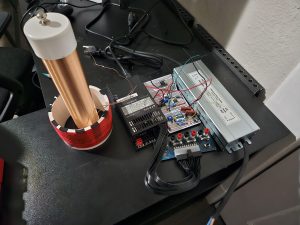
Throughout the last two weeks, all parts were delivered, though many of the circuit components have not yet been received. While this does place us slightly behind schedule, we intentionally spaced our schedules in such a way to allow for some timing errors to happen, and believe that it should not create much affect. Coil assembly is underway, and is expected to be completed alongside circuit assembly when we meet on Monday 03/09/2026. Then the rest of the week can be dedicated to testing.
The current greatest threat to success that has been identified is proper winding of the secondary coil. The wire is thin, and many windings must be made tightly, however this is being done by hand, so some error is expected. This issue has already been accounted for though; we gave the Schmitt Trigger Oscillator such a large tuning range to account for resonant frequency misalignment between the coils, which we expected to be exacerbated by manual assembly.
One minor change has been made to the design, which is the inclusion of hot glue and electrical tape to hold the coil windings in place. Again, following from manual construction, it is very difficult to keep the windings in place without some form of adhesive.
Though we are slightly behind schedule, this was somewhat expected, and as such, no changes have been made to the schedule.
We were also asked to describe the product again in multiple ways, and these descriptions can be found below. Description A was written by Jayson, Description B was written by Jack, and Description C was written by Caleb.
A) The Musi-Coil system was designed to address a need that exists beyond the academic setting, which is making high-voltage electrical phenomena accessible, safe, and engaging to general audiences. Traditionally, Tesla Coils have been large and dangerous, only operable by specialists with significant training and access to industrial facilities. This design deliberately deviates by using a safe 48V supply, and much smaller coils, which will produce arcs that are visually striking but don’t carry large enough amounts of power to significantly harm someone. This makes it suitable for usage anywhere, be that schools, public maker spaces, or at home, not just in industrial labs.
The audio modulation capability further broadens the Musi-Coil’s global appeal by transforming a purely technical demonstration into an artistic medium. The ability to play recognizable music through plasma attracts significantly more attention, and makes it more engaging to a broader crowd, not just those who already understand the underlying electromagnetic principles. This allows the Musi-Coil to serve as a device for boosting overall STEM engagement worldwide, serving to increase STEM engagement which is extremely low in many areas globally. By using readily available, off the shelf components, the design is reproducible by hobbyists but also affordable, which reduces the barrier to providing more interesting and exciting ways to get people to engage with physics and electrical engineering.
B) Though the Musi-Coil isn’t explicitly suited for this purpose due to its compact size, it serves as a prototype for more culturally impactful implementations, such as in entertainment installations like night clubs or live music venues. Night club culture often emphasizes immersive audio-visual experiences where lighting, music, and visual effects work together to enhance the atmosphere of the performance. Because the product generates visible plasma arcs in response to music, it could be scaled up and integrated into stage or club environments as a unique visual implement. With an installation this large, the arcs would modulate with the music, creating synchronized electrical discharges that visually represent the sound being played. This aligns well with nightclub culture where audiences value novel and dramatic visual effects.
However, cultural expectations surrounding safety and accessibility would still need to be considered. Music venues are typically densely populated spaces with large audiences, so any scaled version would require appropriate shielding and arc-control mechanisms to ensure safe operation, especially for those with devices such as pacemakers. The current design already prioritizes controlled arc length and stable operation, though using methods which may not translate as well to larger installations. Regardless, by considering both entertainment and safety norms, the Musi-Coil could serve not only as an educational demonstration but also as a culturally relevant visual performance device.
C) The Musi-Coil has only one major implication on the environment, power consumption. As is well known thanks to decades of research on global warming, higher power consumption items produce a higher need for power production, which in most areas is not done using clean energy. While the Musi-Coil is not nearly large enough to create a noticeable spike in strain on the grid or increase in power consumption needs, it is considered good practice environmentally for all people to consume less power personally. As such, the Musi-Coil meets this good practice through a very efficient design.
In designing this high voltage product, a major concern was power efficiency. Since we intended for this to serve primarily a demonstrative purpose, we needed the Musi-Coil to be usable in any commonplace setting, and operate properly when plugged into a wall. This meant power consumption needed to be kept low enough as to not trigger a standard breaker, which trips at 1600W. What also influenced our power consumption decisions was user safety, as even though our product produces high voltage, if it did so with too much power, it would be inherently more dangerous and less controllable. As such, current peak power consumption estimates are only at around 350W, which is equivalent to the charger for a typical high end gaming laptop. Thus we believe that even though the Musi-Coil is not designed to serve some environmental purpose, it is designed to be environmentally friendly.