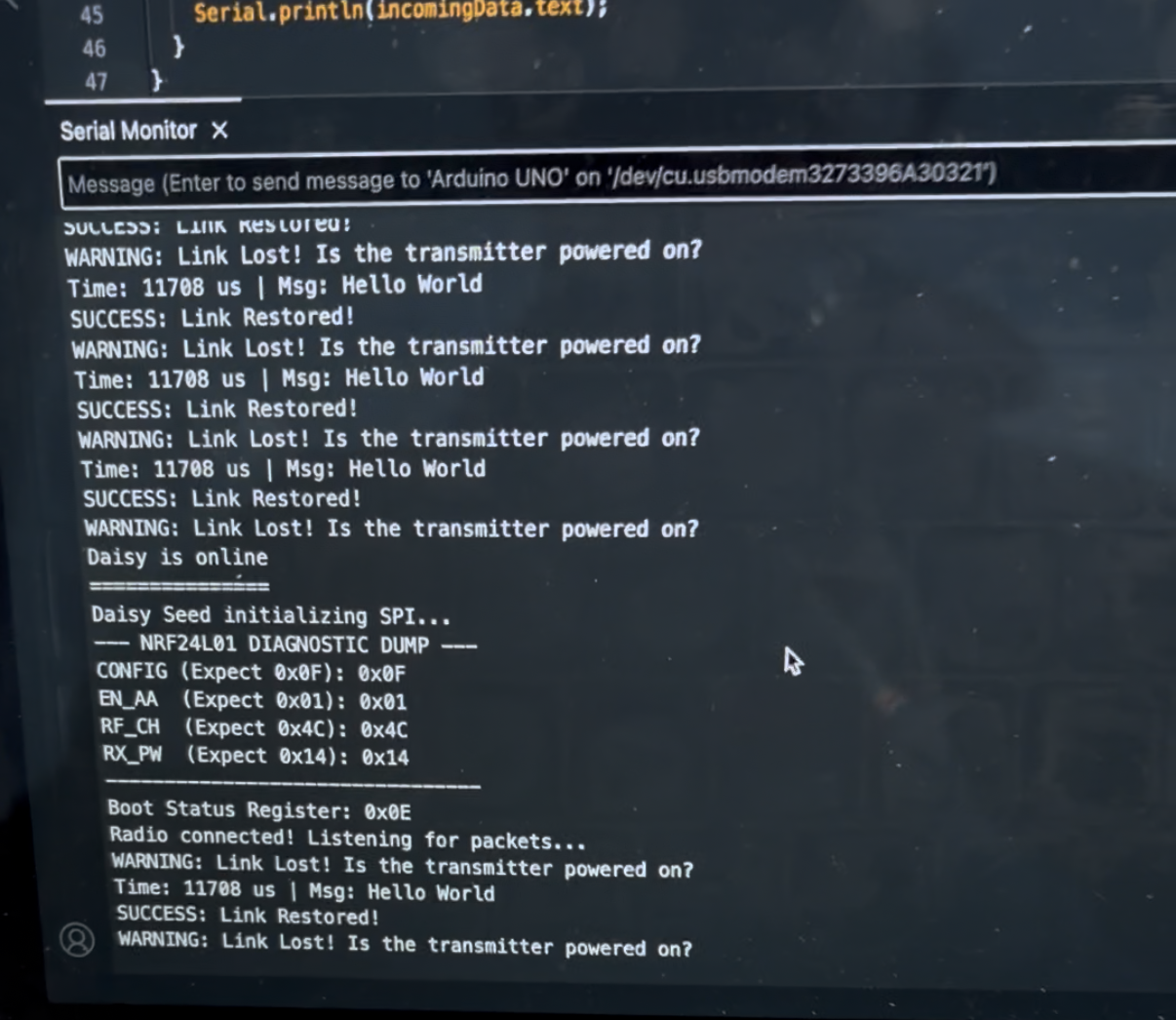
I just went over all the code within the hardware to make sure they had the most updated versions and did not register erroneous double hits. In the test/validation I described in the team status report I achieved a 97.3% no double hit rate on all pads by increasing the debouncing window between hits and slightly increasing the threshold of the hit activations.
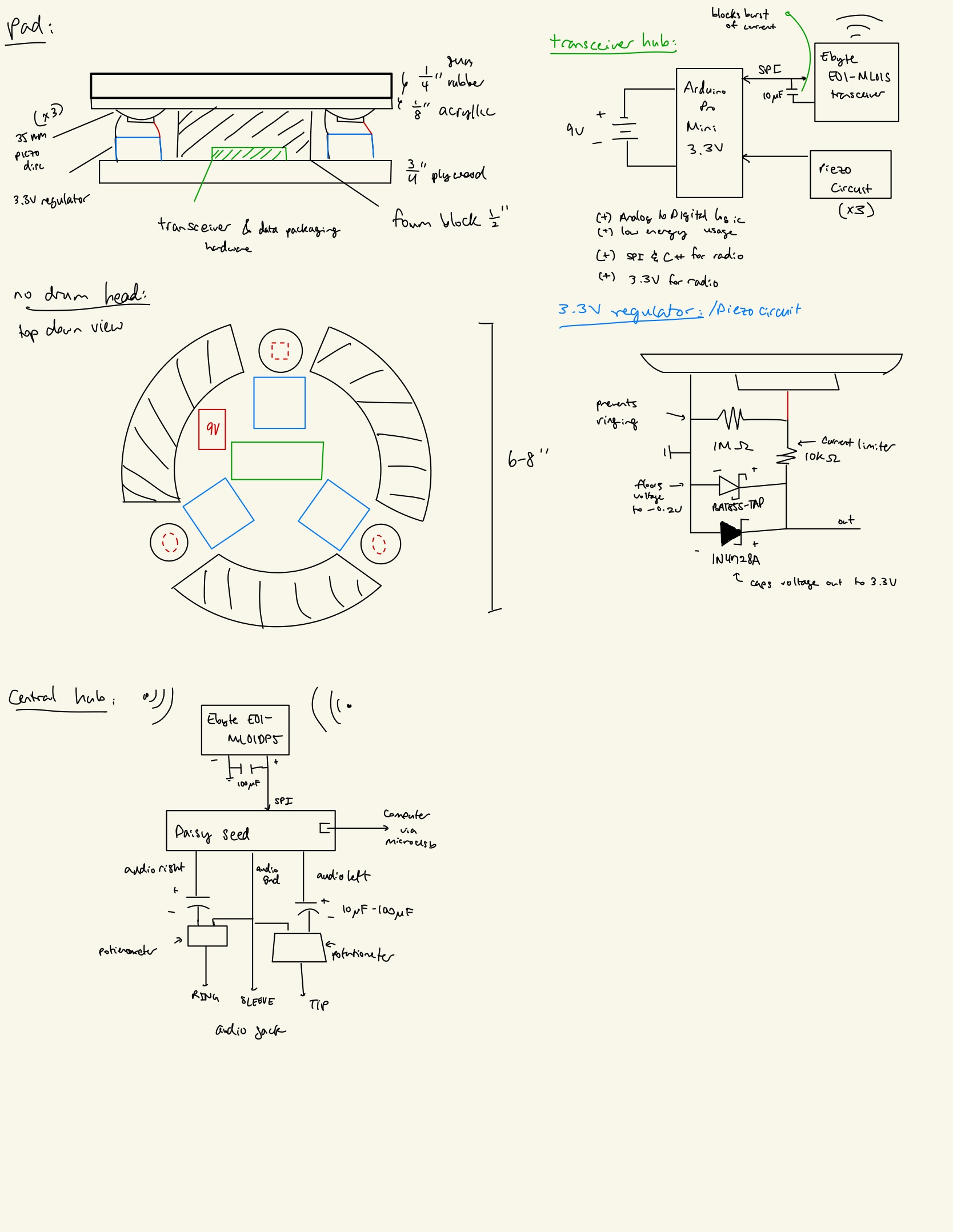
Center hits are classified by having all piezo sensors reading within 1% margin of error from each other. Rimshot hits are classified as having 1 or 2 sensors being greater than 1 V and 1.5 V. An edge hit is classified as at most one sensor being greater than or equal to 1.5V
For center hit: set at 100 bpm we achieved 100% no double hit rate, set at 140 bpm we achieved 92% no double hit rate but 4% missed hits, set at 85 bpm we achieved 100% no double hit rate.
For rimshots: set at 100 bpm we achieved 92% no double hit rate, set at 140 bpm we achieved 88% double hit rate, set at 85 bpm we achieved 100% no double hit rate.
For edge shots: set at 100 bpm we achieved 88% no double hit rate, set at 140 bpm we achieved 83% no double hit rate, set at 85 bpm we achieved 96% no double hit rate.
We hit the target rates (<8% double hit rate) for center hits and rimshots but could not hit it on the edge shots which makes sense because I was not able to procure rubber stoppers in time for the final presentation so when you hit the edge of the drum casing, the vibrations are still preserved rather than being dampened and cause the piezos to pick up twice.
I finished up adding additional functionality to the central hub where it intakes keyboard inputs to set the mode to freeplay (audio generated by daisy seed on its own but needs a 5V 150 mA power supply), interactive game mode (interim demo but having the pads interface via bluetooth to the computer as inputs to a guitar hero-esque game), or multiplayer (a networked multiplayer game where 3 pads are split among the 2 players, each with their own central hub and laptop seeing the same game).
Overall, I would say I got a lot more comfortable looking at documentation especially on github repos and forums for open source resources. It also really consolidated my embedded understanding of nRF32L01+ protocols while trying to find a bandwidth of 2.4GHz WiFi that wasn’t too convoluted or noisy. Lastly, it also really helped with the overall design process; I feel like I practiced the idea of iterative designs well especially for the development of the pads which helped me to really streamline the process and get it done early so that I could focus on other features of the central hub. Also this helped consolidate my interpersonal skills when trying to meet deliverable deadlines as a team and gave me experience in being able to divvy up the work and trust my partners.
In terms of the schedule I am on schedule and have enough slack time to be able to debug anything that arises in final presentation day in time for the actual final presentation for capstone. For next steps, I will try to stress test the hardware to uncover any bugs that I may not be expecting.