Lakshmi’s Status Report for 3/14/2026

What did you personally accomplish this week on the project? Give files or photos that demonstrate your progress. Prove to the reader that you put sufficient effort into the project over the course of the week (12+ hours).

I have now finished integration of the VQF and the SageMotion code, all that needs to be done is to add the testing with the physical device for debugging.

I have also looked through the Apple docs and found how to access the step data if needed.


Is your progress on schedule or behind? If you are behind, what actions will be taken to catch up to the project schedule?

We still need to work through encasing the device for wearable testing, but on my end (signal processing for FPA analysis) we are on track for testing by the end of next week as planned.

What deliverables do you hope to complete in the next week?

Next steps are to integrate the new FPA analysis code with the physical device to ensure functionality before mocap testing.

Rhea’s Status Report for 03/14/2026

What I accomplished this week:

The majority of my time for the first half of this week was spent working on the ethics assignment.

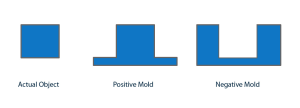
I also further discussed with Iqui about creating the soft case on Thursday; specifically, he gave me suggestions on how to design the mold for the case. I plan on making a case similar to this design:

I have never 3D printed anything before, so I spent a lot of time this week doing research on how to get started with 3D printing and making a CAD design for a mold that can get 3D printed. I went through multiple beginner SolidWorks Tutorials as well as a LinkedIn Learning introductory tutorial to become familiar with the software to use it for making a CAD of the mold.

On schedule? 

No, I am behind schedule for prototype fabrication. The plan was to finish developing a few different versions of the case by the end of this week, but I was set back due to the learning curve of how to use CAD and 3D printing, since I have never done either before. To catch up, I have already done multiple tutorials on how to use SolidWorks, so I feel more confident in being able to easily make a design for the mold. I will meet with Iqui again earlier next week (Monday or Tuesday) to get feedback on the mold design and 3D print it by Wednesday so that the soft case can be completed by Friday.

Objectives for next week:

  1. CAD 3 different versions of the soft case mold to be printed by Wednesday
    1. Meet with Iqui to get feedback on the deign for the mold before printing
  2. Fabricate the soft case using the molds and the liquid silicone that was delivered last week
  3. Write up an official experimental/testing protocol for the prototype testing (treamill walking, motion capture, overground walking scenarios)
    1. Get feedback from Dr. Halilaj if any adjustments need to be made for the experimental protocol before officially conducting tests

Team Status Report for 3/14/2026

What are the most significant risks that could jeopardize the success of the project? How are these risks being managed? What contingency plans are ready?

  • The soft case may not cure well, we have not worked with this material before (same as last week, as we are still in the process of developing the case). 
  • The soft case may cause irritation or absorb vibrations from the LRAs, negating vibration feedback (same as last week, as we are still in the process of developing the case)
    • Contingency plan: We will be experimenting with the different materials and case shapes/dimensions to find the best one in terms of user comfort and minimizing vibration absorption 
  • We plan to have an AWS backend that triggers a mobile app notification when the user’s FPA changes (which will be determined by our FPA algorithm). However, we will most likely encounter many bugs with setting up and initializing the AWS connection with our current app (i.e. setting correct permissions, ensuring proper libraries are added, etc.)
    • Contingency plan: We will reach out to TAs during mandatory lab time with strong experience in AWS if we encounter any significant blockers.

Were any changes made to the existing design of the system (requirements, block diagram, system spec, etc)? Why was this change necessary, what costs does the change incur, and how will these costs be mitigated going forward?

No change was made to the existing design of the project.

Provide an updated schedule if changes have occurred.

  • Soft case fabrication is taking longer than expected due to the learning curve of using CAD software and 3D printing since none of the group members have had any previous experience
    • We originally planned to finish case fabrication by the end of this week, however, we now aim to finish fabrication for the soft case by the end of next week (by 3/20th). 
  • Due to delays in case fabrication this will push back our timeline for starting to conduct testing. We originally planned to start doing motion capture in lab testing/data collection starting this upcoming week, however that will have to be pushed back to the week of the 23rd. 

Kaitlyn’s Status Report for 3/14/2026

What did you personally accomplish this week on the project?

  • Completed Ethics Assignment (Steps 1-3)
  • Added UI element templates (with no backend connection) for our 3 mobile app pages
    • Current Session: current foot angle visualization, short-term FPA line graph, stop/pause session buttons
    • History: past session cards, long-term FPA line graph
    • Analytics: goals / insights text

Is your progress on schedule or behind? If you are behind, what actions will be taken to catch up to the project schedule?

While UI progress on the frontend is somewhat caught up, my progress is still behind since we have not been able to make much progress on implementing and integrating the FPA code. To catch up, I plan to set up AWS while Lakshmi finishes up the FPA script. Then, once both parts are ready, we can piece together the FPA mobile app update workflow.

What deliverables do you hope to accomplish in the next week?

  • Integrate FPA code onto the mobile app backend
  • Set up AWS dashboard for our project
    • Initialize preliminary connection between AWS Lambda and our frontend via API Gateway (ie. send test string’ from frontend and store in backend
    • Conduct background research into AWS Timestream functionality since I have zero experience with the service (unlike AWS Lambda)

Kaitlyn’s Status Report for 3/7/2026

What did you personally accomplish this week on the project?

  • Completed my assigned portions of the design report
    • “Mobile App” subsections in use-case requirements, design requirements, design trade studies, system implementation, and testing/validation
    • Project Management section, including bill of materials table
    • Updated system block diagram figure with connections (ie. I2C, AC)
  • Preliminary outline for UI changes I will make when developing frontend
    • Based on feedback from Prof. Orta-Martinez (ie. only one foot can be analyzed at a time) + our own system adjustments

Is your progress on schedule or behind? If you are behind, what actions will be taken to catch up to the project schedule?

My progress is behind we did not anticipate the design report taking up all of our work time this week. My initial plan was to finish up the report earlier in the week, so I (or we) could spend the remaining days leading up to break on integrating FPA with IMU and updating UI. However, luckily we have accounted for this in our slack time so we still have the opportunity to catch up this coming week. And as Lakshmi mentioned, we should be able to conduct our system testing in parallel saving us some time in the future.

What deliverables do you hope to accomplish in the next week?

(Note that some of these deliverables are the same as last week’s since I was only able to fully complete the design report):

  • Integrate FPA code onto the mobile app backend
  • Add the 3 pages mentioned above (current session, session history, analytics)
    • Focus particularly on FPA UI: regardless of if FPA is properly being measured, the “visuals” should be added to the frontend
  • As an added measure, I will collaborate closely with Lakshmi this week to understand her progress on FPA measurement accuracy/gait detection to ensure the mobile app is properly aligned with the hardware

Lakshmi’s Status Report 3/7/2026

What did you personally accomplish this week on the project? Give files or photos that demonstrate your progress. Prove to the reader that you put sufficient effort into the project over the course of the week (12+ hours).

I wrote the following sections (and drew out their corresponding diagrams) of the Design Review Report:

  • Introduction
  • Use-Case Requirements: Measuring FPA
  • Architecture and Principles of Operation
  • Design Requirements: Measuring FPA
  • Design Trade Studies: Foot-Mounted Wearable
  • System Implementation:  Measuring FPA
  • Test and Validation: Tests for FPA Measurement
  • Summary

After meeting with the PhD students Iqui and Vu last week, I did some more in depth literature review to ensure that the details of the design were consistent with the advice given to us by the Haptics and Biomechanics labs as well as the existing research.

I have also looked into how to integrate Apple Health’s step counter as a secondary check for when to measure FPA. I have a plan for integrating it devised, but I first wish to test the existing FPA analysis pipeline’s efficacy before adding this secondary measure.

Is your progress on schedule or behind? If you are behind, what actions will be taken to catch up to the project schedule?

According to our Gantt chart, we were aiming to complete the mocap setup this week so that we could test out the FPA accuracy. However, we have yet to do a preliminary validation of the FPA algorithm pipeline to ensure that it outputs a reasonable angle, since our slack week was taken up by the design review. However, we are able to do mocap tests and the comfort tests in parallel, so once I get the FPA analysis pipeline initial testing and Rhea gets the device’s case created, we can simply test both at the same time and shave off a week of our testing plans.

What deliverables do you hope to complete in the next week?

I plan to verify the accuracy of the FPA measurements and gait stage detection through simple, rudimentary tests (i.e. changing the position of the breadboard and verifying the FPA measurement aligns, taping the current hardware to leg for rudimentary gait position detection tests). Once these rudimentary tests are completed, I will then sync Apple Health’s step detection feature as a secondary precaution for any accuracy faults.

Team Status Report 03/07/2026

What are the most significant risks that could jeopardize the success of the project? How are these risks being managed? What contingency plans are ready?

  • The soft case may not cure well, we have not worked with this material before. 
  • The soft ase may cause irritation, or absorb vibrations from the LRAs, negating vibration feedback
    • Contingency plan: We will be experimenting with the different materials and case shapes/dimensions to find the best one in terms of user comfort and minimizing vibration absorption 
  • The FPA analysis may be deeply inaccurate, more time may be needed to tune parameters to adjust for each walking pace pushing back test time
    • Will be consulting our two PhD students for what work they’ve already seen in the space of FPA analysis, what research papers have documented precise error ranges so that I can go into finetuning and developing the FPA analysis algorithms with a base line knowledge of error rate

Were any changes made to the existing design of the system (requirements, block diagram, system spec, etc)? Why was this change necessary, what costs does the change incur, and how will these costs be mitigated going forward?

No change was made to the existing design of the project.

Provide an updated schedule if changes have occurred.

N/A

Part A (Rhea): … with consideration of global factors. Global factors are world-wide contexts and factors, rather than only local ones. They do not necessarily represent geographic concerns. Global factors do not need to concern every single person in the entire world. Rather, these factors affect people outside of Pittsburgh, or those who are not in an academic environment, or those who are not technologically savvy, etc.

The LKR system addresses the global need for accessible and personalized rehabilitation technologies, in particular for individuals with chronic knee pain. Knee osteoarthritis affects millions of individuals worldwide. In 2050, there will be an estimated 642 million individuals with knee osteoarthritis [1]. Traditional gait retraining often requires repeated visits to specialized rehabilitation clinics with motion capture systems and trained therapists, creating barriers for individuals who live far away from medical centers, have limited financial resources, or cannot easily access consistent care. By providing real time vibrotactile feedback through a portable device, LKR allows users to retrain their gait during everyday walking activities without the need for expensive laboratory equipment. This system supports broader access to rehabilitation tools outside specialized clinical environments. The feedback provided by the device uses simple directional cues rather than complex visual or language-based cues, allowing individuals with varying levels of technological literacy or language backgrounds to interpret the feedback. 

Part B (Kaitlyn): … with consideration of cultural factors. Cultural factors encompass the set of beliefs, moral values, traditions, language, and laws (or rules of behavior) held in common by a nation, a community, or other defined group of people. 

The attitude towards aging in the United States is severely negative, and how we treat our elders reflects that. There is a strong divide between the old and young, and one cause of this is how inaccessible daily life is for non able-bodied individuals. Specifically, knee joint pain can make both daily necessities (ie. transport) and recreational activities (ie. concerts) challenging to engage in. The LKR system broadly addresses this by providing older individuals with the chance to improve their joint health and feel more comfortable and present in their everyday lives.

Additionally, due to our choice of physical components and removing the need for external human assistance, our system is designed to be lightweight and independent. This reduces the cultural stigma of being perceived as reliant or susceptible – empowering older individuals to improve their health on their own terms. 

Part C (Lakshmi): … with consideration of environmental factors. Environmental factors are concerned with the environment as it relates to living organisms and natural resources.

Traditional knee rehab requires patients to make repeated trips to a physical therapist’s office, each visit contributing to transportation emissions and the energy demands of running a large medical facility. LKR shifts knee rehabilitation to the user’s home, avoiding the environmental costs associated with transportation. The small size and low power consumption we have been designing towards to ensure longer battery life also have the added effect of being far less energy-intensive than the large electronic walking harnesses found in medical centers.

Furthermore, we have chosen to build upon an existing piece of technology that almost all patients will own: their smartphone. Rather than creating another, more specialized piece of technology beyond the wearables to process data, by using an existing technology that most patients have access to can reduce e-waste. When a patient has confirmed that the course of their gait retraining has been completed, they can simply uninstall the app, rather than having to throw out another specialized electronic device.

Rhea’s Status Report for 03/07/2026

What I accomplished this week:

This week majority of my time was spent working on the design review report. Specifically, I worked on the following sections: Abstract, Related Works, as well as all the sections related to the shank-mounted wearable and the vibrotactile feedback throughout the report.

I met with Vu and Iqui this week with Kailtlyn to discuss 3 different methods for creating the soft case for the hardware components (outlined here). After this discussion, I decided that the best method for making the case is to 3D print a mold for the case (given the dimensions of the actuator system and the central component) and create the case using the mold and liquid silicone.

On schedule? 

Yes, I am on schedule for prototype fabrication. We recently ordered a second round of parts specifically for the foot-mounted device as well as the soft case, and will begin prototyping different versions of the case after the team is back from spring break.

Objectives for next week:

  1. Fabrication of different models for the case mold. I aim to make 3 versions of the soft case
  2. Solder the new hardware components
    1. 2nd Seeed Studio MCU/IMU
    2. Integrate the on/off switch into the shank-mounted wearable
  3.  Develop vibration command sequences for the left and right LRA and test to see which vibration pattern and waveform is the most detectable

Rhea’s Status Report for 02/21/2026

What I accomplished this week:

I practiced my presentation and presented the Design Review slides on Wednesday.

This week I integrated the second LRA and haptic driver with the current prototype for the shank (last week’s version only had one LRA being controlled by the MCU). This allows for the MCU to send vibration commands to either the left or right LRA using a mux. We also received the parts we ordered, so I was able to connect the circuit to the battery and have it run wirelessly without needing to be plugged into the laptop for data transmission.

After discussing with Dr. Melissa Orta-Martinez as well as a PhD student in her lab, Iqui, I started doing research for how to encase the hardware components that will be the most “wearable”. I looked into different materials to make a soft case compared to a hard case that has been used in previous studies.

On schedule?

I’m on schedule in terms of the hardware for the prototype (putting together both LRAs for the shank component and the IMU for the foot). However, I am behind in terms of fabricating the sleeve/cases for the components to be worn on the user’s leg. This was something I wanted to start this week. In order to make up for this, I will be able to use the slack time we built into our schedule to first finalize the plans for the soft case and order the parts early next week to start fabrication.

Objectives for next week:

  1. Finalize the plans for fabricating the soft case after discussing with Iqui one more time
  2. Order the parts for the soft case
  3. Develop vibration command sequences for the left and right LRA and test to see which vibration pattern and waveform is the most detectable
    1. For now, I will place the entire breadboard and circuit on my leg using wig tape that we have borrowed from Iqui
  4. Complete the Design Review Report

Lakshmi’s Status Report 2/21/2026

What did you personally accomplish this week on the project? Give files or photos that demonstrate your progress. Prove to the reader that you put sufficient effort into the project over the course of the week (12+ hours).

  1. Programmed shank with vibration commands through multiple LRAs via mux
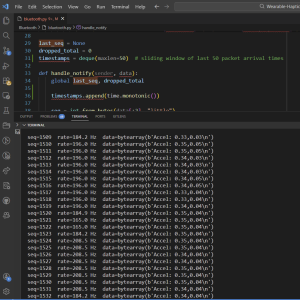
  2. Set up Bluetooth data processing code pipeline on laptop (previously, could only receive IMU data through Bluetooth on the LightBlue app, now we can do post-processing on that data.)
  3. Tested max rate of Bluetooth data transfer (200 IMU data samples/sec) More than enough needed for FPA analysis calculations!!
Bluetooth receiving code on laptop, printing rate of samples received when wearable device is sending IMU data at max rate.

4.  Added VQF filter to process IMU data (mimicking what would be on the smartphone backend, not onboard the wearable device).

Is your progress on schedule or behind? If you are behind, what actions will be taken to catch up to the project schedule?

By the end of this week it was planned that we integrate the foot progression angle code with the IMU input. Our current implementation does send IMU data to the foot progression angle code, but we do not know its accuracy. I still need to test its accuracy (whether through a rudimentary on-person wearable setup or by moving the breadboard). I am still on schedule, as we have planned for slack time for this upcoming week.

What deliverables do you hope to complete in the next week?

While the thorough FPA testing (comparing with mocap) is planned for the week of March 9, I plan to use the Slack time we scheduled for this upcoming week to integrate the filter code onto the device, and verify the accuracy of the FPA measurements and gait stage detection through simple, rudimentary tests (i.e. changing the position of the breadboard and verifying the FPA measurement aligns, taping the current hardware to leg for rudimentary gait position detection tests).

During our group meeting with Iqui and Dr. Melissa Orta-Martinez of the haptics lab, they also mentioned that we could sync/confirm our gait stage detection algorithm with Apple Health’s step counter step detection, so I will be looking at that as well.