Lakshmi’s Status Report for 4/25

What did you personally accomplish this week on the project? Give files or photos that demonstrate your progress. Prove to the reader that you put sufficient effort into the project over the course of the week (12+ hours).

  • Created the FPA accuracy and training effectiveness slides for the Final Presentation slides, added brief explanations for the why behind our testing results
  • Tested the portable treadmill for demo day with Rhea
  • Cleaned up the Github code and revised documentation for the firmware and the laptop bluetooth processing code for future PhD students to build on our device
  • Revised graphs and plotted correlation between mocap and IMU measured FPA for final meeting with Dr. Eni Hallilaj and Dr. Melissa Orta Martinez

Is your progress on schedule or behind? If you are behind, what actions will be taken to catch up to the project schedule?

On schedule.

What deliverables do you hope to complete in the next week?

  • Finish final report
  • Finish final poster
  • Finish final video
  • Do one complete run through of what we’re going to present to judges on demo day.

Lakshmi’s Status Report for 4/18/2026

What did you personally accomplish this week on the project? Give files or photos that demonstrate your progress. Prove to the reader that you put sufficient effort into the project over the course of the week (12+ hours).

  • Implemented scaled feedback dependent on the FPA angle
  • Changed Bluetooth connection workflow so that we no longer have to reset the wearables in between sessions
  • Programmed shank MCU to take in an adaptive encoding for vibration feedback so there is no need to reflash the MCU every time we want to send a different vibration pattern
  • Tested FPA accuracy in mocap lab
  • Plotted FPA accuracy graphs comparing IMU measured FPA with mocap measured FPA to get RMSE (2 degrees!)
  • Tested vibration feedback efficacy (toe-in + toe-out) in mocap lab

Is your progress on schedule or behind? If you are behind, what actions will be taken to catch up to the project schedule?

On schedule.

What deliverables do you hope to complete in the next week?

  • Get vibration feedback efficacy data parsed and graphed
  • Do more testing in mocap lab for vibration feedback efficacy
  • Conduct surveys for vibration effectiveness and device comfort.


As you’ve designed, implemented and debugged your project, what new tools or new knowledge did you find it necessary to learn to be able to accomplish these tasks? What learning strategies did you use to acquire this new knowledge?

We recognize that there are quite a few different methods (i.e. learning strategies) for gaining new knowledge — one doesn’t always need to take a class, or read a textbook to learn something new. Informal methods, such as watching an online video or reading a forum post are quite appropriate learning strategies for the acquisition of new knowledge.

  • I learned how to test documentation thoroughly after setting up the firmware code on multiple MCUs, and how to make the documentation understandable to a layperson (i.e. booting a new XIAO NRF from scratch, without forcing the user to look at the MCU forums) 
    • This was learned through experience in building it because I had to make it as easy as possible to set up the firmware for my teammates
  • I learned how to code and flash firmware onto an MCU
    • Mainly looking on forums to understand how to move from the Arduino IDE to VSCode, and setting up the workflow so that it was extremely similar to running a python file for inexperienced developers
  • I learned how to use Bluetooth UART protocols 
    • Mainly looking the wiki and the pinout to understand the specs for the XIAO NRF Sense MCU
    • Looking at forums for the laptop Bluetooth receiver code
      • Also learned how to use a queueing system for the receiver and transmission code so that you only need to connect once, rather than having the extra latency from connecting and disconnecting
  • I learned the algorithm for calculating foot progression angle, which required a shallow knowledge of kinematics and how to interpret the data from each of the IMU’s axes
    • To acquire this knowledge I conducted literature review over a couple of previous papers in foot progression angle/joint kinematics.

Lakshmi’s Status Report for 4/4/2026

What did you personally accomplish this week on the project? Give files or photos that demonstrate your progress. Prove to the reader that you put sufficient effort into the project over the course of the week (12+ hours).

  • Fixed Bluetooth processing code to include timestamp for synchronization when processing acceleration and gyroscope data
  • Fixed IMU sampling code to resample at 100 Hz for consistency rather than its max (~180 Hz)
  • Ported IMU-data-sending code from designated foot wearable MCU to secondary MCU for further development
    • Updated documentation to ensure smoother code portability (needed to add the external change for making Bluetooth packets 24 bytes instead of the default 22), reformatted as README in Github
  • Added code to connect to both MCUs at the same time (kept code in for receiving data from foot wearable MCU, now can connect to shank wearable IMU to send vibration commands)
  • During group meeting with PhD students: Discussed with Vu the details of testing “convergence”, or the number of steps needed to calibrate the FPA algorithm’s step detection mechanism. Currently, we have the number of steps at 8, but I tested in a small room where I would be turning often. Turning introduces error into the FPA algorithm, so we must now test the calibration while walking in a straight line via treadmill.

Is your progress on schedule or behind? If you are behind, what actions will be taken to catch up to the project schedule?

Progress is on schedule according to updated Gantt chart for demo.

What deliverables do you hope to complete in the next week?

  • Isolate mocap FPA analysis code for mocap testing use
  • Create script to port results into CSV for analysis during mocap testing
  • Determine calibration time length during mocap testing
  • Write scaled vibration command code (that is actually reactive to calculated FPA angle rather than hardcoded)

Lakshmi’s Status Report for 3/28/2026

What did you personally accomplish this week on the project? Give files or photos that demonstrate your progress. Prove to the reader that you put sufficient effort into the project over the course of the week (12+ hours).

  • Met with PhD students Iqui and Vu to discuss methods of shortening the IMU data packet contents so that they could be sent within 20 bytes
  • Finalized stages of mocap testing through discussion with PhD students (needed to test without calibration as well)
  • Fully integrated SageMotion code into the off-device (on laptop) processing of IMU data
  • Tested FPA and rudimentary step detection of SageMotion code by tucking IMU with flashed code under shoelaces, was able to confirm correct step detection
  • Finalized code for LRA vibration demo
  • Finalized code for FPA and step detection demo

Is your progress on schedule or behind? If you are behind, what actions will be taken to catch up to the project schedule?

Progress is on schedule according to updated Gantt chart for demo

What deliverables do you hope to complete in the next week?

  • Test FPA detection accuracy with mocap
  • Understand calibration level difference between mocap and SageMotion

Lakshmi’s Status Report 3/21/2026

What did you personally accomplish this week on the project? Give files or photos that demonstrate your progress. Prove to the reader that you put sufficient effort into the project over the course of the week (12+ hours).

  • Set up Github repo and reflashed firmware onto wearable IMU to test documentation for future developer/PhD student use
  • Edited code for sending different vibration intensities for in-person device demo with our project advisor Dr. Eni Hallilaj
  • Discussed with Dr. Eni Hallilaj the specifics of moving the FPA analysis processing to the app’s backend (rather than the initial assumption it would be on an onboard computer)
  • Lit review of a new research paper sent to us by Dr. Eni Hallilaj that detailed the differences between scaled feedback and pulsed feedback for programming the vibration commands based on intensity
  • Through resources set up by PhD candidate Vu Phan, I set up mocap FPA analysis for the ground truth mocap testing on personal laptop.

Is your progress on schedule or behind? If you are behind, what actions will be taken to catch up to the project schedule?

On schedule considering earlier adjustments. We are not able to start testing FPA accuracy until we have the wearable’s version 1 that can be strapped to the leg. I’m early on getting the mocap-based FPA algorithm testing in thanks to Vu.

What deliverables do you hope to complete in the next week?

  • Move FPA analysis implementation to the backend of the smartphone app, collaborating with Kaitlyn.
  • Get Apple Developer account set up so that we can make the app portable between different devices for independent testing.
  • Get access to mocap room (courtesy of Dr. Eni Hallilaj’s biomechanics lab) to test data pipeline set up on personal laptop
  • Discuss the calibration techniques for FPA analysis with Iqui and Vu

Team Status Report for 3/21/2026

What are the most significant risks that could jeopardize the success of the project? How are these risks being managed? What contingency plans are ready?

  • We have addressed the previous significant risks with the case, as we now have a hard case, hard flex case, and soft flex resin cases. We are now informed of the different vibration effects through these cases and are moving forward with creating soft flex resin cases.
  • The risks with the FPA processing accuracy are still existing, however we will be addressing these risks during the first two weeks of April as we will move forward with testing then
  • (This is from last week, but we still need to work on FPA integration) We will most likely encounter many bugs with setting up and initializing the AWS connection with our current app (i.e. setting correct permissions, ensuring proper libraries are added, etc.)
    • Contingency plan: We will reach out to TAs during mandatory lab time with strong experience in AWS if we encounter any significant blockers.

Were any changes made to the existing design of the system (requirements, block diagram, system spec, etc)? Why was this change necessary, what costs does the change incur, and how will these costs be mitigated going forward?

No changes were made to the system design. 

Provide an updated schedule if changes have occurred.

  • Since we were focused on fabricating the physical cases, we are still behind on integrating the FPA code onto our mobile app. We plan on finishing this up this weekend and early next week. 

Here’s a link to a folder containing all the photos for the case development.

Lakshmi’s Status Report for 3/14/2026

What did you personally accomplish this week on the project? Give files or photos that demonstrate your progress. Prove to the reader that you put sufficient effort into the project over the course of the week (12+ hours).

I have now finished integration of the VQF and the SageMotion code, all that needs to be done is to add the testing with the physical device for debugging.

I have also looked through the Apple docs and found how to access the step data if needed.


Is your progress on schedule or behind? If you are behind, what actions will be taken to catch up to the project schedule?

We still need to work through encasing the device for wearable testing, but on my end (signal processing for FPA analysis) we are on track for testing by the end of next week as planned.

What deliverables do you hope to complete in the next week?

Next steps are to integrate the new FPA analysis code with the physical device to ensure functionality before mocap testing.

Lakshmi’s Status Report 3/7/2026

What did you personally accomplish this week on the project? Give files or photos that demonstrate your progress. Prove to the reader that you put sufficient effort into the project over the course of the week (12+ hours).

I wrote the following sections (and drew out their corresponding diagrams) of the Design Review Report:

  • Introduction
  • Use-Case Requirements: Measuring FPA
  • Architecture and Principles of Operation
  • Design Requirements: Measuring FPA
  • Design Trade Studies: Foot-Mounted Wearable
  • System Implementation:  Measuring FPA
  • Test and Validation: Tests for FPA Measurement
  • Summary

After meeting with the PhD students Iqui and Vu last week, I did some more in depth literature review to ensure that the details of the design were consistent with the advice given to us by the Haptics and Biomechanics labs as well as the existing research.

I have also looked into how to integrate Apple Health’s step counter as a secondary check for when to measure FPA. I have a plan for integrating it devised, but I first wish to test the existing FPA analysis pipeline’s efficacy before adding this secondary measure.

Is your progress on schedule or behind? If you are behind, what actions will be taken to catch up to the project schedule?

According to our Gantt chart, we were aiming to complete the mocap setup this week so that we could test out the FPA accuracy. However, we have yet to do a preliminary validation of the FPA algorithm pipeline to ensure that it outputs a reasonable angle, since our slack week was taken up by the design review. However, we are able to do mocap tests and the comfort tests in parallel, so once I get the FPA analysis pipeline initial testing and Rhea gets the device’s case created, we can simply test both at the same time and shave off a week of our testing plans.

What deliverables do you hope to complete in the next week?

I plan to verify the accuracy of the FPA measurements and gait stage detection through simple, rudimentary tests (i.e. changing the position of the breadboard and verifying the FPA measurement aligns, taping the current hardware to leg for rudimentary gait position detection tests). Once these rudimentary tests are completed, I will then sync Apple Health’s step detection feature as a secondary precaution for any accuracy faults.

Lakshmi’s Status Report 2/21/2026

What did you personally accomplish this week on the project? Give files or photos that demonstrate your progress. Prove to the reader that you put sufficient effort into the project over the course of the week (12+ hours).

  1. Programmed shank with vibration commands through multiple LRAs via mux
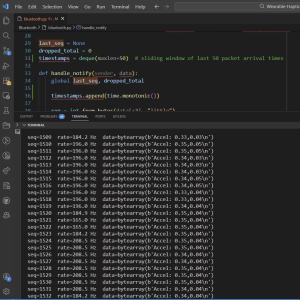
  2. Set up Bluetooth data processing code pipeline on laptop (previously, could only receive IMU data through Bluetooth on the LightBlue app, now we can do post-processing on that data.)
  3. Tested max rate of Bluetooth data transfer (200 IMU data samples/sec) More than enough needed for FPA analysis calculations!!
Bluetooth receiving code on laptop, printing rate of samples received when wearable device is sending IMU data at max rate.

4.  Added VQF filter to process IMU data (mimicking what would be on the smartphone backend, not onboard the wearable device).

Is your progress on schedule or behind? If you are behind, what actions will be taken to catch up to the project schedule?

By the end of this week it was planned that we integrate the foot progression angle code with the IMU input. Our current implementation does send IMU data to the foot progression angle code, but we do not know its accuracy. I still need to test its accuracy (whether through a rudimentary on-person wearable setup or by moving the breadboard). I am still on schedule, as we have planned for slack time for this upcoming week.

What deliverables do you hope to complete in the next week?

While the thorough FPA testing (comparing with mocap) is planned for the week of March 9, I plan to use the Slack time we scheduled for this upcoming week to integrate the filter code onto the device, and verify the accuracy of the FPA measurements and gait stage detection through simple, rudimentary tests (i.e. changing the position of the breadboard and verifying the FPA measurement aligns, taping the current hardware to leg for rudimentary gait position detection tests).

During our group meeting with Iqui and Dr. Melissa Orta-Martinez of the haptics lab, they also mentioned that we could sync/confirm our gait stage detection algorithm with Apple Health’s step counter step detection, so I will be looking at that as well.

Team Status Report 2/21/2026

What are the most significant risks that could jeopardize the success of the project? How are these risks being managed? What contingency plans are ready?

  1.  The code to process the IMU data includes a filter to smooth out noise (VQF filter). This filter was first planned to be on the smartphone as part of the rest of the pre-processing, but after discussions with Iqui and Dr. Melissa Orta-Martinez from CMU’s Haptics Lab, we realized we may need to move the filtering code onto the wearable device, to increase fidelity.
    1. The MCU onboard the device is currently single core, and from Iqui’s experience the current VQF library does not work on a single core MCU. We have a dual core one to switch in that still fits within our size constraints as backup.
    2. We can also sidestep the signal fidelity problem and keep the filter on the smartphone if we are able to send IMU data at a rate above 30 Hz. We will be testing the max rate of information sent through the Bluetooth module on our current MCU as specified in its datasheet.

Were any changes made to the existing design of the system (requirements, block diagram, system spec, etc)? Why was this change necessary, what costs does the change incur, and how will these costs be mitigated going forward?

Other than moving the filtering code onto the MCU, no other changes have been made.

Provide an updated schedule if changes have occurred.

N/A

This is also the place to put some photos of your progress or to brag about a component you got working.

Commands sent to multiple LRAs via mux