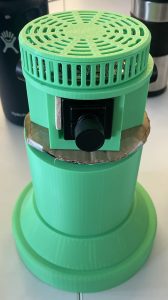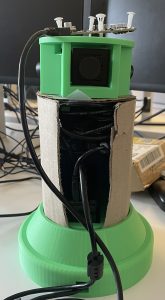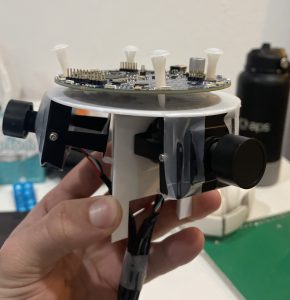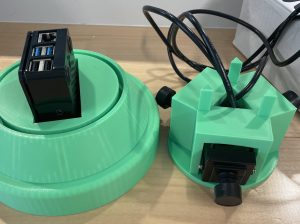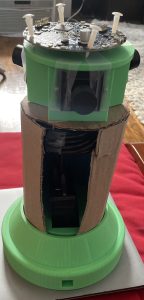
This week, I focused on moving FocusField’s Raspberry Pi meeting-peripheral path closer to a field-ready appliance by improving production hardening, demo readiness, runtime observability, and vision-stack stability on Raspberry Pi hardware. My work was centered on making the system more reliable on the actual deployment platform, while also improving our ability to measure, diagnose, and validate performance under real operating conditions.
A major part of this week’s effort was formalizing the production path instead of relying on ad hoc setup and bring-up. I added a top-level production release gate, boot validation helpers, guided provisioning and recovery workflows, a support-bundle generator, and expanded the Raspberry Pi runbook. As a result, cold boot, service installation, model-asset validation, and recovery now follow a documented and repeatable workflow rather than depending on tribal knowledge. I also introduced separate meeting_peripheral and meeting_peripheral_demo_safe configurations so that we now have a clearer distinction between the production appliance path and a safer, more traceable demo path. These changes make the system significantly easier to deploy, reprovision, and debug on-device.
In parallel, I improved the demo and benchmarking workflow so that readiness can be judged using measurable evidence rather than informal observation. I added demo rehearsal and host-meeting gates, demo A/B capture and panel reporting scripts, bench profiles, scene catalog and labeling improvements, and expanded FocusBench metrics and scoring. The benchmarking stack now evaluates not only core audio quality, but also latency percentiles, queue pressure, output underruns, lock stability, runtime behavior, and conversation-level signals. This gives us a much more defensible way to compare candidate builds and determine whether a configuration is truly ready for a live demo or production use.
I also strengthened runtime telemetry and observability across the live system. The new performance monitor captures stage timing, queue age, audio capture pressure, output health, face reacquisition timing, fallback behavior, and lock-state dwell time. I added a Pi telemetry watch script for longer soak monitoring and updated the UI telemetry and live views so the active detector backend and runtime state are easier to inspect. Together with the support and recovery improvements, these changes make the system much easier to operate and debug under realistic load.
Another important part of the week was stabilizing the face-detection path on Raspberry Pi builds. I fixed YuNet readiness checks across different OpenCV variants, corrected the Haar cascade path probe on Pi, and lowered wide-FOV face-area thresholds across relevant configurations so distant faces are less likely to be dropped on the 160-degree camera setup. These were relatively small implementation changes, but they address exactly the sort of environment-specific brittleness that can make a hardware demo appear unreliable even when the core pipeline is otherwise functioning correctly.
I also expanded automated test coverage in the areas that changed most, including release gates, demo workflows, support workflows, production defaults, telemetry correctness, output-path hardening, and FocusBench metrics and scene handling. As a result, this week’s work was not just about adding scripts and configuration files, but about building a tighter operational story around how FocusField is provisioned, evaluated, monitored, and recovered when failures occur.
Verification
Verification for my subsystem focuses on whether the Raspberry Pi meeting-peripheral path satisfies the engineering requirements for reliability, observability, and runtime performance. The key tests I have run or am planning to run include cold-boot and reboot validation, service-install and model-asset checks, production release-gate execution, failure-recovery testing, and automated tests for configuration correctness and telemetry integrity.
I am also using FocusBench to verify measurable subsystem behavior. For each candidate build, I will analyze metrics such as latency percentiles, queue pressure, output underruns, lock stability, and conversation-level behavior to determine whether the build meets the expected performance thresholds. In addition, I will use long-running soak tests with the new telemetry-watch tooling to detect issues such as queue buildup, runtime instability, or degraded detector behavior over time.
For the vision subsystem specifically, I will verify that the detector path behaves consistently across Raspberry Pi and OpenCV variants, and that the updated wide-FOV thresholds improve distant-face detection without introducing unacceptable false positives. The goal of these tests is to confirm that the appliance path behaves predictably on the real hardware platform we care about, not just in a development environment.
Validation
Validation for the overall project focuses on whether FocusField delivers the intended meeting experience in realistic use cases. To evaluate this, I am using demo rehearsal flows, host-meeting gates, A/B capture workflows, and panel-based reporting to compare candidate builds in realistic meeting scenarios.
The main validation questions are whether the system remains stable during live use, whether tracking and fallback behavior are acceptable in a real room, and whether the audio and interaction quality are good enough for an actual meeting setting. I will validate this by comparing production and demo-safe configurations, reviewing benchmark and telemetry evidence, and correlating those measurements with observed behavior during real meeting sessions.
Analysis of Results
To analyze the measured results, I will compare each run against explicit engineering and use-case requirements rather than relying on anecdotal impressions. For verification, that means checking whether subsystem-level metrics stay within acceptable thresholds for latency, underruns, queue health, detector stability, and recovery behavior. For validation, that means determining whether those measured improvements translate into a more stable and usable end-to-end meeting experience.
I will also use A/B comparisons between candidate configurations to identify whether a change actually improves system behavior or simply shifts problems elsewhere in the pipeline. In particular, I plan to compare production versus demo-safe runs, examine telemetry trends during longer sessions, and correlate runtime events such as queue spikes or fallback activation with user-visible issues such as lag, instability, or tracking loss. This analysis will help demonstrate that my contribution is not only technically functional, but also meaningfully improves the project’s ability to meet its design and use-case requirements.
Schedule
On track with the current production-hardening and demo-readiness push.
Next Steps
Next week, I plan to run the new release and demo gates using real Raspberry Pi evidence, with particular attention to cold boot, reconnect recovery, and meeting-app input selection on the appliance path. I also plan to use the telemetry-watch and demo-safe tracing workflows for longer soak tests, compare production and demo-safe configurations with A/B capture, and continue tuning detector and fallback thresholds until the wide-FOV rig behaves more consistently under live conditions.