
This week I focused on finalizing the physical fabrication of our system. The main work I completed involved laser cutting the base and final enclosure components for the system. This was an important step because it allowed me to move from earlier prototype structures to a more finished and fully enclosed design that can better support testing and demonstration.
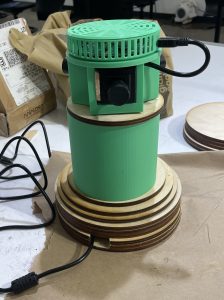
Specifically my work focused on creating a new design for the base of the stand. Instead of relying only on previous fabrication ideas, I developed a new approach using laser cut wooden slices that could be stacked together to form the base component. This allowed me to build a stable structure while also using a more efficient fabrication method. I cut and assembled these layers to create the final base, which now supports the rest of the system more effectively.
In addition to fabricating the base, I also made sure that the enclosure design accounted for wire routing and full hardware integration. I cut holes for the wires and confirmed that the cameras, microphone array, and other necessary components could all remain enclosed while still functioning properly. A major part of this process was ensuring that the system was not only physically assembled, but also operational in its enclosed form.
Plans for Next Week
Next week I plan to continue testing and validating the full enclosed system to ensure it meets all of our design requirements. I will also make any final adjustments needed to improve enclosure fit, wire management, or overall system presentation so that the prototype is fully prepared for demo.
Reflection on New Tools, Knowledge, and Learning Strategies
As I designed, implemented, and debugged my part of the project, I had to learn new tools and new knowledge in several areas. One major area of learning was fabrication strategy. Earlier in the project, much of my work was focused on 3D printed enclosure design, but this week I expanded that by using laser cutting as a practical fabrication method for the final base and enclosure. I had to learn how to adapt my design thinking to a layered construction approach, where individual wood slices could be cut and stacked to form a stable final component. This required a better understanding of how to design parts specifically for laser cutting rather than only for 3D printing.
I also gained more knowledge about physical system integration. It was not enough to simply create parts that looked correct on their own; I needed to ensure that the full hardware system could function while enclosed. This meant learning more about wire routing, spacing, component fit, and how enclosure decisions affect usability and testing. Designing holes for wires and confirming that all hardware could remain operational inside the enclosure helped me better understand the relationship between mechanical design and system functionality.
Another area where I built new knowledge was prototype validation. As the project progressed, I learned that building a physical component is only one step; it is equally important to test whether the fully assembled system still performs correctly. This required me to think more carefully about designing for both assembly and testing, rather than treating them as separate tasks.
To acquire this knowledge, I used several learning strategies. One of the most important methods was hands-on experimentation. By creating the design, laser cutting the parts, assembling them, and then checking how well they worked with the real hardware, I learned through direct trial and iteration. I also used online resources and examples to better understand fabrication options and practical enclosure design methods. In addition, I relied on problem solving through observation when I encountered design constraints, I adjusted the structure based on what I saw in the physical build rather than only relying on the original concept. Team discussion was also valuable, since talking through integration needs and testing requirements helped me better understand how my enclosure work supported the full project.
Overall, this project required me to expand my knowledge of fabrication, enclosure design, and system integration. I learned not only new technical skills, but also how to use practical, hands-on learning strategies to solve real design problems effectively.
Schedule Changes
None.