This week I focused on getting the project ready ready for the demo. We fixed some issues with the following car not going straight by adding weights to counterbalance the weight distribution. This allowed the car to drift less and led to more accurate localisation and odometry data which helped with the movement of the following vehicle. We also ironed out some of the kinks with the path planning of the lead vehicle. To accomplish this we had t fix some issues with the object detection, mainly we created a history of depth values of the detected object and if the object detection spit out a depth of 0, we would simply use the previously detected depth as an approximate. This allows for a much smoother object detection algorithm and more consistent objects for path planning. We were also working on integrating the lead and following vehicle together, however, ran into an issue with the following vehicle’s odometry, which resulted from a faulty optocoupler. In the next few days we have to finish filming the demo of the lead and following vehicles working together.
Jeffrey’s Status Report 1/5/21
This week I mostly worked with Joel and Fausto together on integration. We amended our path planning algorithm to rely on A*, that would be rerun every time an obstacle is found. Therefore, navigation would depend on localisation data, and sending discrete x,y and tile locations that the car must get to. These locations are dynamically updated every time A* is run when a new obstacle is found. After making these changes, we gave the car a straight path, but found that there was significant drift in the car’s odometry data. Therefore, we implemented a PD controller to allow the wheels to get feedback so that the wheel velocities would be fairly consistent. We also developed a ramp up and ramp down period to help with odometry, so there would be a number of steps before the wheel velocities hits the target instead of immediately ramping the wheels to the target velocities. We found better performance in odometry data after implementing these changes. This allowed the car to go straight. We then started integrating object detection and path planning and had some difficulties moving around the object. The issue is with figuring out the next location to go to to change directions. This still needs to be tinkered with as sometimes the vehicle fails to plan around the object but it’s performing well.
Next week we plan to continue to fine tune the path planning and object detection of the lead car, as well as begin to test the following car. Our current ideas is to either send object locations and have the follow car run A* as well, or for the lead car to send the same landmarks that it follows for the path to the follow car. We expect the latter to have difficulties because of the differences in drift between the two cars, but further experimentation is needed.
Jeffrey’s Status Report 24/4/21
This week we focused on finalising the object detection algorithm and porting it into ROS for integration purposes. We originally ran into an issue where the network we were using was too big and consuming too much power and memory on the Jetson causing the frame rate to be too low to be useful. Upon further research, we realised that neural networks on the Jetson are supposed to be developed using TensorRT rather than vanilla Tensorflow. Primed with this information, we went back to the Jetson development page to look at examples of neural networks using TensorRT, and converted the object detection module to use Jetson documentation and TensorRTs. From here, we then ran it on the Jetson Nano and mounted the camera on the car to see if the object detection algorithm was working. We found that using gatorade bottles worked consistently, as in the algorithm could routinely detect and plan around the gatorade bottle. I also worked on converting the object detection algorithm into ROS to be able to integrate and communicate with the other nodes.
In the next few days, we will begin real time testing on the autonomous navigation capabilities of the car, primarily its ability to navigate around obstacles, and we will also begin testing the following capabilities of the following car. The following car will rely on a map that the lead car sends to trace the lead car’s path through the course.
Jeffrey’s Status Report 10/4/21
This week I finalised and began compiling together the python script that does all the object detection. I also did more robust testing for the distance at which an object could be consistently detected. I found that using a small cardboard box, the laptop camera could routinely detect the image at ~40cm away, which is well within our requirements. This was done using OpenCV and using a pretrained MobileNet v2 using the laptop camera. There are issues with latency, however I believe this has to do with the laptop camera and is not bottlenecked by the actual model. Once the object was detected I found a way to draw the bounding box onto the image with additional padding to ensure the entire object is safely encompassed in the bounding box. Furthermore I also began integration with the Intel RealSense camera. There were originally a lot of issues with the realSense documentation, but the object detection system should be fully functioning as of now. The specifications are as follows. The module takes in raw RGB camera feed from the intel real sense, passes it through MobileNet v2 to extract the bounding box and redraw the bounding box information on the depth map. From here we can approximate the width of the object by looking at the edges of the bounding box, and use arctan to find the angle at which to move the car to avoid the obstacle. From here, we can also use the depth map and to update the map of the course in order to facilitate localisation of the car.
For next week, we want to begin integration and porting my module over to ROS and integrating with the car. There needs to be work to figure out the optimal angle at which to angle the RealSense camera to maximise object detection.
Jeffrey’s Status Report 3/4/21
This week I focused on fine tuning the object detection algorithm and began writing the planning algorithm. I had a little trouble downloading all the drivers for the Intel RealSense camera, but managed to get everything installed properly by the middle of the week. After that I experimented with extracting the RGB footage values and using OpenCV to process them into something that MobileNet v2 can use to make object classification and detection decisions. After that I started determining the robustness of the Intel camera by moving it around the room to see if there are any jitters in the feed, to determine the fastest sampling rate at which we can sample from the camera while still maintaining clear images. I found that we can sample faster than MobileNet v2 can process the image, making our lives easy in the future. Starting tomorrow, I will hook up the Intel camera to MobileNet v2 to see what the real time object detection looks like. After that we can start integrating and I can begin determining heuristic values for the planning algorithm.
Additionally, we plan to meet up to figure out what the obstacles will look like and generate realistic feeds from the car to further determine the robustness of the object detection algorithm.
Honestly what does it even matter, you work so hard only to have Jalen Suggs hit a half court shot to win the game.
Jeffrey’s Status Report 27/3/21
This week I mainly focused on the planning aspect of the project. I had to figure out how to use the bounding boxes created by the object detection algorithms to figure out what angle to set the wheels such that the car would avoid the obstacle. The issue was that the bounding box around the object does not contain depth information and thus we don’t know how far the object is. We can assume that the object is a short distance from the car, but this would lead to wide turns around the obstacles and may affect planning if the course is dense with obstacles. Therefore we needed some way to approximate the horizontal distance necessary to avoid the obstacle. Once this is determined, we can use the depth map from the Intel RealSense to create a right angled triangle with depth and horizontal distance as the legs, and the angle created by the hypotenuse and the depth leg would be the angle necessary to turn the wheels. 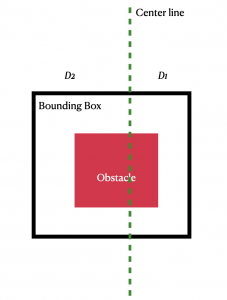
In the diagram above, I let D1 and D2 be the distance from the centre of the image to the edges of the bounding box. I figured if we could scale these distances D1 linearly, i.e apply some affine transformation to it, we can approximate the horizontal distance necessary. This works, since the planning algorithm will only account for the left/rightmost bounding box when making decisions, and since the closest obstacle will be detected at around a range o 0.2m, we can approximate a transformation such that the horizontal distance will not be too far off the true distance, and the vehicle will never collide with the obstacle.
For next week I will go back to object detection and continue experimenting with MobileNet on my laptop and try and integrate MobileNet with the intel RealSense camera.
Jeffrey’s Status Report 6/3/21
This week I mainly focused on finalising some of the object detection algorithms and figuring out what is possible given our limited compute power. I brushed up on CNNs including some of the state of the art object detection algorithms and investigated the possibility of using RGB-D information as part of the object detection. This would mean using depth as well as the image to make detection decisions, rather than simply using the depth information for planning. This led me to read about Faster R-CNN algorithm that uses RGB-D information for state of the art object detection. I read more about it and how it can be used in conjunction with VGG16. The authors of the paper had a frequency of around 5 fps processing rate on COCO datasets using a standard GPU. This is definitely one algorithm I will look more into, however, it depends on the quality of data we can get from the depth camera. Since they used data generated from high quality depth camera such as Intel Real Sense, the point clouds they can generate using the RGB-D information will be much higher quality than what we can generate with a make shift PS4 camera. More experimentation will be needed to see if such algorithms can work even if the RGB-D information isn’t as rich. Looking into VGG16, it seems like a very lightweight and accurate algorithm for our purposes. To get around the problem of the network being trained on real objects we plan to print out pictures and paste them on our obstacles so there isn’t a need to generate a new dataset and retrain the network. We can simply freeze most of the weights and tune the network to give the desired precision and recall.
Moving forward, I want to start generating RGB-D data from the PS4 camera that we bought this week and begin testing object detection algorithms to see what works best and whether or not we need to rethink our approach.
Jeffrey’s Status Update 27/2/21
This week I focused on trying to finalise the design details of our project. After our presentation, we reconsidered the possibility of using LIDAR in our project, and decided against it. The reason for this is cheap LIDAR sensors don’t produce rich enough point maps to make meaningful object detection decisions. The good object detection algorithms require heavy computation and high quality point maps which isn’t possible with the hardware we are planning on getting. Instead we researched and found out a way of manipulating PS4 cameras to work with Python and OpenCV to perform depth calculations. We are heavily considering using this as an alternative to buying Intel Depth cameras since they are expensive.
Aside from this, I also looked into IMU units and found that the BMI160 IMU is compatible with the NVIDIA Jetson Nano. The communication is done with I2C, but supports SPI for faster data transfers. I looked into how setting up SPI would work, since we would want accelerometer and gyroscope information from the IMU fairly often in order to successively communicate with the following car. I also researched a bit on integration and it appears to be fairly straightforward since the BMI160 communicates via MMIO
Moving forward, we want to research more into outfitting the PS4 camera with the Jetson Nano and seeing if the tutorial on getting depth sensing to work is accurate enough. I also plan to look more into algorithms that can do object detection without needing to default to colour filters and painting all our obstacles the same colour.
Jeffrey’s Status Update 20/2/21
This week I mainly focused on finalising some of the details for our project. We met with the TA to discuss some of the details, including what kind of RC car to use, and whether or not we should build one from scratch or retro fit an existing one. After some discussion, we decided to build our own car, since Joel has experience building a car with 4 motors. Furthermore, I also looked into some of the details regarding perception. I looked at previous work where students used LIDAR for object detection, and found out that most used some form of odometry to make the path planning more accurate. I then looked into efficient implement some form of odometry. I considered both using a eagle-eye camera and also hall-effect sensors, as both technologies have been used for autonomous RC cars in the past.
Looking forward, I want to finalise and discuss the odometry setup and continue finalising parts and start looking into possible perception algorithms.