
This past week I spent a lot of time working on fixing high frequency noise in the controller. I noticed quite a few oscillations around the setpoint which I hypothesized were being caused by high frequency noise in the gyro that was interacting with the D term. To solve this, I implemented a Exponential Moving Average on the gyro readings in order to smooth them out (although this causes a bit of lag) and implemented a variable gain schedule to provide better stability. We are very close to hovering
Ankit’s Status Report for 11/30/2024
The Thanksgiving Break for me was quite productive. I brought home all of our stuff in order to be able to work on teh project and I made quite a bit of progress. I made two major changes to the software pipeline: 1) the complementary filter implementation we were using originally suffers from drift in the presence of high frequency noise in the gyroscope (which will happen on a drone) and so I properly implemented a kalman filter based approach that results in next to no drift for the IMU and 2) I realized that our original formulation of the PID which was to minimize the error in the angular position of the drone is very unresponsive and not how it is done on professional drones. Instead, these drones implement a rate controller which minimizes the error in angular rate, which is what I changed my PID implementaiton to. With this, our drone is now very stable in both roll and pitch and we are close to trying a hover test after we integrate the radio comms to allow for autonomous takeoff and landing.
We still have about two weeks to demo day and while this is definitely crunch time, I think the immense progress made over the break will help us finish this project.
Ankit’s Status Report for 11/09/2024
This past week was very productive. We started off facing an issue where one of motors seemed to not be spinning. After some diagnosis we realized that this motor was probably dead from an earlier test where it had smoked up, causing us to have to replace the motor. Then, I changed the formulation of our Kalman Filter based state estimation as Kalman Filters require a prediction step that is very hard to encode for through quadcopter dynamics. Instead, I changed to a Complementary Filter, which is a measurement only approach that combines gyro and accelerometer readings essentially through a linear sum. After some quick tuning, this worked very well. Finally, i added in a safety mechanism where if the throttle stick is set to zero, then regardless of the PID outputs the motors stop spinning. This is necessary to ensure our safety during PID testing.
This week will finally all be PID tuning. We will setup a mechanism by which the drone is hanging from a string, fully unsupported, turn on the drone, and hopefully see if balance as we tune the PID gains. I am a little worried about the little time we have to tune both the pitch and roll gains, considering our interim demo is next week, but I do think it is possible.
I believe I am a bit behind schedule as I was hoping to get to PID tuning last week but because of the motor issue and the reformulation of the Complementary Filter, I wasn’t. That being said, I have set aside this entire week to work on PID tuning for the drone, so I think if I put my head down I can make it work.
Ankit’s Status Report for 11/02/2024
This past week was quite productive. I spent the week building the electronics of the frame and getting the motors tested. I started by writing some code to control the ESCs via Arduino PWM and then created a small test setup to verify the motor speed could be varied. Then, I got our transmitter to transmit to the arduino through a receiver, and while our drone is autonomous, this setup will be used to test our PID manually. Finally, me and Bhavik soldered the ESCs to the power distribution board built into teh frame and tested all four motors together. The entire setup works and we now have a drone with motors that spin.
This upcoming week, I will spend time actually tuning the PID and merging in the kalman filter state estimation. The goal is to tune the PIDs for roll and pitch to teh point where we can have stable hover flight, with throttle controlled by the transmitter. I think this will be an ambitious goal, but we should be able to accomplish it.
After the intense progress of this week, I believe I am on track.
Bhaviks Status Report for 11/02/2024
This week was mostly spent on building the actual drone and connecting all the electronic components. We began the week by putting the entire drone frame together. Once we had the basic drone frame together, we had to connect all the ESCs to the motors. Once this step was complete, I worked with Ankit to solder all the wires to the power joints. This involved soldering the wires, running a continuity test, and finally doing a final test with the actual power on. After soldering and performing a continuity test on all the wires, we were able to verify that the wires were placed in the correct spots and that there was no short circuiting. Then we plugged in the battery could see the motors were powered. This signifies that we can properly power the drone and have all motors working.
We then began to run basic tests on the ESCs by plugging in the motors to the ESCs and connecting the ESCs to an arduino. We also had a drone receiver connected to the arduino. We programmed the arduino such that it would take the input of the drone controller and equally power the motors. Ex, if we are at full throttle, all the motors would be spinning at its fastest rate. We ran the program and confirmed that the drone motors were correctly responding to the inputs. The next step would be to test the pid control code by hanging the drone and checking if it can be stable. If not, we will need to fine tune the PID control system. This part of the project is at the highest risk right now since the rest of the project relies on this aspect working. If the drone is able to be controlled in a stable manner, the path planning should hypothetically be simple.
In regards to the computer vision aspect of the project, we were delayed due to the switch we made to the Rasberry Pi 5. The parts arrived at the end of the week and we are currently working on setting up the pi. This process hopefully shouldn’t take too long. I will be prioritizing this step next week and getting the computer vision algorithms up and running on the pi.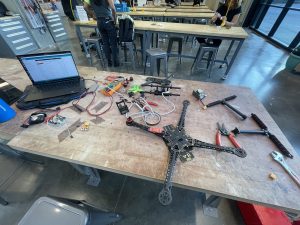
Ankit’s Status Report for 10/27/2024
This past week I focused on reformulating the kalman filter. As I stated last week, our original formulation for the kalman filter was entirely wrong and so I spent significant time this week rederiving the dynamics equations for the quadcopter and understanding how to properly incorporate the gyro and accelerometer measurement updates into the state estimate. This led to a very productive week but I need to figure out how to properly tune the process and measurement noise variables in order to ensure that the state estimation does not lag the real variable.
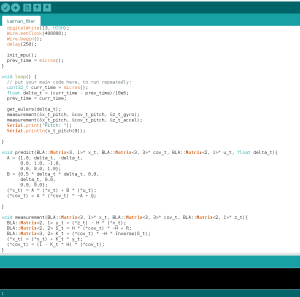
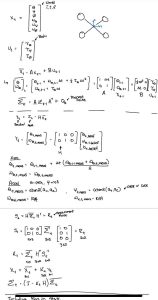
This upcoming week I will focus heavily on tuning the kalman filter. Additionally, now that Bhavik and Gaurav were able to assemble the frame, I will be able to test out my code for controlling the drone motors. This is some boilerplate code I have lying around from a previous project. This should allow us to delve pretty heavily into tuning PID which is the next major step of our project and something that needs to happen quickly so we can get to actual flying testing.
Ankit’s Status Report for 10/20/2024
The week before Fall Break, I spent quite a bit of time on the design report. This included writing a lot regarding the system architecture as well as some of the principal design choices we made regarding the hardware and software of the drone. Additionally, I realized there was a huge problem in the formulation of the kalman filter (essentially in our state update step we were doing a double integration of acceleration to retrieve position, however this is especially error prone to drift and highly not recommended). As a result, I changed the formulation of the kalman filter to include the linear and angular velocity in our state which should make our state estimation a whole lot more stable.
I am currently behind because of this additional work that was needed for the kalman filter but this sort of learning and iteration was expected given that we are designing our own control system and state estimation. I’m hoping to finish up all kalman filter stuff this week then move onto to final integration onto the drone specifically regarding tuning the PID loops. Now that we have hardware in hand, this sort of functional testing is possible and we will be focusing on this over the next several weeks until the demo in November.
Team Status Report for 10/20/24
Gaurav did Part A, Ankit did Part B, Bhavik did Part C
The most significant risks that could jeopardize the success of the project are scheduling issues. Trying to make the first demo is definitely a time crunch, and we have lots of work left to do. The way we are managing the risks is by keeping each other accountable to make sure we stay on track. Our contingency plan for the demo is to just show the object detection working and the drone flying, and have those two subsystems be put together for the next demo.
There have not been any existing changes to the design of the system. Although we have lots of work to do, we should still be able to meet the deadlines we have set for ourselves to make the first demo.
Part A:
The search and rescue drone addresses critical global needs such as usage in disaster search and rescue scenarios. For the target audience, search and rescue teams, time is of the essence and we are able to greatly minimize the time spent searching for the target by introducing our drone into the search process. By using object detection technology and integrating the processing power of the Kria all on the drone, we are able to get rapid autonomous detection of stranded individuals and maximize the area covered in given period of time.
With respect to how our solution caters towards those who do not necessarily have a technical background, our solution will start searching as soon as the drone is turned on. It will run its start sequence, rise into the air, and start the lawnmower search. This makes our product extremely useful for non-specialized teams or SAR teams in remote regions who do not have access to highly specialized equipment or a technically proficient staff. In this way, it scales to meet the global demand for effective, autonomous emergency response systems and greatly improves disaster preparedness around the world.
Part B:
From a cultural perspective, it is the goal of governments (both federal and local) to provide safety for their residents. For coastal communities, this involves providing search and rescue for any people lost at sea or on another body of water. However, a common theme across search and rescue, especially over bodies of water, is that it is an expensive proposition. By creating this low-cost SAR drone, we are hoping to enable communities, regardless of income level, to provide safety for their residents.
The other cultural aspect of our project is that we want to maintain privacy, and so all computations related to the person detection are done onboard the drone. This means no camera footage is saved or offloaded which allows us to maintain the privacy of any people being detected at sea or any rescue crews that might show up at a later period of time.
Part C:
The autonomous SAR drone aims to help find missing people in an ocean environment, and as such, it is important we minimize the disturbance caused to the marine life and ecosystem during operations. We have designed the drone such that it doeesn’t have to interact with the ocean environment at all. Given that all the necessary components are onboard, the drone simply has to fly above the ocean environment without having to physically land or make contact with the water. This allows us to avoid interference with aquatic animals and the ocean ecosystem.
Furthermore, in order to reduce disturbances, we have designed the drone to have a small mechanical footprint made from carbon fiber. This will ensure that the drone is very light and can more efficiently make use of the battery power on board. Additonally, we have selected efficient yet quite drone motors such that noise pollution is reduced, thus helping avoid disrupting aquatic life. In regards to powering the drone, we have elected to use a recharable battery, this allows us to reduce wastage and reuse the tools hardware for multiple flights.
Bhaviks Status Report for 10/19/2024
The majority of the week went into working on the design review report. For this report, I worked on various sections of the paper including introductio, use case, architecture and many more. I spent quite some time with my team to understand the feedback received from the design presentation and discussed if any changes were required to the original plan. We incoorporated any needed feedback and wrote up a comprehensive design report.
I also put some time looking into interfacing with the xbee radios to begin communication with the drone. In order to test any of the code I wrote, I need the hardware first. Therefore, I placed orders for two radio devices (one for the drone and one for the base station – my laptop). I am on schedule but will need to put in some extra effort next week to make sure my code is working as expected. Additoinally, our previous order has come in and I was able to get a small start on looking into buildling the actual drone frame. This work will continue next week with the team to finish building the frame and attatching the motors for testing any initial code.
For the next week, Gaurav and I will work closely to get the vision system working on the Kria. We will uplaod the model weights to the kria and hopefully get it running. We will also build out the frame as a team to get started on testing if possible.
Ankit’s Status Report for 10/05/2024
This past week, I continued work on tuning the process and measurement noise for the Kalman Filter and working to interface with the motors. Specifically, this week I looked into the PPM interface and realized that this is quite similar to a PWM implementation. I found some open source code online that generates the PPM signal and used an oscilloscope to verify that the pulses generated make sense. I wasn’t able to test with our actual drone ESCs and motors because the parts have been delayed in arriving but once those come this week I should be able to test.
I will admit I am a bit behind right now. I’m having some trouble understanding how to tune the process and measurement noise for our Kalman Filter. Measurement noise I understand can be empirically calculated through data analysis of our IMU measurements but process noise is something I’m struggling to figure out how to tune. Additionally, our parts not arriving this week has really set us behind. We are hoping to get parts next week.
This week I will focus on hardware testing. We got confirmation from the ECE receiving desk that the parts should arrive this week so I am hoping to actually do the testing this week. If we can get the Kalman Filtering working with drone motor control by end of Fall Break, I’m confident we will be back on schedule