Team Status Report for 12/07/2024

The most significant risks that could jeopardize the success of the project are the PID controller not working and various filtering issues. Currently we are running into issues with the PID not able to get the drone to hover exactly level, instead it is drifting off to the side. We are managing these risks by working on the drone itself as diligently as possible to showcase the controller working to some degree.  We have enough to showcase at the final show, but our contingency plan is to make the drone manually controlled.

The major change that we have made to this system is using a manually controlled drone to showcase the PID controller. This change was necessary as we cannot immediately get the lawnmower operation working even though we have the algorithm ready. Our new schedule is having everything done by Wednesday.

Unit tests for CV:
* Yolov8n is able to get camera feed
* Yolov8n is able to detect any object (can be wrong)
* Yolov8n is able to detect any object correctly
* Yolov8n is able to detect object we want to detect
* Yolov8n is able to detect object image coordinates correctly

Unit Tests for Tracking:
* Tracking is able to receive image input
* Tracking is able to receive image coordinate for bbox
* Tracking is able to parse the inputs into ints
* Tracking is able to ouptut the distance vectors from the object detect
* Tracking is able to compute the direction

Unit Test for Radio:
* Radio is able to receive bytes
* Radio is able to send bytes
* Radio range testing

Unit Tests for Drone IMU:
* Drone IMU calibaration
* Drone IMU Kalaman filter outputs correct values
* Drone IMU Kalaman filter with IMU reading cause no drift
* Drone IMU maintains correct readins after vigorus movements
* Drone controlls operating at 200+Hz

Unit Tests for Drone PID:
* Drone PID controller is able to get set point error
* Drone PID controller is able to utilize kalman filter data to calculate D
* Drone PID controller is able to calculate error required for I value
* Drone PID controller shows the drone trying to compensent with only P value
* Drone PID controller shows drone’s leveling gets dampned with addition of D value
* Drone PID controller shows I value is able to take care of steady state error

Raspberry Pi enclosure
Drone midair
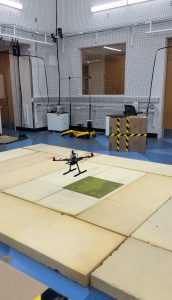
Drone Hover Test

Team Status Report 11/30/2024

The most significant risks that could jeopardize the success of the project is getting the PID controller working. We recently had a major breakthrough in the calibration process and we have two axes currently working with our setup. We hope to have a hovering drone soon. Although this is behind schedule, we have the path planning code and the tracking code ready to use as soon as the hovering drone part is working. We are managing the risks by having absolutely everything else ready.

No major changes were made to the design of the system.


Team Status Report 11/16/2024

Currently, the biggest risk that could jeopardize the success of the project is the PID controller. All the AI inference and electrical hardware is able to accomplish the desired function but all that is remaining is to mount it on the drone. The way we are managing these risks are by focusing solely on the controller while also investigating back ups that may be easier. Gaurav, Bhavik and Ankit are all going to only be working on the PID controller from now on to try to get it ready in time for final demo. Our contingency plan is to use the Pixhawk flight controller which comes with all the necessary hardware on it. This should theoretically be easier to calibrate to get the drone to fly stable.

No changes were made to the hardware design as of now. If we ever have to use our contingency plan, we will have to change the requirements to incorporate the Pixhawk. For software design, we did make a change to the model we were using. When trying to compile the balloon detection model for the Hailo-8L accelerator, we were having trouble parsing through all the documentation. However, there was a pre-trained, pre-optimized model already available in the provided model zoo, which we decided to use instead. We are modifying the script used to run the inference to only detect humans and only transmit the human with the highest inference confidence.


same model detecting a human
object detection model detecting bottle
testing the drone motors

Team Status Report for 11/09/2024

The most significant risks that could impact the success of the project are not being able to tune the PID in time for the interim demo. Currently we have the drone motors running, and partially tuned. However we still have to test the drone in the air and on the harness.

No major changes were made to the existing block diagram. We are all working on our individual parts and collaborating when necessary.

There is no updated schedule, everything is on track to finish in time.

Team Status Report for 11/02/2024

The most significant risks that could jeapordize the success of the project are getting the integration to work and the battery pack. These risks are being managed by finishing the other components earlier. We are about to start the integration step already, and we will be testing the efficacy of the battery pack soon once we get the drone motors installed.

No additional changes were made to the system design.

Current drone status wiring

Video of drone turning on


Team Status Report for 10/27/2024

The most significant risks that could jeopardize the success of the project are setting up the Raspberry Pi 5 and getting the drone flying with the weight of the components that we have on it. Currently, we are putting a pretty significant load onto the drone, and we want to get at least 10 minutes of flight time on the drone. With peak power, we may be able to get about 10 minutes but we are running some tests soon to see how much that changes with a drone that does not move much while also carrying a full load.

We have made some changes to the design this week. We realized that the FPGA acceleration is not worth the time and the effort of setting up the Kria, in addition to the development time of getting the Kria on the drone to keep using it. I talked to Varun and he told me about an AI accelerated Raspberry Pi 5 that we are planning to switch to. This was mentioned in Gaurav’s Status Report but the KRIA can only manage about 1 TOPS (trillion operations per second) while the AI kit with Raspberry Pi 5 can do about 13 or 26 TOPS depending on the hat that we buy. As such, the increased performance and the reduced form factor makes the Raspberry Pi the ideal platform for our uses moving on. This will cost an additional $100 which we accounted for in our budget by not allocating more than we need. Since we are also getting the Raspberry Pi from the inventory, then the extra cost is extremely minimal for this addition.

We also made some changes to our battery requirements. As mentioned above, we were not sure how long the drone could fly for with a 2200 mAh battery that we are drawing 40 A from. We will run some tests soon to see how much that changes when the motor is not running at peak power but still carrying a full load. We have some batteries we can use to test, then we will order the batteries we need, which is how we will mitigate this cost. We are only buying the battery that we will need for our use case, and using recycled parts for our initial battery tests.

Although we have made some changes, we are still on schedule and no changes have been made to our timeline.


Team Status Report for 10/20/24

Gaurav did Part A, Ankit did Part B, Bhavik did Part C

The most significant risks that could jeopardize the success of the project are scheduling issues. Trying to make the first demo is definitely a time crunch, and we have lots of work left to do. The way we are managing the risks is by keeping each other accountable to make sure we stay on track. Our contingency plan for the demo is to just show the object detection working and the drone flying, and have those two subsystems be put together for the next demo.

There have not been any existing changes to the design of the system. Although we have lots of work to do, we should still be able to meet the deadlines we have set for ourselves to make the first demo.

Part A:

The search and rescue drone addresses critical global needs such as usage in disaster search and rescue scenarios. For the target audience, search and rescue teams, time is of the essence and we are able to greatly minimize the time spent searching for the target by introducing our drone into the search process. By using object detection technology and integrating the processing power of the Kria all on the drone, we are able to get rapid autonomous detection of stranded individuals and maximize the area covered in given period of time.

With respect to how our solution caters towards those who do not necessarily have a technical background, our solution will start searching as soon as the drone is turned on. It will run its start sequence, rise into the air, and start the lawnmower search. This makes our product extremely useful for non-specialized teams or SAR teams in remote regions who do not have access to highly specialized equipment or a technically proficient staff. In this way, it scales to meet the global demand for effective, autonomous emergency response systems and greatly improves disaster preparedness around the world.

Part B:

From a cultural perspective, it is the goal of governments (both federal and local) to provide safety for their residents. For coastal communities, this involves providing search and rescue for any people lost at sea or on another body of water. However, a common theme across search and rescue, especially over bodies of water, is that it is an expensive proposition. By creating this low-cost SAR drone, we are hoping to enable communities, regardless of income level, to provide safety for their residents.

The other cultural aspect of our project is that we want to maintain privacy, and so all computations related to the person detection are done onboard the drone. This means no camera footage is saved or offloaded which allows us to maintain the privacy of any people being detected at sea or any rescue crews that might show up at a later period of time.

Part C:

The autonomous SAR drone aims to help find missing people in an ocean environment, and as such, it is important we minimize the disturbance caused to the marine life and ecosystem during operations. We have designed the drone such that it doeesn’t have to interact with the ocean environment at all. Given that all the necessary components are onboard, the drone simply has to fly above the ocean environment without having to physically land or make contact with the water. This allows us to avoid interference with aquatic animals and the ocean ecosystem.

Furthermore, in order to reduce disturbances, we have designed the drone to have a small mechanical footprint made from carbon fiber. This will ensure that the drone is very light and can more efficiently make use of the battery power on board.  Additonally, we have selected efficient yet quite drone motors such that noise pollution is reduced, thus helping avoid disrupting aquatic life. In regards to powering the drone, we have elected to use a recharable battery, this allows us to reduce wastage and reuse the tools hardware for multiple flights.


Team Status Report for 10/05/2024

Currently, the most significant risks that could jeopardize the success of the project is integration. Currently we each have our own parts of the project that we need to work on individually so getting that working together will be our biggest struggle. Also making sure we can keep on each other schedule, for example that Ankit can complete the drone by the time that Bhavik has completed training the model and I have finished setting up the vision model on the KRIA. To manage these risks, we are keeping each other accountable and up to date so that we can all finish on time.

No changes were made to the design of the system. Our progress is currently on schedule. We are currently trying to finish our individual components for full integration sometime soon.

By next week, we hope to have the drone partially assembled assuming the parts get here in time and have the balloon detection algorithm working on the KRIA in some capacity. We may have to alter the model to account for the distance from the target but for now we want the KRIA to simply detect the target object.

Team Status Report for 09/28/2024

Gaurav did Part A, Ankit did Part B and Bhavik did Part C

Currently, the most significant risk for the team is the viability of our Kalman filter approach to getting Euler angle measurements that don’t drift. In order for our PID to work, we need to have reliable 3DOF measurements and if we cannot correct for the natural integration drift of our gyro, we will not be able to get a stable drone. We believe we have found good resources online that walk us through the process of calibrating our noise in our Kalman filter and they use the same cheap IMU we are using, so we have confidence that we can solve this. Additionally, we are currently worried about getting high-fidelity measurements from our GPS as this depends on weather conditions outside, but there are ways to mitigate this such as setting up RTK base stations. We will have to empirically see if this is necessary based on outdoor testing.

We additionally decided to descope a lot of the custom components we were going to build. We decided that instead of designing and 3D printing our own chassis, we would buy an off-the-shelf carbon fiber frame. This will save us prototyping time and also will be a lot more durable than any 3D printing solution. Additionally, we decided to scrap the custom PCB in favor of a breadboard solution which should save us time in terms of prototyping for a PCB solution.

Part A:

Our product will meet a search and rescue operation need. This has extremely large impacts on safety and welfare. In terms of safety, this product will help search and rescue ships canvas a large amount of area in a much faster time. This means that search and rescue teams can deliver supplies and medical aid much faster and save lives. This will also satisfy the basic needs of people because in lower-income areas where they may not have access to robust search and rescue equipment, this drone will help teams maximize the resources they do have by locating the target much faster and more cost-effectively.

Part B:

With regards to social factors, our low cost solution enables increase in safety regardless of income level of the region. By focusing on a cost effective solution, we are enabling even impoverished regions that border large bodies of water to provide search and rescue. Communities are responsible for the safety of their people and as such, our product is enabling them to provide that regardless of resources that exist in the region

Part C:

Our project addresses the specific need of economic factors because we aim to reduce the overall cost and resources required to perform search and rescue operations. In traditional search and rescue missions, large teams, expensive equipment like helicopters, and significant fuel consumption all contribute to a high operational cost. Therefore, by including an autonomous drone-based solution, we can significantly reduce these costs. Out autonomous drones will allow these rescue missions to include fewer people and reduce the need for equipment such as helicopters. Additionally, the production and distribution of the drone will be open source and can be easily used by any team. Since the cost of the drone is also cheaper compared to traditional drones, it makes it easier for teams in lower-income areas to utilize.

Team Status Report for 09/21/2024

Currently, the most significant risks that could jeopardize the success of the project are scheduling and training/calibration time. With scheduling, there are many deliverables and many components we need to ensure can work together. This could definitely jeopardize the success of the project if we have underestimated the development time. the other risk is training/calibration time. This time includes training the model and also calibrating the PID controller may take time to make sure it is stable and functions properly. If we are not able to calibrate it properly it could put the rest of the project at risk. These risks are being managed by ensuring the components of the task that could take the most amount of time are being done first and we are all working together to make it easier to deal with hurdles or obstacles. Since the calibration is unique to our drone, it is not possible for us to get around this part of the drone. We have to make sure this part functions properly. With the AI training, our contingency plan is to use an even simpler target that will be easier to spot.

There were some major changes made to the design of the system this week. We switched from the KV260 to the KR260 board. This change was necessary because another team needed the vision board so we switched. This actually reduces our cost as we no longer have to buy the accessory kit for the vision board. Another change that we made was using a pre-made drone chassis instead of 3d printing one. This change was necessary because this drone chassis we are buying has much of the power distribution and design done for us already, with a strong frame made out of carbon fiber. This will be more durable and solve our power distribution problems that we would have run into before. This will incur a cost of 60 dollars, but since this is a necessary cost, it will be mitigated by saving money in other areas. The final change we are making is our use case. We are narrowing down our use case to just over a body of water to detect people that are lost-at-sea which will make the efficacy of our drone much better.

No updated schedule required, everything is on track.