
Nicholas’s Status Report 4/4/26

This past week I completed work on the sensory and motor foundations for the project. I programmed a full inertial orientation tracking system based on the RPI’s connection to the LSM9DS1 IMU and helped in setting up basic motor functionality the rest of which was completed by my project partners.

Working with the LSM9DS1 9-DOF IMU required communicating with the device via I2C using python libraries. Once all the raw data could be processed I implemented a Mahony AHRS filter which combined the data from the three sensors on the breakout I was using. Combing those three readings can give accurate readings for the absolute orientation of the sensor relative to the earth. This will enable the umbrella to understand where it is relative to the sun and the user which is tracked through the camera. I now need to finish up with the assembly manufacturing that will go on the actual umbrella as we move into the final phases of the project.

The verification that will come later is testing the stability and truthfulness of the LSM9DS1 IMU. Its orientation should not only be accurate but be resilient to motor noise and tuned to the local magnetic interference. The bias values which control its ground truth also nee to be tuned and verified.

In terms of the motors as we complete the final assembly the main verification that will be required is testing of the PID of the motor system. If we were to give the motors a specific orientation to turn to which marking to denote where it should be we can measure the error of how far it is away from its desired orientation and as well how long it takes.
Nicholas’s Status Report 3/28/2026

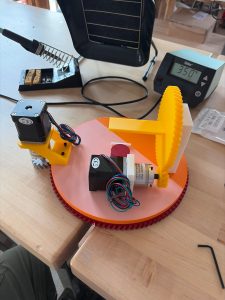
This week I made a lot of progress in terms of manufacturing and hardware testing. As mentioned last week this week I really needed to get the test bench fully 3d printed and assembled so that it was ready as soon as possible for hardware testing and also for demonstration for the interim demo. Manufacturing the test bench required a lot of 3D printing as well as waiting for some screw hardware to come in along with heat set inserts. Luckily all the parts fit together on the first try so no extra printing was needed. By the time of this post there still needs to be some work in terms of hardware testing/integration including with the stepper motors and the 9-DoF sensor but I plan to finish that with my group by tomorrow.

So far we remain on schedule with our goals and the last major steps that I have will be doing the control systems for the motor, tuning the 9-Dof sensor, and completing the integration with the actual umbrella. Next week I plan to finish any CAD design related to the physical design and have all necessary parts ordered by the start of the week. While I wait for those parts to come in I will continue to work on my aspects of hardware integration/testing.

Nicholas’s Status Report for 3/21/26

This week was mainly focused on 3D printing a basic test 3D print to allow so preliminary testing of some of the components including the stepper motors, to motor drivers, their interaction with the Raspberry Pi, and the IMU. I was not able to fully complete the printing and assembly of the test rig but I was able in the meantime to work on some of those peripheral devices and their interaction with the RPi.

I would have liked to complete the 3D printing and assembly, so given that I am slightly behind on that I am going to move forward with attempting a first iteration that will go onto the actual umbrella. Some of the CAD design and specific part selection for the parts that will interact with the 3D printed components (screw hardware, bearings, shaft collars, etc) has also taken longer than I would have liked so I need to really move forward with this next phase. This coming week the plan is to have a first iteration of the pan and tilt gimbal system on the umbrella complete.

Nicholas’s Status Report 3/14/26

This past week I mad a lot of progress on the physical design of the actuation assembly. I have moved forward with a gimbal design with 2 rings one concentrically rotating the other to provide the two axes of rotation that we need to accomplish our designs goals. Crucial to this design was figuring out the different shaft connectors we needed in order to deal with the rotating and non-rotating parts of the assembly. I also realized that given that in the final design the battery will be positioned on the non-rotating part of the pole, while its wires will be connected to the rotating servos, we will need a specialized slip ring wire part in order to ensure that the wires do not get continually twisted.

Next week will be all about 3D printing an iteration of the assembly which doesn’t use the umbrella at first so that we can test the hardware and software. I will be using the TechSpark 3D printers to accomplish this and will also use this as an opportunity to test the strength of a PLA based print and see if we might require a higher strength material for the final assembly.

Nicholas’s Status Report 3/7/26

Most of our work recently was finalizing decisions for the design document which took a big push due to the fact that we were slightly behind on research because of our project pivot. Some of the decisions I worked on are listed. We selected the majority of the BOM and ordered our parts which we should receive by the end of the week after spring break.

We decided on NEMA 17 planetary gear stepper motors because their peak torque at 0 RPM provides the necessary mechanical resistance against coastal wind forces, which was a critical trade-off compared to the lower standstill torque of servo motors. Furthermore, we selected Lithium Iron Phosphate (LiFePO4) for our power subsystem specifically for its thermal safety and stable voltage discharge, ensuring the system can operate reliably for a full 8-hour day in high-temperature beach environments.