

Carnegie Mellon ECE Capstone, Spring 2026: Ore Abolade, Bonnie Ji, and Nicholas Piñon
This week I made a lot of progress in terms of manufacturing and hardware testing. As mentioned last week this week I really needed to get the test bench fully 3d printed and assembled so that it was ready 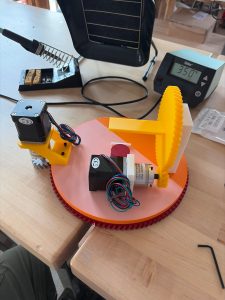 as soon as possible for hardware testing and also for demonstration for the interim demo. Manufacturing the test bench required a lot of 3D printing as well as waiting for some screw hardware to come in along with heat set inserts. Luckily all the parts fit together on the first try so no extra printing was needed. By the time of this post there still needs to be some work in terms of hardware testing/integration including with the stepper motors and the 9-DoF sensor but I plan to finish that with my group by tomorrow.
So far we remain on schedule with our goals and the last major steps that I have will be doing the control systems for the motor, tuning the 9-Dof sensor, and completing the integration with the actual umbrella. Next week I plan to finish any CAD design related to the physical design and have all necessary parts ordered by the start of the week. While I wait for those parts to come in I will continue to work on my aspects of hardware integration/testing.
One of the most significant risks to the project at this stage is the mechanical integrity of the system, particularly the weight constraints and the strength of the arm supporting the umbrella. As we continue assembling the physical structure, we are evaluating whether the current materials and design can reliably support the motors and canopy under expected loads, including environmental factors. To manage this risk, we are testing the structure incrementally and assessing whether reinforcement or material changes are needed. If the current design proves insufficient, our contingency plan is to adjust the arm design by using stronger materials or modifying the geometry to better distribute load, even if this slightly increases weight.
Another potential risk is ensuring smooth integration between the hardware and software subsystems. While major components such as user detection and BLE-based motor control are now functional independently, integrating them into a cohesive system introduces complexity. To mitigate this, we are prioritizing early integration testing as soon as physical assembly allows, so that issues can be identified and resolved well before final demonstrations.
There have not been major changes to the overall system architecture or high-level design requirements, but minor adjustments are being made to the mechanical design as we better understand real-world constraints. These changes are necessary to ensure the stability and durability of the system in a beach environment.
The project schedule remains largely on track. While some time was spent resolving hardware setup and debugging issues, progress in parallel across mechanical assembly, vision, and communication subsystems has kept the team aligned with key milestones. As integration begins, we will continue to monitor progress closely and adjust task distribution as needed.
This week, I completed the integration between the iPhone application and the Raspberry Pi using Bluetooth Low Energy (BLE) as well as polishing the APP interface. The system is now structured with the iPhone acting as a BLE central that scans for and connects to the Raspberry Pi, which operates as a BLE peripheral. Once connected, the app sends JSON-based commands such as movement, stop, mode, and location, which are received and processed by the Pi.
On the Raspberry Pi side, I implemented a BLE server that advertises services, handles incoming commands, and translates them into motor control signals. The system successfully maps directional commands from the app to two stepper motors controlling the umbrella’s vertical and horizontal movement through GPIO pins. Testing confirmed that commands from the app correctly trigger motor actions, establishing a functional end-to-end control pipeline.
At this stage, both only manual is integrated at the software level and reflected in the app, although motor behavior is currently driven directly by movement commands. Overall, the system now supports reliable wireless control of the umbrella, and future work will focus on the automation mode and refining mode-based behavior and specific calculations of the motor movement degree.


This week, I successfully got the user detection system fully running on the Raspberry Pi 5 with the Raspberry Pi Camera Module. I resolved the remaining camera and runtime issues and verified that the full vision pipeline works reliably on the device. The system now runs the MoveNet pose estimation model in real time, detects body keypoints, computes the user’s torso center, and outputs the position error relative to the center of the camera frame. I also began working on communication between the user detection script and the motor control subsystem, preparing to use the error signals to drive the pan and tilt motors.
My progress is now on schedule. With the major debugging issues on the Raspberry Pi resolved, the vision subsystem is stable and ready for integration. This puts me in a good position to move forward without impacting the overall project timeline, while the rest of the team continues advancing the mechanical assembly in parallel.
Next week, I plan to complete the integration between the vision system and the motor control subsystem so that the umbrella can automatically adjust based on the detected user position. I will also continue testing the system in real-time conditions to ensure stability and responsiveness, and support full system integration as the mechanical components are finalized.
The primary risks to the success of the projects remains mechanical hardware and assembly delays often regarding the 3D printing or just general assembly time. Delays in CAD refinement and hardware selection have pushed back the physical testing phase a bit which is more than we would have liked. As mentioned last week we continue to adopt an all-hands approach to the hardware integration.To mitigate any backlog in assembly and 3D printing, team members primarily focused on software will shift their attention to assist with the physical build as needed so that it can be up and running for our testing processes. This will ensure that the mechanical components don’t become a permanent bottleneck for our progress. As of right now there are no significant design changes.
This week was mainly focused on 3D printing a basic test 3D print to allow so preliminary testing of some of the components including the stepper motors, to motor drivers, their interaction with the Raspberry Pi, and the IMU. I was not able to fully complete the printing and assembly of the test rig but I was able in the meantime to work on some of those peripheral devices and their interaction with the RPi.
I would have liked to complete the 3D printing and assembly, so given that I am slightly behind on that I am going to move forward with attempting a first iteration that will go onto the actual umbrella. Some of the CAD design and specific part selection for the parts that will interact with the 3D printed components (screw hardware, bearings, shaft collars, etc) has also taken longer than I would have liked so I need to really move forward with this next phase. This coming week the plan is to have a first iteration of the pan and tilt gimbal system on the umbrella complete.
This week, I focused on refining the mobile application and completing its integration with the Raspberry Pi–based control system for the smart umbrella. I continued developing the app in Xcode and worked on improving the overall user interface and responsiveness. The control features were polished to make manual adjustments of the umbrella’s position more intuitive, allowing users to easily set the desired pan and tilt angles.
In addition to the app improvements, I successfully integrated the mobile application with the Raspberry Pi. I established communication between the app and the controller, enabling commands sent from the app to be received and executed by the hardware system. Through testing, I verified that user inputs from the app correctly trigger the stepper motors, allowing the umbrella to move as intended.
Overall, this week’s progress resulted in a functional end-to-end pipeline for manual control, where the mobile app can reliably communicate with the Raspberry Pi and control the physical system. Moving forward, I plan to enhance real-time feedback from the controller, improve communication reliability, and begin adding more advanced features such as automated tracking and preset positions.
This week, I focused on continuing to debug the user detection deployment to the Raspberry Pi 5. I worked on identifying setup and runtime issues on the device. I also installed the fan case for the Raspberry Pi because it was overheating even when idle, which will help ensure stable operation during longer testing sessions. Progress this week was somewhat limited because I was at a conference starting midweek and had to leave the Raspberry Pi on campus, but I still spent time diagnosing issues and planning next steps for debugging and setup.
My progress is behind schedule due to the remaining setup and debugging work required on the Raspberry Pi. There are still a few external components we need, such as a USB keyboard and mouse, and an Ethernet cable, to fully configure and streamline code development on the Pi 5. Once those are available, I expect the setup issues to be resolved quickly. Importantly, this delay does not block my teammates’ progress, as they are continuing work on the mechanical assembly and other subsystems in parallel.
Next week, I plan to complete the Raspberry Pi setup and get it running reliably on the hardware. I also aim to begin integrating the user detection system with the motor control subsystem, allowing the position error output to drive the pan and tilt adjustments. As the physical assembly progresses, I will support early integration testing of the full system to ensure the tracking pipeline works smoothly with the mechanical components.
This past week I mad a lot of progress on the physical design of the actuation assembly. I have moved forward with a gimbal design with 2 rings one concentrically rotating the other to provide the two axes of rotation that we need to accomplish our designs goals. Crucial to this design was figuring out the different shaft connectors we needed in order to deal with the rotating and non-rotating parts of the assembly. I also realized that given that in the final design the battery will be positioned on the non-rotating part of the pole, while its wires will be connected to the rotating servos, we will need a specialized slip ring wire part in order to ensure that the wires do not get continually twisted.
Next week will be all about 3D printing an iteration of the assembly which doesn’t use the umbrella at first so that we can test the hardware and software. I will be using the TechSpark 3D printers to accomplish this and will also use this as an opportunity to test the strength of a PLA based print and see if we might require a higher strength material for the final assembly.