
Team Status Report for 4/4/26

The main risks at this stage are mechanical stability and system integration. As more components are added, the arm must support increased weight and handle external forces like wind. We are managing this by testing the structure under load and evaluating reinforcement options. If needed, we will strengthen the arm or adjust the design, even if it slightly increases weight. Integration is another risk, so we are beginning full system testing early to catch issues.

The project is on schedule with a revised version; the physical design and assembly were the main things keeping a lot of things behind, but with almost all of the major subsystems now functional, we’re more effective in parallelizing testing and validation. We are moving into integration.

We have several working components, including BLE-based motor control, a functioning user detection system on the Raspberry Pi, and a semi-completed physical assembly.

For validation, we are running end-to-end tests from user detection to motor movement and will measure tracking accuracy, response time, and system reliability against our design requirements.
Bonnie’s Status Report 4/4/26

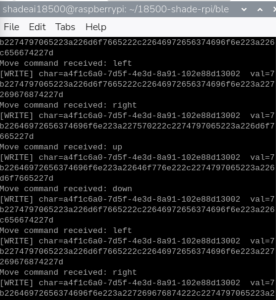
At this stage of the project, development has moved into the verification and validation phase. I developed an iOS application using Shifted that communicates via Bluetooth with a Raspberry Pi, which is connected to a motor step driver controlling a motor. This subsystem allows wireless control of the motor through the mobile app.

For verification, I focused on testing the functionality and reliability of my subsystem. I tested Bluetooth connectivity to ensure stable pairing and consistent communication between the app and Raspberry Pi. I also verified that commands sent from the app (such as start, stop, and speed changes) were accurately received and executed by the motor system. Motor behavior was observed and compared to expected outputs to confirm correct operation. Additionally, I tested the user interface to ensure all controls function properly and respond as intended.

For validation, I evaluated the complete system to ensure it meets the overall project requirements. This included end-to-end testing from user input on the app to motor movement. I measured response time and checked system reliability during continuous use. I also tested the system in realistic scenarios to confirm that it meets the intended use case of simple and effective remote motor control.

To analyze results, I compared measured performance (such as response time and accuracy) against the design requirements. I also conducted repeated tests to ensure consistent performance and monitored for errors such as missed commands or delays. Overall, the system is functioning as expected, and continued testing will focus on improving stability and performance under more demanding conditions.