Team Status Report for 4/25

The most significant risk to the project is issues with the translation or navigation apps during the demo. To manage that risk, we’re rigorously testing the apps for debugging and reliability. Additionally, there’s a slight risk that the demo environment may be too bright causing people to have difficulty seeing the display, so we’ve adjusted the brightness and also taken steps to test in different lighting environments.

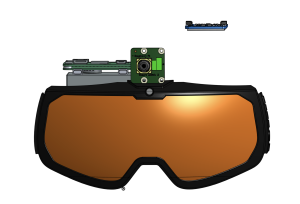
Changes weren’t made to the design of the system. Instead, we made a few final touches to the CAD of the goggles to make them as comfortable as possible.

There aren’t any changes to the schedule.

Tests:

  • Battery life test (> 1.5 hours) ✅
  • Charging time test (< 1 hour) ✅
  • Weight test (< 350 grams) ✅
  • Display text test (≥ 10 characters per line, ≥ 2 lines) ✅
  • Camera resolution test (≥ 640x480p) ✅
  • Translation latency test (≤ 2 seconds round trip time) 

By working through the semester and making thoughtful design choices, our final Dawggles product passes each of the requirements and tests that we specified at the beginning of the semester. We thus didn’t need to make any design changes.

Team Status Report for 4/18

The project is in its final stages; every risk that could have jeopardized the success of the project has been managed and mitigated.

No changes were made to the existing design of the system.

Our dawggles now smoothly pairs with an iPhone through an iOS app over bluetooth by matching codes. Moreover, we can take a picture with the dawggles, send it over to the phone, translate on the phone, and send the translation back to the dawggles with low latency, meeting the expectation and goals of the project.

Our progress is on schedule.

Team Status Report for 4/4

The most significant risk to the project is similar to last week’s, where we are focusing on reducing the text being warped. By changing the distance between the biconvex lens and the display and the biconvex lens and the beam splitter, we have high hope to reduce the warping.

The tests we plan to run for validation involve placing lines of text on the display and seeing if a user can comfortably read it. This would mimic a translation. Similarly, we plan to add the strap to see if the goggles can be worn for long periods of time. This may involve adding a cushion to the front which we are in the process of adding on.

The changes to the design of the system are discussed above.

There aren’t any changes to our schedule.

Team Status Report for 3/28

The most significant risk to the project is the optical system being unable to reach the specifications that we outlined in our requirements document. As mentioned in our individual progress updates, we finished a 3rd iteration of the goggles and tested writing a single word to the display. However, we could only see 1 word, and the word was warped on its edges. In addition, you need to move the position of your eyes in the goggles to see the word instead of simply wearing the goggles and seeing the word. Luckily, there are several changes we’re making that should address these issues. However, it’s concerning because if we can’t see enough text through the display, then it won’t be possible to fit translations on the screen. To mitigate this issue, we’re considering other fixes beyond design changes such as a better biconvex lens. In the worst case, we’d abandon the transparency effect and move the entire display in line with the user’s line of sight to guarantee that text fits in the display.

No changes were made to the design of the system besides the previously mentioned refinements of the CAD to improve the optical system.

There aren’t any changes to our schedule.


Team Status Report for 3/21

The most significant risks to the project are software based. Specifically, we’re worried about whether or not we’ll be able to achieve our desired 2 second latency from user input to result. This week, we’ll try to achieve the latency requirement through lots of work on software. Luckily, if it’s not achievable, we believe that a similar low latency will be possible such as 3 or 4 seconds.

We didn’t make any changes to the system. Instead, we further specified it by including straps and foam for the user’s comfort.

There aren’t any updates to the schedule.

Team Status Report for 3/14

The most significant risks to our project are shifting from mechanical risks to software risks, as we’ve now addressed many of the mechanical aspects of the project. For example, one of our largest risks was addressed this week when our beam splitter from AliExpress arrived in perfect condition. It functions exactly as expected and, as discussed earlier, is superior to anything we could find from other vendors. Furthermore, with our first 3D print completed, we can now do a complete test of the optical system to make sure everything functions as expected. By then, we’ll expect our mechanical work to only revolve around improvements to user comfort. Our risks will move from mechanical to software risks because the Dawggles will be mechanically complete. Our software risks are significantly less severe than hardware risks, but our current highest-priority software risk is our ability to reach the 2-second latency requirement that we’ve outlined for a user who presses the translation button on their Dawggles. As previously mentioned, we’ve mitigated this risk by designing a system that combines both Bluetooth and WiFi for user-friendliness and high-speed data transfers. Now, we’ll implement the design to ensure that it truly mitigates the risk of high latency.

A few small changes were made to the design of the system to improve user comfort while wearing the Dawggles. Specifically, we’ll be ordering foam padding to fit around the outside edge of the Dawggles so that the user’s face presses against foam rather than rigid printed PLA. We’ll also be ordering a strap that fits around the user’s face to hold the Dawggles in place. We’ll experiment with comfortability and decide whether to use a ski-goggles style strap that fits around only the back of the head or a VR-style strap that fits around both the back and the top of the head.

There aren’t any changes to the schedule.


Team Status Report for 3/7

The most significant risks to the project still revolve around the mechanical and optical parts of the goggles. Specifically, the placement and angles of the display, mirror, and lens in the  optical system are very specific, so it may require a decent amount of time to fine-tune the distances and angles of optical system components. It may also take several attempts at the goggles to create a design such that each component (mirrors, lenses, etc) can be installed and also held mechanically stably.

The system’s block diagram has been refined slightly because we’ve experimented with different methods of connecting the goggles and the iPhone and determined the best method. Essentially, we want the user experience and simplicity of Bluetooth but the speeds of Wi-Fi. We’ve refined the block diagram by further specifying that the Raspberry Pi will advertise its hosted Wi-Fi network over Bluetooth. In this way, users will pair with the goggles as any Bluetooth device, and they’ll receive a prompt on their iPhone confirming that they’d like to join the goggles Wi-Fi. This system design specification change won’t cost because it is a simple clarification.

We don’t have any changes to our schedule.

Part A was written by Aidan:

The product solution we are designing will meet a specified need with consideration of global factors for various reasons. First of all, the product is designed for people of any age, including the elderly, by prioritizing simplicity. The goggles are simple to pair and use over Bluetooth, and translations require only a single button to be pressed. Secondly, they provide translations which are helpful to tourists and areas of the world where multiple languages are commonly used. We could improve our consideration of global factors by providing translations to output languages other than English. If time allows, we’ll display text other than English on the display so that the goggles are capable of translation from any language to any language.

Part B was written by Patrick:

The clear cultural need that the Dawggles target is language. The Dawggles allow users to both respect and self-learn the native language of a foreign country. This is both beneficial to the user, who is gaining significant knowledge of the foreign language, and also those in the country that the user is traveling. The Dawggles show that the user is making an effort to learn the native language rather than relying on someone to translate for them. This shortens the language barrier and improves connection between the users of the Dawggles and native people.

Part C was written by David:

Dawggles considers environment impacts by prioritizing a lightweight, repairable, and long-lasting design. Using modular, off-the-shelf components means individual parts (like the battery, camera, or display) can be replaced or upgraded without discarding the entire device, which helps reduce electronic waste. Furthermore, our open-source apporach encourages reuse and improvement rather than frequent full rebuilds. Lastly, our 3D-printed goggles can be improved upon while minimizing material use.

Team Status Report for 2/21

The most significant risks we are currently facing in our project are centered around mechanical design. In order for our setup to be comfortable and the transparent display readable, the mechanical setup needs to be incredibly precise.

For this reason, we both chose to self design the goggles themselves and are putting in a lot of work upfront to work on this CAD design so that we can print, test, and make modifications as needed. For example, if the Pi Zero and battery end up being too much weight on top of the goggles, we may have to consider moving these back and adding a mirror or adding additional straps on top of the goggles. Using fully 3D printed models grants us the flexibility to deal with these issues in stride.

We got a great start on the CAD for these goggles this week, including creating v1 models for the goggles themselves, and additional ventilated housing for the Pi Zero Battery in order to keep it from overheating.

In terms of schedule, we’re still pretty on track. We are meant to start testing hardware next week, but more time is going to be spent on the CAD and working on the design document. As a result, our hardware testing will likely get pushed back until next week. Still, hardware testing really is not going to take us more than a week, so this is not a huge concern.

Team Status Report for 2/14

The most significant risks that our group is facing are related to latency, overall physical housing, and text size. We are planning on actually switching from our own CNN for text recognition to an open source model, in order to speed up the computation. Furthermore, we have decided to use our own IOS app so that we can run the CNN and language translation models on our phone rather than the RPi.

The physical housing is somewhat of a challenge, as the focal length of our biconvex lens is 45mm. We may consider adding another mirror if having the display above the goggles becomes too bulky.

In terms of the text size, we now have area allocated for both a GPS HUD and translation at once, but a 12px text size may not be large enough for comfortability. In this case we may switch to having a button that can toggle between GPS and translation so that we only have 1 feature at once on the display.

There is no update to the current schedule.

A was written by Aidan:

The product solution will meet a specific need with respect to considerations of public health, safety or welfare because it enables people who would previously face a language barrier to read written text and signs in other languages. For example, a tourist visiting another country could wear Dawggles and see translations of important safety signs, navigation directions, and other information. These translations greatly improve safety and welfare.

B was written by Patrick:

I feel like our project had a clear positive social impact on the user. The Dawggles are targeted towards those who are trying to travel to foreign countries and need assistance with both navigation and translation in that country. This meets a clear need of eliminating—or at least decreasing—the language barrier and social anxiety that people may experience in this situation.

This project also encourages people to learn the language they are translating. Because the translation appears just moments after glancing at the foreign text, one can actually connect the two terms. If someone had to look up the term later, the foreign word would be less associated. This again helps people learn language in a more interactive and enjoyable way.

UX_DEMO

C was written by David:

The focus of Dawggles is on affordability and openness. This is through the use of open-source hardware and software. Hence, both the cost of production and the barrier of entry for independent developers to work on the goggles is lowered. This can include upgrading a part or writing new software for the developers needs. A modular design also supports easier distribution and maintenance since parts can be sourced from multiple vendors, swapped if supply changes, and replaced individually rather than requiring a full device upgrade.

Team Status Report for 2/7

The most significant risks that could jeopardize the project’s success are related to the lens and mirror not working correctly. For example, the screen might appear to have double images if our 1 mm beam splitter is too thick, or it could appear out of focus if the screen isn’t placed exactly at the lens’s focal point. In addition, the screen could be warped by the beam splitter unless the angle is correct. Finally, the beam splitter is 50% transparent and 50% reflective, but the screen’s display might be too dim or too bright compared to the outside world. We’re managing these risks by allowing extra time and money in our budget for changes that might need to be made to the lens and mirror system.

This week, we also made changes to the existing design in terms of its screen. Instead of using a large screen that spans the width of the goggles at the top, we’re using a simpler approach that shows the screen in a single eye. We made this decision so that we can use a simpler, more common approach and use more widely-used parts such as rectangular displays, lenses from Google Cardboard, and square beam splitters.

There aren’t any updates to the schedule because everything’s on time so far.