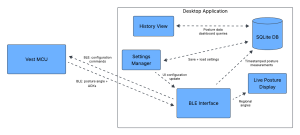
This week, I focused on refining the desktop app UI design and software documentation for the design report (adding control flow diagrams + high level architecture). Building on the BLE research and interface scaffold, I organized the Python/PySide6 interface around live upper and lower-back readings, baseline calibration, and adjustable angle and duration thresholds. Settings changes require an MCU acknowledgment, while feedback decisions remain on the wearable.
The app is currently being tested with simulated angle readings (randomly generated), including individual and combined regional deviations. These scenarios let me check the live displays, calibration controls, and settings acknowledgment flow before connecting to hardware. I also refined the proposed guided calibration process, which will let users trial their thresholds by turning left, turning right, and stretching backward. With the updated single-motor design, the desktop will identify which back region exceeded its threshold.
My progress is on schedule with the software design and initial prototype. The current implementation supports continued UI testing while preparing for hardware integration. Real BLE communication and E2E performance still need to be tested (but our timeline for this fits into the first week of November).