Nish Status Report 4/29

What did you personally accomplish this week on the project? Give files or
photos that demonstrate your progress. Prove to the reader that you put sufficient effort into the project over the course of the week (12+ hours).

I’ve been working on redoing the App interface on a Desktop version for easier CV + Bluetooth integration. I also spent a lot of time learning how to do to the Bluetooth integration and getting that set up to pass to Caroline, who is working on the actual glove.

Is your progress on schedule or behind? If you are behind, what actions will be taken to catch up to the project schedule?

Slightly behind because I got sick and wasn’t able to get out of bed for a few days! But getting back on track, don’t really have a choice since the demo is due in a week. Should have the CV + app integrated by Sunday night or Monday morning, and then spend the rest of the time testing and integrating bluetooth.

What deliverables do you hope to complete in the next week?

Finish up the CV + App integration and then bluetooth integration and testing.

Nish Status Report

What did you personally accomplish this week on the project? Give files or
photos that demonstrate your progress. Prove to the reader that you put sufficient effort into the project over the course of the week (12+ hours).

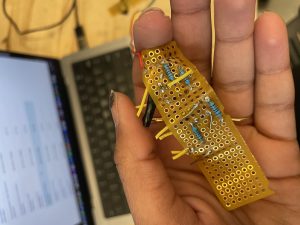
This week I tried to work on soldering the glove fully so we would be able to show it. It did not work, as I am really bad at soldering, and soldering a flexible protoboard is terrible. I spent a long time doing it and then at the end snipped the whole thing and have asked to order a new arduino because I ruined it pretty badly. I spent a long time trying to desolder it but then figured we have the budget anyway.

^^ failed soldering that was painstaking.

” Is your progress on schedule or behind? If you are behind, what actions will be taken to catch up to the project schedule?

My progress is currently behind. To catch up, I will have the full integration between the apps done tonight and have the Python interpreter in the package tomorrow.

” What deliverables do you hope to complete in the next week?

This coming week, on Tuesday I will have the two halves of the app merged, and on Friday I would have gotten all the Python code for the CV running in the App. We recognize that there may be a delay with the frame processing, but hopefully the interpreter will still run in under 100 ms.


Nish Status Report

What did you personally accomplish this week on the project? Give files or
photos that demonstrate your progress. Prove to the reader that you put sufficient effort into the project over the course of the week (12+ hours).

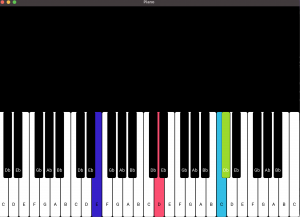
I made the initial frame of the piano app and a camera demo. I made sure that you could hide the camera view will still sending frames, and got buttons to attach to different actions and work. In the frame of the piano app, I worked on pulling up the interface with two octaves on the screen. Currently, you can play the piano with touch input. Later, this touch input will be replaced with bluetooth input that mimics the touch.


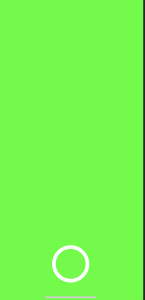
Here is a photo of the piano frame:


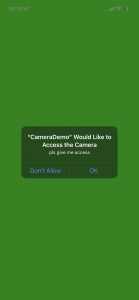
Some images of the camera demo:
” Is your progress on schedule or behind? If you are behind, what actions will be taken to catch up to the project schedule?

Yes, we are on schedule according to our Gantt chart.

” What deliverables do you hope to complete in the next week?


I will merge the two demos into one app in Xcode, which will take some nifty little hacking. Also, I will create a calibration screen and convert the frames into the appropriate format to forward to the Python code.


Now that you are entering into the verification and validation phase of your project, provide a comprehensive update on what tests you have you run or are planning to run. In particular, how will you analyze the anticipated measured results to verify your contribution to the project meets the engineering design requirements or the use case requirements?


In the app, I will be making sure that we have 2 octaves playable (tested by counting the maximum display). We will need to set some user input to allow them to change which octaves are displayed. Other tests are adapted from our design report:

Tests for Volume

– Measure the volume output in Xcode for each note, make sure they are all within the same decibel (inbuilt in Xcode, can also measure with an external phone’s microphone)

Tests for Multinote Volume

– Same test as above, but when playing multiple notes at a time.

Tests for playback

–

Because we will be playing multiple notes at the same time, we want to have a fast enough playback time for the notes played. First, we will test our playback speed, playing at least 8 notes over 2 octaves. We will start the time when the arduino registers a pressed key, and then see how long it takes to reach the app and call the command to play the speaker. All of this should happen in under 100ms. If it doesn’t, we will need to alter how our apps’ threads handle input and prioritize better, or change our baud rate.

Tests for time delay

  • We want our product to behave as similarly to a real piano as possible, so we want the way that our note fades to accurately reflect how notes actually fade out on a real piano. We need to make sure that playing successive notes quickly allows each note to fade and layers the next note on top, in addition to adding in the sound levels. We will also compare the sound to a real piano, using a metronome and timer to see how long each note rings out on our piano version of a real piano. Our goal is to have the keys fade out within 0.5 seconds, although our fade may be more linear than on a real piano.
 

Team Status Report April 8th

What are the most significant risks that could jeopardize the success of the project? How are these risks being managed? What contingency plans are ready?

The most significant risk for the CV portion of the project is thresholding the image to obtain the coordinates of the warping function in any lighting environment. The thresholding values will never be 100% accurate so this leaves a possibility that the project could be a risk. The backup plan is to have the user click to choose their points instead or have an error message that tells the user to put the image in better lighting.

Another significant risk is the Arduino Nano BLE. In the past week, we have had issues with connectivity, powering the circuit correctly, and receiving accurate pressure sensor information. Because our project relies heavily on the gloves being able to send information to the computer about which finger is pressed and how hard it is pressed, not having this information will definitely be a risk. The contingency plan for this is to connect the pressure sensors to an Arduino Uno and transfer the information through the Arduino IDE.

Were any changes made to the existing design of the system (requirements, block diagram, system spec, etc)? Why was this change necessary, what costs does the change incur, and how will these costs be mitigated going forward?

The changes that were made to the CV side of things was trying out an external package (mediapipe) to help with identifying the hands and fingers of a person in a given image. This is much easier than color-thresholding finger tips.

Nish’s Status Report Feb 11

Originally located: http://course.ece.cmu.edu/~ece500/projects/s23-teamb6/weekly-status-reports/nish-weekly-status-report-for-february-11th/

In the past week, we worked mainly on our proposal presentation. I worked on our “Thievery Flow” as well as flushing out the different components in our solution to try and make it more cohesive.  I identified specific versions of products we could use, such as the STM32 + RAK4600 Bluetooth that would complement each other, and researched the other components we were considering working with. We worked as a team to edit all the slides together.


I think we are a little behind on our design. Though we tried to edit our use case requirements, I think we still have written our requirements based on our selected implementation, leading to aspects of our design that may seem unnecessary, such as having Bluetooth. To make sure our design review goes smoothly, I would like to go back and refine our requirements, or perhaps pick another use case where we can implement a similar type of sensing mechanism as people are walking through a certain space, allowing for identification of who is passing through. I think we have been trying to overcomplicate a simple solution with a lot of “nice-to-haves” without having a solid foundation.;

We plan to have a meeting to focus on our project, whether that be through a different use case or refining our current one and redoing the requirements. I plan to bring a few ideas for different use cases to this meeting.

Next week, I want to have a complete parts list and have ordered the different components we need. We might need some more time on the PCB side because once we decide on the components, we still need to put the actual PCB together. I want us as a team to revisit each component we were thinking about and make sure having it serves a requirement in our use case rather than something that would be making our project more complex for the sake of it. Once we have our components ready, we can also set up our repo with the starter code (especially for something like the STM32, if we choose to continue using it).