
Nick’s Status Report for 4/16

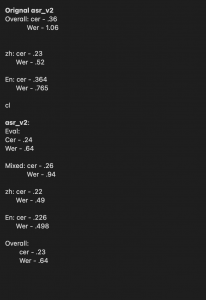
This week we’ve been working diligently to improve our model’s performance and work on improving our projects overall insights and user experience. Within a day of our meeting earlier this week, I spent time retraining a fresh model with some slight modifications to which pre-trained feature extractor we were using as well as training hyper-parameters. This lead to a model with much better performance compared with what we were able to demo at our interim in both the character and word error rate metrics across all evaluation subsets and overall.

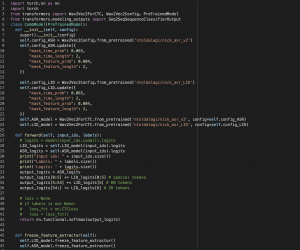
This is continued progress now being made in completing the training of a model with a slightly more nuanced architecture using both CTC and classification loss fused and with fused logits as well. Overall, the larger model should generally have the capability for greater knowledge retention and a finer ability to distinguish between mandarin and English by more explicitly focusing on separating the task of LID and ASR. We will continue work tomorrow to strategize about what we would like the final outcome of our project to be and what we would like to highlight during our final demo and report.
 

Our Idea

Most speech recognition apps have good performance today. From Siri to voice texting on most smart phones, the accuracy and processing speed of speech recognition in these apps are great — with annoying limit though: most apps only support one language mode. Siri only supports single-language recognition. If you set your Siri supporting language to English and try speaking into your Siri with a mix of two languages, Mandarin and English for example, you will find Siri treat everything you said as English and translate the part you speak in Mandarin as gibberish.

So we want to build an app that provides accurate and real-time recognition for speeches mixed with Mandarin and English. It will be very useful for (1) voice texting when a speaker is bilingual and speaks in a mix of English and Mandarin; (2) transcription for international conferences when attendants from different countries start a mixed-language dialogue. Our goal for our app is to reach an word error rate (~10%) that matches existing single-language speech recognition apps and an end-to-end latency of less than 1 seconds so that the recognition can catch up with human normal speaking rate (~100 words per second).