George’s Status Report for 4/30
All of my time last week was dedicated to preparing for the presentation on Wednesday. I didn’t work on the game code at last week.
My team and I created the presentation slides on Sunday of last week. We took some time to practice the presentation together and I also took additional time to practice it alone. After the presentation on Wednesday, I had to focus on other classes because I had other end-of-semester deadlines.
This week I will be doing the following things:
- Create poster for public demo
- Work on final report
- Finish work on health bar
- Finish work on game death loop
We are on track to have a fully working version of Hit It! on Thursday. I’m looking forward to the TechSpark Showcase on Thursday and the demo on Friday!
Stephen’s Status Report for 4/30
The last task I need to finish before the public demo is the completion of the central module for our project, which will isolate the ESP32 and supporting circuitry from the user while they play the game. I spent several hours trimming down some wire headers and soldering them to a general-purpose through-hole breadboard which will help reduce the over size of the circuitry and also fix the connections in place so they cannot be jostled loose. Currently, I’m about 70% of the way done with this soldering, and this video shows the current functionality of that board:
Other than this, all I need to do is 3D print a small housing for the board once I’ve finished soldering it. This box shouldn’t be very expensive compared to the drums, as it doesn’t need to withstand any significant forces, which permits the use of thin walls. I’m expecting this module to cost around ~$15 when printed.
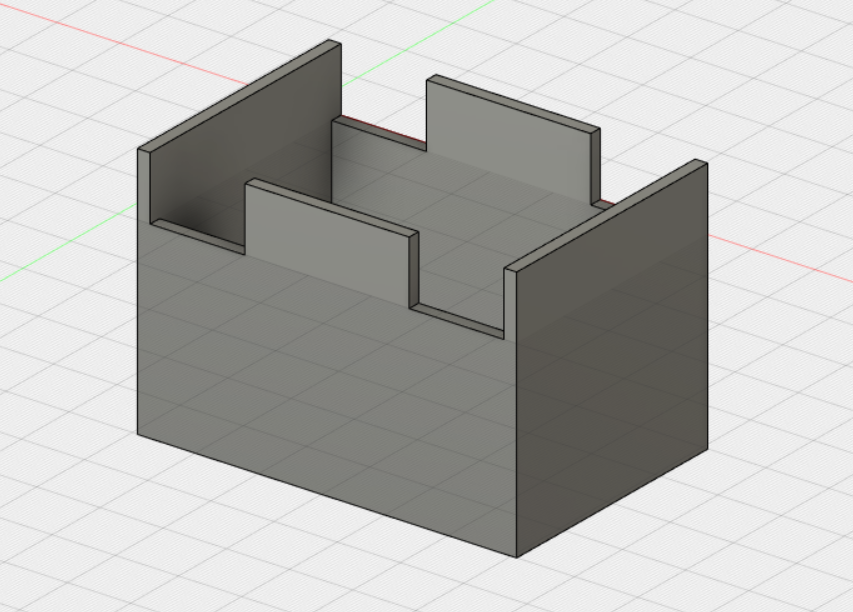
Regarding where I am in regards to completing these tasks, I’m confident I’ll be able to wrap everything up every next week. Most of my classes finished up this recent week with their last exam or a final project, so I have little else to work on other than these tasks, as well as the final report due at the end of next week.
George’s Update for 4/23
This week I worked on the following things:
- Conducting playtesting sessions
- Fixing a new drum input bug that was discovered during playtesting
- Adding visual feedback to user input
- Changing colors of game lanes
- Preparing for the final presentation
This week we conducted 2 playtesting sessions on Wednesday. We had 8 people play our game and provide feedback to us on our feedback form. A lot of their feedback was related to the visuals of the game, and I had to make some tweaks based on their feedback. Here is what the game looks like now:
Next week we will be adding the finishing touches to the game and giving our final presentation to class on Zoom. I will be cleaning up the gameplay a little bit more, tweaking the main menu, and refining some of the colors.
Team Status Report for 4/23
This week was primarily spent performing our testing and making any last minute improvements that would be needed going into the final presentation. Each of our group members spent time improving/testing their individual portions of the project, but we also had a user feedback session Wednesday night with CMU’s Game Creation Society so that we could get user input into the state of our game.
During this session, users play-tested the game in a fashion similar to how the final product would be used and gave their opinions on what they felt could be improved on. Some examples of feedback included user’s feeling specific drums were less responsive and that the scroll speed/note density of the game was too much for the average (or even experienced) rhythm gamer.
Receiving user feedback in this fashion was also needed for some of our specific use case requirement tests, such as the set-up time of the game, so we gathered that information as well so that it could be presented during the final presentation next week.
Following the final presentation next week, the majority of the changes we still need to make to our game are just improvements or to already implemented features (such as the game’s graphics and drum-game communication), many of which are aesthetic in nature. As such, we should be on pace to finish this project by the upcoming final demo.
Stephen’s Status Report for 4/10
The majority of this week was spent preparing to print the final drum modules, as earlier this week the PCBs arrived from PCBway, and after soldering the components to verify that they perform as expected, I was ready to 3D print the final drum design. The only change I made from my recently posted drafts was to reduce the thickness of the top wall of the housing from 5 mm to 2 mm. This is mainly to allow the LEDs more room to stick through the holes in this layer, as I hadn’t originally accounted for how the stubs of the other through-holes components may prevent them from getting as close to the roof of the housing as the PCB would naturally allow.
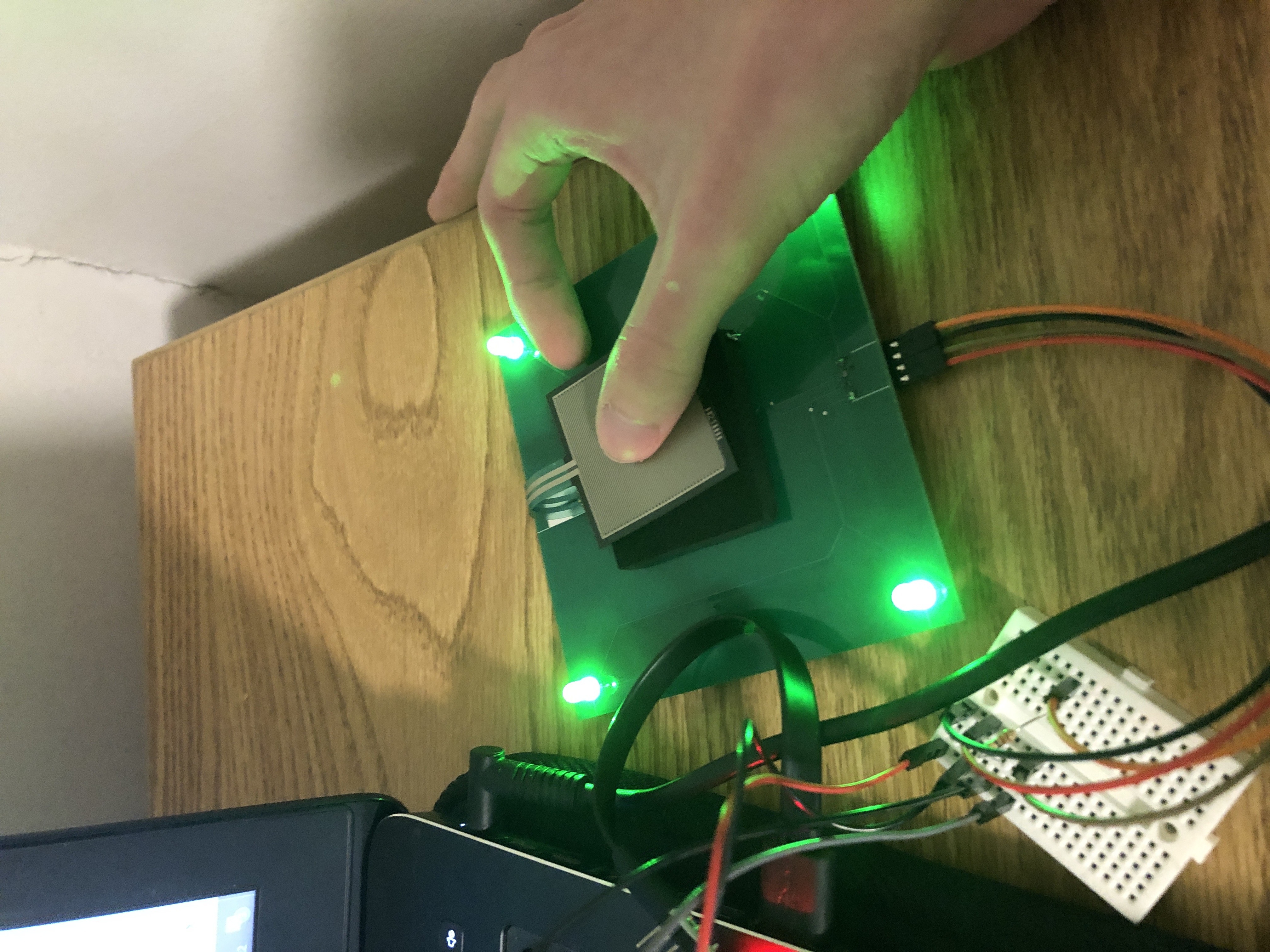

The print had reduced scaffolding and height compared to the demo design, which brought the cost down from $56.50 previously to just $36.00 for this final version.


However, after clearing the scaffolding, I encountered an issue with the design’s size, as although both the drum’s internal cavity and the PCB measured 11 cm, the PCB was slightly too large to fit within the drum.
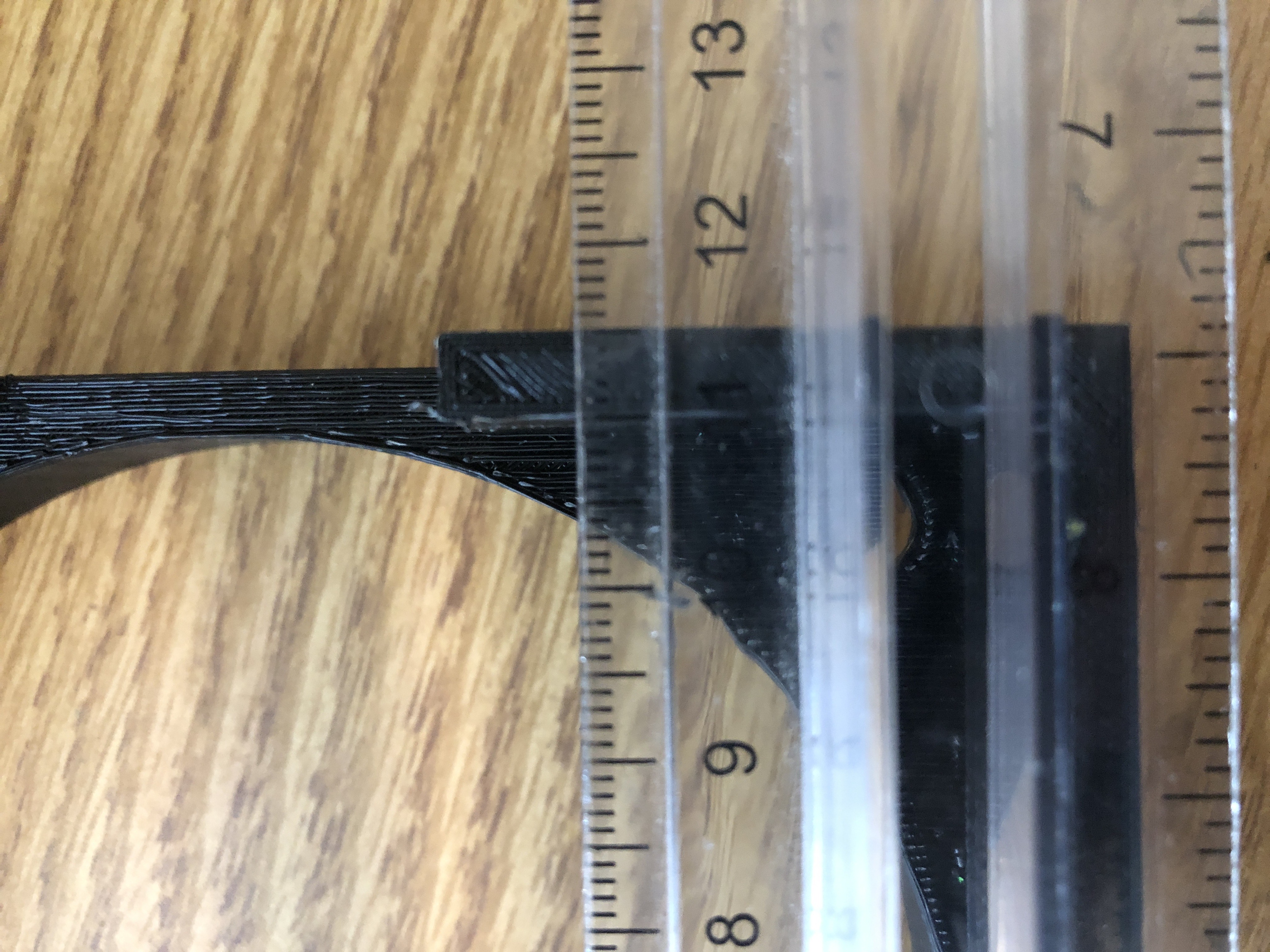

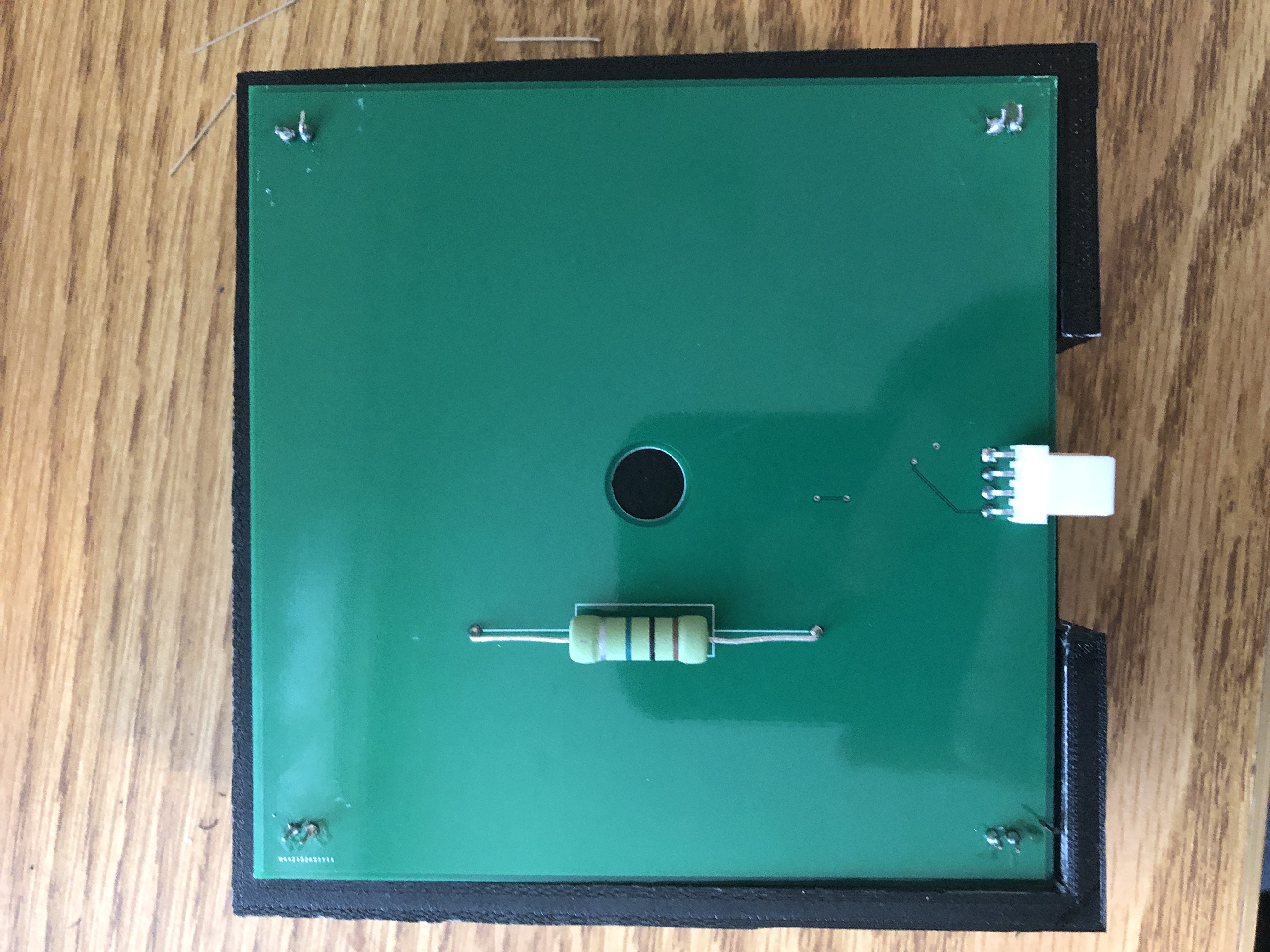
Since this size difference was less than a millimeter, I’ve been trying to sand down the interior of the drum enough to allow the PCB to fit. However, although the difference in size has shrunk from my efforts, the PCB is still unable to fit smoothly even after several hours of sanding.
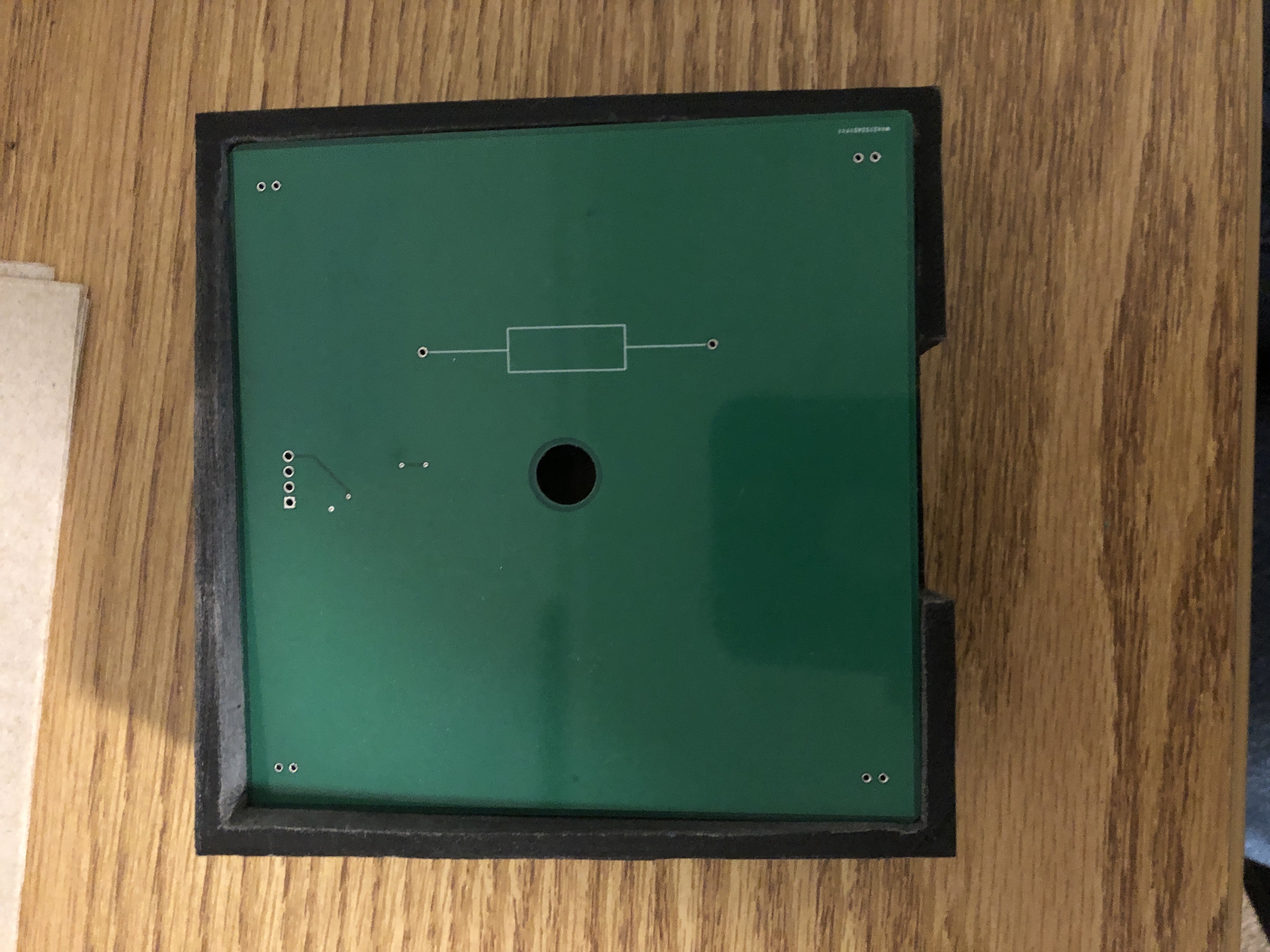

I still believe this drum module is salvageable, as I was able to shorten the difference greatly, however I’ll need to dedicate more time to sanding or use a tool within TechSpark to assist me in doing so. Going forward, I plan on reducing the side walls of the housing from 5 mm to 3 mm for the other three drums, with all of the gained space going to the inside of the module. This may give me too much room on the drum’s inside, however it will be much easier to remove the additional space rather than to create more through sanding.
Regarding where I am in regards to our schedule, I am now slightly behind where I had hoped to be after carnival, as I was hoping to have a fully functional final module ready going into this week. However, This is not a major delay, as if I am able to perform a successful 3D print tomorrow with the new design I’ll only be a day behind where I expected to be. Other than that, the rest of this week will be focused on finalizing the drums and the Arduino code which communicates with them, so that hopefully I’ll be able to assist with other tasks going into the last few weeks.
George’s Status Report for 4/10
Here is a list of tasks that I completed this week:
- Designed main menu
- Created and added art to gameplay screen
- Created sounds for main menu and song selection menu
- Created song selection menu
- Added fading screen transition between song selection menu and gameplay
- Added hit indicators that show how the accuracy of a player’s hit
- Fixed small bugs with sound loading and image loading
I worked mainly on SongSelectionMode.cpp, Sound.cpp, PlayMode.cpp, and FadingScreenTransition.cpp this week.
Here is a video of the current state of the game:
As you can see from the video, there is an issue with the font rendering. The text is not being shaped correctly by Harfbuzz. It looks like the lowercase letters are placed at weird locations, which makes the text look a bit silly. I’ve known about this issue for a few weeks now but I have not had the time to go back and fix it. I’m hoping that I will have the time to fix it once we start playtesting, which will happen the week of April 19.
Here is a list of sounds that I’ve created to make the gameplay feel more polished:
Here is the main menu design. I used GIMP (a free image editing software) to create the background and arrange the menu together. I used Google Drawings to create the title text and button text.

This week I did not get to all of the tasks that I had originally planned for this week. I wanted to continue working on Windows compatibility, but after discussion with the Professor and our TA during the Interim Demo we decided to not pursue Windows compatibility because it was taking too long. For now, our game will only run on MacOS.
By the end of this week I would like to have our game in a completely playable state. We need to begin playtesting soon, so it is critical that that game is fully playable by the end of next week. This will give us 1 full week to do playtesting and add any final polishing touches. I am still on track to complete all of my goals before the end of the semester.
George’s Status Report for 4/2
This has been a very hectic week for me. The good news is that I have job offers on the table for after I graduate! The bad news is that I had a little less time to work on this project than I would have liked. I had job interviews on Wednesday and I’ve had a ton of phone calls and decision-making to do this week, which was pretty time consuming.
The game is now compiling on Windows. I met with my teammates last week and we all worked together to resolve the compilation problem. To get the game to compile on Windows, we had to comment out the Sound.cpp code, because the sound library that I am using, which claimed to work on Windows, does not work out-of-the-box on Windows.
The game is in a-playable state, but it is still pretty simple. The remainder of my work for this semester will be related to making the game more polished and fun to play.
Here are the tasks that I will be working on next week. This is a lot of work; I intend on working a little bit during Carnival. It is critical that the game takes shape ASAP so that we can playtest it after carnival.
- Get sound to work on Windows
- Add “Miss”, “Good”, and “Awesome” hit indicators to PlayMode
- Add health bar to gameplay scene
- Set up basic main menu and song selection menu so that Shreya and Stephen can work on them
Stephen’s Status Report for 3/19
Much progress towards reaching MVP has been made since my last status update on 2/26. For starters, I was able to 3D print the prototype drum pad module before spring break began so that I could create the working prototype while away from campus. The process of removing the internal scaffolding was slightly more involved than I originally anticipated, as without having used a 3D printer before I wasn’t aware of just how much scaffolding would be needed for my design. However, I still managed to remove the scaffolding without damaging any features of the module, so it still works as I intended.

After this, I arranged the FSR and other circuitry inside the module and began testing the responsiveness, with somewhat mixed results.

Although the ESP32 was recognizing strong hits to the direct center of the drum pad, hits off the center and to the sides were inconsistent in their recognition, and hits along the crossbars that supported the center platform had basically no recognition. The below diagram details my estimates for the relative accuracies.

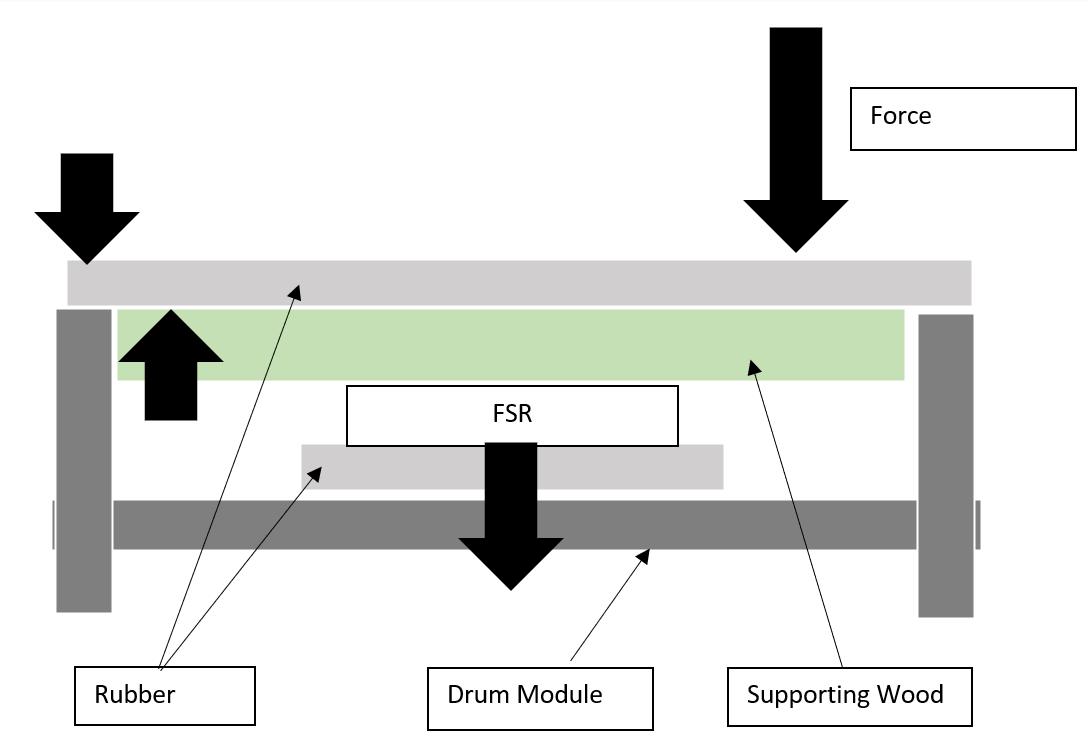
The main issue that seemed to be causing this unreliability was the fact that the center platform (where the FSR is located) was at the same height level as the crossbars supporting the platform. This lead to any forces that are on top of the crossbars or close to the crossbars being dissipated through the crossbars rather than through the center platform, which meant the FSR never got a chance to recognize them. To remedy this temporarily, I placed a spare piece of rubber between the FSR and the center platform, which raises the FSR compared to the crossbars. Additionally, I used the adhesive edges of the rubber to fix the drum pad to the module’s rim, holding it in place as it is hit. This creates a pivot directly on the FSR, which redirects much more force through the center platform and greatly increased my recognition accuracy during my trial testing. A diagram illustrating this and the setup for the drum currently can be seen below.
After getting reaffirming results with this new makeshift setup, I began work on the final drum pad module design. This prototype module will be sufficient for MVP, but a new and slightly modified design would better accommodate for this new setup. Additionally, one issue I encountered with this prototype is that the small breadboards I had planned on using were somewhat hard to fit underneath the FSR’s platform, so I would like to design a PCB to go along with that new drum module design.
Designing the PCB and new drum module, as well as creating the BOM/order for them will be my primary tasks this following week.
Regarding how my progress fits into our timeline, I think the progress I’ve made so far has aligned well with our goals. We originally aimed for an MVP target of 3/20, and this progress meets most of our goals. Regarding the functionality, this drum setup has everything we need, as its capable of providing a signal quickly and reliably to the game’s program. The one area my progress doesn’t meet our MVP goals is that I only have one drum as opposed to our MVP target of 2. Creating a second drum wouldn’t be difficult, but I chose not to do so because the current drum design is only a prototype, and I know for certain that I will be changing it later. As such, printing a second prototype module would unnecessarily eat into our budget, as it would likely just get discarded once I began printing the final modules. However, other than that one consideration, I feel like this demo module satisfies our MVP targets and sets me up well to move into the post-MVP stage of the design.
George’s Status Report for 3/19
I’ve made lots of progress on this project since my previous update on 2/26.
Here’s a list of the major things I’ve added:
- Sound playback
- Font rendering
- More accurate calculation of score
- Reading beatmap data from JSON file
- Communication with drum peripheral
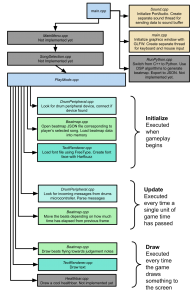
To keep everything organized, I’ve separated most of these changes into different files. Some changed files include Sound.cpp, DrumPeripheral.cpp, and Beatmap.cpp. Here is a diagram that shows how the gameplay code is structured:
Playing sounds
I used PortAudio for realtime audio playback, and I used a free library called libaudiodecoder that reads WAV and MP3 files. To play audio with PortAudio, we must write a special callback function that gets executed by PortAudio every time it needs more data to send send to the computer’s sound device. This function is called the “stream callback” and it is run in a separate thread from the main gameplay code. See Sound.cpp for more details.
Font rendering
If we were using a game engine, then this step would be trivial. However, because we are not using an engine, we need to write an interface for rendering fonts to an OpenGL window. Thankfully, I took Computer Game Programming last semester, and rendering fonts was one of our assignments, so I was already familiar with how to do this. I was able to re-use most of the code from that assignment when adding TextRenderer.cpp and TextRenderProgram.cpp.
One issue we currently have is that the fonts are not being shaped correctly. The positions of the letters look a little bit off. I think this is an issue with Harfbuzz, which is a library used for shaping text, but I haven’t spent enough time debugging this to know for sure. I’m going to put this issue aside for now, because it is not critical to the performance of our game, but after we reach MVP I would like to revisit it.
Communication with drum peripheral
I found a simple library called ‘serialib’ that does cross platform serial communication. It’s only 1 header file and 1 source file. The drums microcontroller and the player’s laptop are communicating using the RS-232 Communication Protocol. The drums microcontroller will send a 1-byte message to the player’s computer when one of the drums has a high output voltage. If no drums are being pressed, then no message is sent. See DrumPeripheral.hpp for more implementation details.
Here is a video of what the game currently looks like. In this example, the game plays a test audio file and a test beatmap. The beatmap notes are not synchronized to the music in this example.
Next steps
Next week we expect to reach MVP. In our gantt chart, we have our MVP scheduled to be completed by Monday. I think that I will need a couple extra days to reach MVP because I got delayed due to the linking issues earlier in the semester, and the font + sound code took a little longer than expected. My main tasks for next week will be:
- Figuring out how to run Python scripts from C++ so that the game can process song data at startup
- Verifying that the beatmap notes are synchronized to the music
After this next week, the game should be in a playable state. I’m expecting that this will be the final week where I am working on building the game framework. After this week, I can work on adding features that make the game look and feel fun to experience.