
This week, our team finished our design presentation, and I worked on several of the slides, including hardware diagrams and component research that helped us finalize our prototype design. Our ordered parts also arrived on Wednesday, so Carys and I began physically prototyping the system. While Carys worked on the vest design and we discussed ways to securely position the IMUs, I soldered header pins onto several of our components, including the nRF52840 MCU and motor controller, and soldered leads onto the vibration motor. Soldering the MCU was a little nerve-wracking because I initially had the iron set too high and left a small scorch mark near some of the traces. Since we only have one MCU, damaging it could have significantly delayed our progress, but fortunately the board still worked properly. I then wrote a basic program in the Arduino IDE and successfully tested the nRF52840 with the motor controller, making the vibration motor buzz every two seconds. The motor was much smaller than I expected (around half the size of a penny) so I also experimented with how noticeable the vibration would be when worn. I found that applying some pressure against the motor makes the vibration easier to feel, which is something we will need to account for in the vest design. I am also considering whether using multiple motors could improve the feedback, although we would first need to check the additional power requirements and motor driver limitations.
Overall, I think our progress is on schedule. We have moved from component selection and design into physical prototyping, although we still need to verify that the complete sensor system works together as expected. Next week (Monday), our main goal is to assemble an initial E2E prototype for the design report. Once the vest arrives, we can begin testing component placement, but in the meantime we can wire the nRF52840 to the IMUs and begin collecting accelerometer and gyroscope data. We also plan to start developing the MCU firmware for sampling and processing the IMU data so that we can begin reconstructing the relative orientation of the sensors and eventually use that information to estimate posture. These initial experiments should also give us concrete data and results to incorporate into our design report. Additionally, I hope this prototyping gives me the confirmation I need to begin working on the PCB board. Hopefully if I order it by fall break, it can arrive in time.
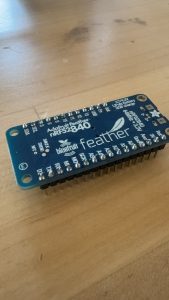
Here is a picture of the nRF with the pins soldered on (from the back). It was fun, I hope I can do some more!