
Final Report: https://docs.google.com/document/d/1ERGdZMEgslOdOnmwZlJDtyJFl2hqgo4iby2YpT13X7Q/edit?usp=sharing
Final Video
Final Video: https://drive.google.com/file/d/13QHA5gB9z0W9KnT92drDgcW-NT82CaLZ/view?usp=sharing
Final Poster
Weekly Status Report 4/25
Group: This week, we finalized our testing schedule and worked on creating our final presentation slides. We conducted testing on both the hardware and software components of the project. Additionally, we began preparing our poster while continuing testing over several days. For next week, we plan to complete all remaining testing, finalize the case and assemble the final device, and continue preparing the final video and poster.
Ines: This week, I primarily focused on preparing the final presentation slides for my presentation. I also worked on completing the scripts for the thermal camera and tested them with our plants under different lighting and environmental conditions. In addition, I’ve started integrating the completed system into the case. Next, Sanjana and I will conduct a full hardware system test, followed by end-to-end testing with the entire group.
Miffy:This week, I wrapped up the software side of the project by finishing debugging on the last remaining component of the app, bringing the mobile frontend to a fully functional state. I also created a user testing document — including a guide and questionnaire — and conducted user tests with three participants. Next week, I’ll support the group with end-to-end testing and contribute to finalizing the poster and video.
Sanjana:
As we wrap up the course, I focused on finishing testing this week. As we already completed any of the short term tests, I worked on some of the longer range tests such as testing for the 5-7 day early detection requirement. To do this, I started by making sure the entire system was functional, testing individual components and subsystems to ensure that everything was working for testing with the final assembly and enclosure. Once this was complete, I set up the system with our test plant. Over the course of several days, we placed the plant in suboptimal conditions to test unhealthy plant behavior. Over this time, we kept steady control conditions and recorded photos and notes every day. As we head into this last week, I plan to complete this testing for the hardware and final enclosure testing, any other small remaining tests, and the final video for demo.
Weekly Status Reports 4/18
Group: This week, our team focused on testing and validation prior to our final demo. After completing integration with our new sensors last week, we moved into full on testing to validate all parts of our system. This included validating the individual sensors (environmental sensors and indices sensors), transmission over wifi to backend, power drainage, environmental tests for the casing, software and ui testing, as well as full system testing. These were in line with the testing plan we refined after our interim demo as well as the requirements we outlined in the design report. Once wrapping up this, we focused on prepping for the final demo which included creating supplementary materials like the presentation and videos.
Inès: This week we focused on testing. I finalized the case to do environmental test on it such as heavy rain and winds. We also finalized the stand for the device, and some of the decorative aspects of it. I then focused on battery test with Sanjana, which we performed in one day to understand how long our device will be able to perform for, while keeping track of the voltage of the battery throughout the whole process. I then focused on the thermal camera tests, which are analyzing and validating the results found from our CWSI script. We are now preparing the final demo slides and getting everything ready for Monday.
Miffy: This week I focused on finalizing the frontend application and deploying the backend. On the app side, I implemented the remaining features including pop-up alerts for when plant health indices fall outside of healthy thresholds, and trend analysis to help users understand how their plant metrics are changing over time. I also wrote user test stories to validate the app experience from an end-user perspective. On the infrastructure side, I deployed the backend to Render.com and handled real-time bug fixes as issues surfaced during user testing, ensuring the system was stable and ready for the final demo.
Sanjana: This week I focused on testing all of the hardware components I’ve worked on for our project as well as power testing, enclosure testing, and transmission to backend testing along with Ines. For the hardware components, I used a digital thermometer, hygrometer, and IR thermometer in order to verify the accuracy of our BME280 sensor’s functionality for temperature and humidity readings, as well as the thermal camera’s leaf-air temperature readings. Along with the BME280 sensor, I worked on testing the spectroscopy sensor which was a bit more vague of a process. Since we don’t have any quantifiable and exact way to test our indices since that’s the whole point of our sensor, we researched common benchmarks for each index and compared this with the behavior of our sensor. By doing so, we were able to validate that our sensor was working accurately. From there, I also worked with Ines to validate that our power supply was lasting for the right amount of days, data was properly being sent to the backend during the correct time periods even with stress conditions applied, and enclosure testing by verifying our case can withstand environmental conditions like wind and rain.
Weekly Status Reports 4/4
Group: This week, the team focused on preparing for the demos held on Monday and Wednesday. We worked on integrating the hardware with the backend and enabling real-time updates on the frontend, allowing the full pipeline to function end-to-end. In parallel, we made progress on the physical design, including the case and stand for the devices. On the hardware side, we finalized the scripts for index calculations and Wi-Fi communication, and continued connecting all components to the microcontroller. On the software side, we worked on getting the backend and frontend updated to accommodate for multiple users. Next week, we will focus on developing a detailed testing and validation plan, completing the full device assembly, and beginning initial testing.
Inès: This week, I focused primarily on developing the index calculation scripts and the thermal camera integration. We received the thermal camera, so I worked on connecting it to the ESP32 and processing the incoming data. In parallel, we revisited the device stand design. I updated the 3D models and had them printed, so we are now ready for assembly. Sanjana and I also researched locations to purchase a real vine plant, which we plan to acquire this weekend for upcoming testing.
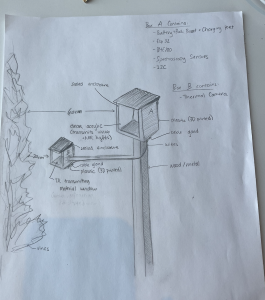 (new updated design of the stand)
Miffy: This week, I focused on finalizing the mobile application. I debugged existing functionality and implemented all remaining features, bringing the app to a fully working state across all components except LLM Analysis, which is still pending. The app is now ready to support the upcoming demos and testing phase.
APP Design:


Sanjana:
This week I worked on integrating the sparkfun spectroscopy sensor into our system. We received this component at the beginning of the week and since it’s arrival I’ve been working on connecting and debugging functionality related to collecting vegetation indices. Once I could reliably collect values from the component, I incorporated Ines’s script to use the values coming from the sensor to calculate the 4 vegetation indices that we decided to use. Into next week, I will continue to debug this functionality and make sure everything is running smoothly from the backend to the app which is now deployed.
Weekly Status Reports 3/28
Group: This week, our team focused on preparing for the upcoming demo by making progress on the software, and integration. On the hardware side, we began assembling available components, including soldering key parts like the battery and adjusting our 3D print design measurements. While we are still waiting on the spectroscopy sensors, we used simulated data to continue working, and we completed our indices computation script to process this data. We also made strong progress with the ESP32, successfully setting it up, interfacing it with the BME280 sensor to collect environmental data, and enabling WiFi capabilities to begin transmitting that data, including testing a temporary setup where the ESP32 generates its own network. On the software side, the frontend was tested and debugged to ensure it is demo-ready, while the backend was run and its interface with the hardware was defined and tested. Overall, this week’s work significantly advanced system integration and ensured that all components are aligned for the demo.
Ines: This past week was focused on preparing for the demo scheduled on Monday. Sanjana and I met to make progress on the hardware components of the project. Since our spectroscopy sensors have not yet arrived, I created simulated data to replicate their outputs and allow us to continue development. I also completed the indices computation script. In addition, we decided to modify the 3D print measurements, which I updated accordingly. Finally, I worked on soldering and assembling the hardware components currently available to us.
Miffy: This past week was also focused on preparing for the Monday demo. I tested and debugged the frontend, ensuring it was functioning correctly ahead of the demonstration. I then began running the backend and worked on defining and testing the interface between the backend and hardware components, coordinating to make sure the integration points were clearly communicated and validated.
Sanjana: This week I made solid progress on the hardware. Now that our components are mostly here, Ines and I got started on assembly. As we had already planned, we soldered and connected the components that didn’t need to be tested such as the battery. Then I took the lead on working with the ESP32. First I set up the ESP32 and got it fully operational, which involved troubleshooting some initial setup issues and verifying that it could run my code reliably. I also connected the BME280 sensor to the ESP32 and was able to read environmental data including temperature, humidity, pressure, and altitude (we are not using all values for our project). In addition, I worked on enabling wireless communication by connecting the ESP32 to WiFi and beginning to transmit the collected sensor data. I also tested an alternative by generating WiFi directly from the ESP32 to temporarily collect data.
Weekly Status Reports 3/21
Group: This week, we focused on both hardware assembly and software development as more components began arriving. We started putting together the available parts of the device and continued refining the case design to ensure it can withstand environmental conditions. In parallel, we worked on developing scripts for processing sensor data and began building out the backend to handle data flow and visualization. We also planned our upcoming field visit to better understand deployment conditions. Next week, we aim to continue assembly, integrate sensors, and prepare for testing and the demo.
Ines: This week I focused on finishing up the last details of the case for the device, along with further exploring the weather tests we should prepare for. As our hardware components are slowly arriving, Sanjana and I are also starting assembly. I’ve also written out the logic of a couple of scripts. This week we will finalize the assembly of all components, but the thermal camera and the spectroscopy sensors as they have yet to arrive. Sanjana and I will be spending this week preparing for the demo, this means getting all the components that we have assembled, and figuring out wifi transmissions for temperature and humidity sensors (as we have that sensor).
Sanjana: As we’ve been waiting for all of our components to arrive, Ines and I have started working on the parts of our project that can be done without needing the physical components. Ines took the lead on modeling the 3D printed case that will enclose our device. At the beginning of the week we worked together to ideate what we wanted this case to look like to prioritize safety of the device, especially with a variety of environmental factors. We decided to design the case to have three 3D-printed sides, to allow accessibility on the the last side. We will attach a clear piece of plastic on this side after the container is 3D printed. After deciding on the basic design of the container, Ines took the lead on its modeling. Next, I moved on to writing the python scripts that we will use to do all the in-unit computations. This includes calculating all of the vegetation indices we chose and preparing all the data for sending to the app for visualization. Towards the end of the week, we received most of our components so next week we are looking to begin assembling our device, especially the battery and environmental sensors.
Miffy: This week I focused on getting more involved with both the fieldwork and the backend development of our project. I will be joining the team in visiting the vineyard to better understand the real-world environment our device will operate in and to gather insights that can inform our system design. On the software side, I have been working on building out the backend infrastructure, including setting up data pipelines and structuring how sensor data will be processed, stored, and prepared for visualization in the app. In the coming week, I plan to continue developing the backend, integrate incoming sensor data, and support the team as we move into testing and demo preparation.
Weekly Status Reports 3/14
Group: After our meeting on Monday, we met as a group to discuss the feedback we have received and what we will do to fix some of the issues present in our design report. We have agreed on the graphs that will appear on the user interface, creating an overall plant health calculations (calculated by using different indices weights), the various indices over time, temperature, and humidity scores. On the hardware side we have started developing the indices scripts, finished the hardware, and our waiting on the components to start assembly. We are also planning on visiting a farm next Friday (2/20) to see what kind of vines we will be working on.
Ines: This week, I finalized the 3D design for the device case and discussed with Sanjana about how to deal with various environmental concerns we have. We’ve decided to use a transparent plexiglass for on side of the box that will be able to slide right in our 3D printed box. The case will also have an opening at the bottom for the charging port. We will also seal the plexiglass to the case using some kind of glue (might end up using a hot glue bun) o make sure no water can come inside. Additionally, our components are starting to arrive. Sanjana and I will then be able to start assembly next week and begin collecting data of our sensors. This week and next week is also being used to start writing scripts for index calculations.
Sanjana:
Miffy:
This week, I implemented the full frontend design of the system interface. Based on the feedback we received last week, I met with the group to discuss improvements and updated the display layout for the different plant health indices. I also worked on adjusting how the indices will be shown on the interface so that users can easily view overall plant health, individual index values over time, and environmental data such as temperature and humidity.
Weekly Status Reports 3/7
Group:
This week, the group worked on completing the design report. We worked on our individual parts as we had previously split up. Sanjana was in charge of the first part of the report, including the introduction, use case requirements, and design requirements. Ines and Miffy split up the architecture and system implementation portions with Ines taking the lead on the hardware portions and Miffy taking the lead on the software ones. Additionally, Ines worked on the testing and validation section and Miffy worked on the product management portion. Outside of the design report which took up the majority of our time, Ines and Sanjana worked on getting all the components ordered so that we could jump right into the heavy work after spring break. Coming back, we expect to get working on pin outs and prep so that we are ready to work once our components come in.
Ines:
This week, our team split the design report so that we could all work different sections in parallel. I was responsible for the Hardware architecture, design trade studies, hardware system implementation, and testing and validation. While writing these parts, I conducted additional research in order to ensure all of our claims were supported by scientific literature and published papers. We also finished our list of hardware components to order, which will allow us to begin assembling and testing the system when we return.
Sanjana:
This week I finished up the design report. Our group has done a lot of research to help back up the choices we have made in our proposal and design presentations so our goal for this report was to try to get as much of this down in writing to help explain our thought processes. While writing the use case and design requirement portions, this was especially important to me. We had chosen all of these requirements very thoroughly and there is clear reasoning behind every choice we made so it was important to me to convey these things through the report. In the previous week, I had compiled all the sources I had been keeping track of so far and picked out the points that I wanted to include from them. This week, I used these sources to build the report and provide thorough reasoning behind each requirement. Other than the report, it was important for us to get all of our components ordered this week. On Monday, Ines and I filled out the sheet with all of the components, and a few days later we submitted the form. Our hope is that these components will be delivered as we arrive back from back so that we can begin our pin out design and assembly.
Miffy:
This week, I focused on completing the software-related sections of the design report and helping finalize the overall document. I wrote the software architecture and software system implementation sections, describing how the different components of the system interact and how the software will support data processing, analysis, and visualization. As part of this work, I designed and drew the full system diagram for the software architecture to clearly illustrate the relationships between the device, backend services, and user interface. I also worked on the product management section of the report to document the project timeline, development planning, and coordination of the different subsystems. In addition to the report writing, I implemented the initial version of the system’s frontend page using React, which will later be used to display the collected sensor data and analysis results. This helped us move from planning toward an early working interface for the system.
Insight into Additional Considerations:
A: Global Factors (Sanjana)
VineHealth’s entire purpose is focused on the consideration of global agricultural challenges, especially on the need for affordable agriculture technologies. Existing solutions for crop monitoring such as drone-based imaging systems or satellite platforms usually require significant investment as well as technical expertise. Even though these systems might work great for large commercial farms, they are not accessible to small-scale vineyards and farmers who might be in developing or resource-limited regions. Our project came from the need for solutions that bypass these financial and technical challenges. We want growers from a wide range of geographic and economic contexts to benefit from data-driven crop management.
Additionally, climate change is a huge issue that is increasingly affecting productivity in agriculture. VineHealth’s application of collecting environmental data allows farmers to view plant stress trends over time and enables them to respond proactively to changing environmental conditions. Our implementation of a wireless, scalable sensing system that provides data visualization through an easy to use mobile interface lets VineHealth be deployed in vineyards and agricultural environments around the world. This will ultimately support farmers who are facing the increasing stresses of climate change, but who may not have access to complex technical infrastructure.
B: Cultural Factors (Miffy)
Our project also considers cultural factors in how technology is adopted in agricultural communities. Many vineyard owners rely on traditional farming practices, so it is important that VineHealth integrates smoothly into existing workflows rather than requiring complex technical knowledge. The system is designed to present information in a clear and accessible way so that growers can easily understand plant health data.
We also consider the diversity of farming communities and varying levels of familiarity with digital tools. For this reason, the user interface focuses on simple visual indicators and intuitive design, allowing users to quickly interpret the data and make informed decisions about crop management.
C: Environmental Factors (Ines)
Our project considers several environmental factors, particularly how our device interacts with the ecosystems and agricultural environments. As our device is used in vineyards, we prioritized minimizing disruption to local wildlife and surrounding ecosystems. The device enclosure and stand will be designed visually to blend into the environment and operate quietly so that it does not disturb or scare away any animals that are crucial for the vineyards health.
In addition, we have taken into consideration various environmental conditions such as rain, win, and outdoor exposure when designing our device. The device is intended to operate under a range of weather conditions, such as light to medium rain and strong winds. As a result, the enclosure has been designed to be both water-proof and wind resistant to ensure consistent operation throughout the various environmental conditions seen in vineyards.