
This week I assisted with final topload testing, where we tried three additional sizes to find the best match for the secondary coil’s resonant frequency. The 1.5-inch diameter sphere ended up being optimal, though it still wasn’t enough on its own — adding a small spike to the top of the topload is what finally produced successful free-air arcing. I also helped with recalculating and installing the revised primary coil to match the updated resonant frequency. The system now arcs freely, though it produces stronger arcs when a conductive surface is nearby, and can produce basic tonal outputs. Audio modulation still needs improvement for clear musical reproduction. Next week I plan to help with the cooling system improvement targeting the MOSFET, and contribute to getting fuller audio modulation working ahead of the final demo.
Team Status Report for 04/25/2026
There is no real significant risk remaining. At this point the product is as good as we can make it in its current format. Realistically, there are many design improvements that could be made, however they would require redesigns of core structures which it is far too late to make. We are pleased with the functionality of the device as a whole, and satisfied with the outcome.
The major design change made this week was the topload. We tried a large one but it ended up being too large unfortunately. Ultimately, through testing, a number of different toploads (including the large one) actually do work, however, the 1.5 inch diameter is most successful overall.
There is not realistically an updated schedule to provide, the only thing happening next week will be a slight improvement to the cooling system.
All in all, the system technically works. It has some quirks sure but it does arc freely (though does produce significantly stronger arcs when a conductive surface is nearby) and can even manage tonal outputs. With this, as stated earlier, we believe the device is as good as it can be without significant redesign work.
Unit tests:
Initial interrupter testing: Exposed that the original interrupter design would not work, as duty cycles were far too high.
Redesigned interrupter testing: Revealed successful design.
Repeated gate driver and oscillator testing: Revealed need to ground unused schmitt trigger inputs. Revealed instability of bridged output operation of gate driver IC. Revealed effects of inductive ringing.
Redesigned gate driver testing: Revealed successful design.
Repeated independent coil resonant frequency testing: Though initially giving confusing results, eventually led to proper turn count on primary coil, and revealed need for differently sized toploads.
Intial arcing tests: Helped establish that coils would successfully function. Helped establish resonant frequency of combined coil system.
First integration test: Exposed need for unified ground.
Second integration test: Revealed need for coil redesigns. Also revealed mosfet limitations and heat management issues.
Final integration tests: Exposed flaws in design that were not previously detected. Many of which call for major redesign to fix, but do not stop device from ultimately working.
Caleb’s Status Report for 04/25/2026
This week I performed the final topload testing. We purchased three more sizes of topload to use, finding that the 1.5 inch diameter sphere was optimal. This was still not enough inherently however, but was the closest we came. What finally ended up producing successful results was adding a small spike to the top of the coil. Then I performed some basic testing.
I think we have finally made it up to schedule. Theres only really one thing remaining to do which I will be doing throughout the next week. This is an improvement to the cooling system, more specifically cooling the MOSFET in order to permit higher duty cycles or frequency without overheating.
Jack’s Status Report for 4/25/2026
I’ve been kept busy this week by my other classes so I have to admit I didn’t contribute as much. Basically I helped sanding and assembling the new boards for the casing; and I also helped with the calculation and the installation of the changed primary coil, which we figured would yield the correct resonance frequency. So far we do have a working product other than the music modulation part. Next week I will make more contribution in the modulation part and hopefully can get all the functionalities in our original design.
Team Status Report for 04/18/2026
The last two weeks have been very productive for the team. As mentioned in more detail in Caleb’s report, after fixing the issue which was repeatedly killing gate driver ICs, the circuit immediately proceeded to kill a MOSFET. This issue was resolved very effectively by including two clamp diodes on the gate driver output, and tying all grounds. Furthermore, circuit reliability is almost entirely verified. With this issue fixed, we attempted to proceed with integration testing. Throughout the testing, we managed to get small arcs to metal objects within a few millimeters of the topload, however nothing strong, long, or consistent. Furthermore, this only occurred when the oscillator frequency was set to 3.54 MHz. Not only is this frequency over double the original target frequency, it is also too much for the MOSFET to handle at the full 48V, and the MOSFET saw some overheating, though we noticed and shut it down before any damage was done.
Upon further testing of the coil’s resonance frequencies independently, it was realized that the self capacitance of the secondary coil was far too low. The topload was replaced with a steel ball measuring approximately 80mm in diameter, which brought the measured resonance frequency (adjusted for probe capacitance) down to 1.48MHz. This of course also called for a redesign of the primary coil. This was further necessitated by the looser coiling on the primary being affected by frequent movement, and therefore the inductance no longer being within spec. We swapped from a PVC former to a 3D-printed one, which included channels cut out for the primary coil wire to be held into. The final design also includes a tophat which secures the wires in these channels. To meet the new target resonance frequency, the primary turn count was increased to exactly 7.75 turns. This resulted in a new primary resonance frequency of 1.425 MHZ, which is well within oscillator adjustability range.
There are two remaining risks to the project. First is thermal management, specifically in the MOSFET. Caleb is attempting to find some solution to this issue, however we are not entirely certain it will be an issue with everything now retuned to a more appropriate frequency. The other risk is that it simply fails to function as intended. This is something we have been combatting consistently with the weeks of unit testing and fixing that we have been performing. By tomorrow, we will have a fully assembled product.
Caleb’s Status Report for 04/18/2026
Over the last two weeks an enormous amount of progress has been made. First, after having successfully solved the dead gate driver issues, we then had a MOSFET die. The cause was identified as V_GS going out of range. This was resolved through a two-part solution. First, the output line of the gate driver was given two clamp diodes, one to VDD and one from GND. This effectively limited the output voltage of the gate driver from -0.3 – 12.3V, well within the MOSFET’s operating range. Second, the MOSFET source is connected to the ground terminal of the 48V power supply, which was not directly tied to the control circuit grounds. This was initially viewed as a non-issue, however, when resolving this problem, I realized it was possible that source was not at 0V relative to the ground of the gate driver. In testing it was found that, while there was no DC offset between the two grounds, ringing was causing voltage transients up to 20Vpp to appear on the MOSFET source. This was quickly resolved by tying the grounds of the two power supplies, forcing a unified reference voltage. This week in specific, I also managed to finish 3d printing, and nearly finish assembling the product enclosure. There are also some things to mention regarding the coils, though that is better saved for the team’s report.
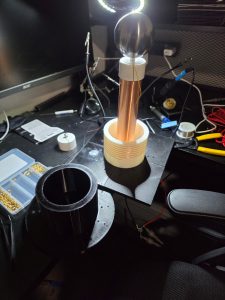
We have been behind schedule for weeks. And technically, here at the end of official work time, we still are by about a week. What remains is final integration and assembly. However, we do not intend to stop just because the final presentation is this coming week. As such, tomorrow, we will be doing final integration items, in hopes to include a success result in our presentation, and certainly our final demos.
By the end of this coming week we will have it fully assembled, and hopefully we will successfully have achieved our MVP.
Jayson’s Status Report for 4/18/2026
This week I participated in full system testing in the lab where we successfully generated small arcs to a conducting metal surface, confirming that the system can transfer enough energy through the coils to ionize air. During testing, we identified a major issue — the secondary coil’s self-capacitance was too low, pushing its resonant frequency to approximately 3.54MHz, nearly double the design target of ~1.834MHz. This mismatch meant the primary and secondary could not efficiently couple energy. The fix was installing a much larger topload on the secondary to add capacitance, which brought the resonant frequency down to approximately 1.48MHz. The primary coil was also adjusted from 6.9 to 7.75 turns to increase its inductance and lower its resonant frequency to better match the secondary’s new value. I assisted with diagnosing and evaluating these changes throughout the week. The coil assembly is now mounted on the housing lid and Caleb is printing the final enclosure piece. The team is meeting Sunday for final testing ahead of the Wednesday interim demo, where the goal is to achieve stable free-air arcs with audio modulation.
Jack’s Status Report for 4/18/2026
This week I was involved in an extensive amount of testing and assembly with the group. During assembly phase, I was responsible for sending the printed plastic boards that eventually made up the casing of the design. After the general assembly of the entire design, I spent many hours with the group either at Caleb’s place or at the 220 lab debugging, making use of tools such as oscilloscope and waveform viewer to make sure the integration was smoothly done after testing of individual components. After conquering many problems, we figured out that the resonance frequency might have not been what we expected after integration we we were on the track of quickly re-design the primary coil. Next week hopefully we’ll make sure everything runs smoothly and is ready to be presented.
Team Status Report for 04/04/2026
This week there was good progress made overall. The base plate of the housing which all of the circuitry bolts to was fully built and assembled. The coil circuit and audio modulation were confirmed to work as well.
The big risk right now however is the gate driver. This is still non-functional. The initial seen issue was that the oscillator was not outputting low level voltage properly. This was easily resolved however by tying unused inputs to ground. The new issue is what appears to be either ground bouncing or shoot-back in the gate driver IC. Next week’s efforts will primarily be dedicated to resolving the gate driver and performing integration. So far no major design changes are confirmable. An updated schedule has been provided, as well as some evidence of things working properly. 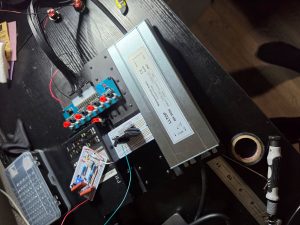
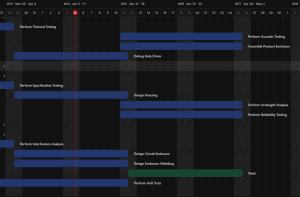
Caleb’s Status Report for 04/04/2026
I’ve spent much of this week attempting to debug the gate driver circuit, and unit testing the others. The audio modulation input is confirmed to work. The coil circuit is also confirmed to work and does switch at an appropriate rate. The current issue is the gate driver. At this point I am undeniably behind schedule. Next week I plan to have the gate driver fully debugged and perform full integration of the circuit, this way we can focus our efforts in the last couple weeks on final integration tests and housing assembly.