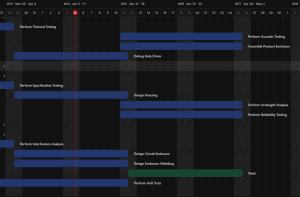
Team Status Report for 04/04/2026

This week there was good progress made overall. The base plate of the housing which all of the circuitry bolts to was fully built and assembled. The coil circuit and audio modulation were confirmed to work as well.

The big risk right now however is the gate driver. This is still non-functional. The initial seen issue was that the oscillator was not outputting low level voltage properly. This was easily resolved however by tying unused inputs to ground. The new issue is what appears to be either ground bouncing or shoot-back in the gate driver IC. Next week’s efforts will primarily be dedicated to resolving the gate driver and performing integration. So far no major design changes are confirmable. An updated schedule has been provided, as well as some evidence of things working properly. 
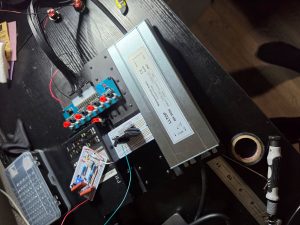
Caleb’s Status Report for 04/04/2026

I’ve spent much of this week attempting to debug the gate driver circuit, and unit testing the others. The audio modulation input is confirmed to work. The coil circuit is also confirmed to work and does switch at an appropriate rate. The current issue is the gate driver. At this point I am undeniably behind schedule. Next week I plan to have the gate driver fully debugged and perform full integration of the circuit, this way we can focus our efforts in the last couple weeks on final integration tests and housing assembly.

Jack’s Status Report for 4/5/2026

We’ve spent most of the time this week testing and creating the housing that will contain our final design, including the analogue designed circuit, the power supply system, as well as Tesla Coil itself that serves as the sound-generating device. I contributed by doing manual calculations when it came to debugging, as well as recording data read from multimeter and oscilloscope. At the same time, as we finished 3D-printing the housing, I helped sanding, polishing, as well as the assembly of the plates. Next week we’ll be done with debugging and put everything together.

Jayson’s Status Report for 4/4/2026

This week I integrated the interrupter circuit with the newly repaired gate driver and ran initial audio modulation tests. The LCR meter finally arrived, allowing me to verify the primary coil inductance and tune the interrupter frequency to match the resonant circuit. I tested the audio input with simple waveforms (sine, square) and confirmed the plasma arc responds to the modulation, though the audio quality needs improvement – higher frequencies (>10kHz) modulate better than bass frequencies. I also adjusted the duty cycle potentiometer range for finer control. Next week I’ll optimize the audio input circuit with better filtering and work on improving low-frequency response for clearer musical reproduction.