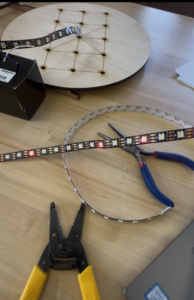
This week I reordered the LEDS to consistently skip 2 LEDs in between even with the slack at the ends. I tried to store the power bank, Raspberry Pi, and breadboard is a way that preserved the structure of the wires by unplugging all of these individual components before the demo, but I accidentally wired the raspberry pi off by one on pin 10 instead of pin 12 during the first day of the demo and blew out all the LEDs that I had previously connected. So this week I rewired all the LEDs onto the wooden strips back to its original state. I hope to glue everything into place so that I do not have to worry about wires popping out and to get starting on the verification of the move suggestions generated from my code.
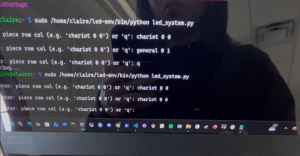
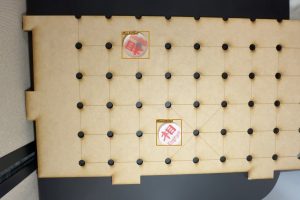
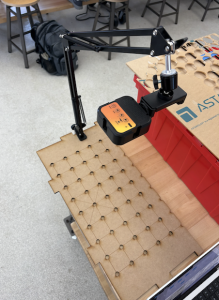
Despite this I am on schedule and no changes need to be made. This next week I hope to test the move suggestions on the 100 different board state and piece combinations that are part of our testing plan. For my verification plan , I will generate these board states randomly with an RNG to decide the index each piece is at and which piece’s potential moves are being questioned. Then, I will have to manually check whether the suggestions are correct and if any are wrong, take note of the accuracy percentage. I will make a spreadsheet and keep track of the board states that cause incorrect suggestions and see if I can find a pattern with the wrong ones. If the computer vision subsystem is able to out an FEN string of some sort, I will also integrate that into the generation of my moves since right now it uses command line inputs. If I can get the FEN string output from the CV, I will also have to test the latency during these 100 different boards by subtracting the timestamp of when the LEDs are turned on by when the FEN string is inputted into the LED system.