Team Status Report for 2/21

The most significant risks we are currently facing in our project are centered around mechanical design. In order for our setup to be comfortable and the transparent display readable, the mechanical setup needs to be incredibly precise.

For this reason, we both chose to self design the goggles themselves and are putting in a lot of work upfront to work on this CAD design so that we can print, test, and make modifications as needed. For example, if the Pi Zero and battery end up being too much weight on top of the goggles, we may have to consider moving these back and adding a mirror or adding additional straps on top of the goggles. Using fully 3D printed models grants us the flexibility to deal with these issues in stride.

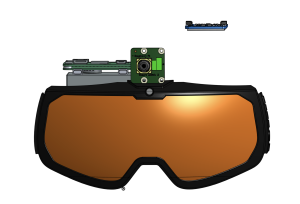
We got a great start on the CAD for these goggles this week, including creating v1 models for the goggles themselves, and additional ventilated housing for the Pi Zero Battery in order to keep it from overheating.

In terms of schedule, we’re still pretty on track. We are meant to start testing hardware next week, but more time is going to be spent on the CAD and working on the design document. As a result, our hardware testing will likely get pushed back until next week. Still, hardware testing really is not going to take us more than a week, so this is not a huge concern.

Patrick’s Status Report for 2/21

I had a pretty busy week this week, so I wasn’t able to work on this capstone until later in the week. With that said, I made great progress on the goggle CAD. As a group we decided it would be easier to make the entire set of goggles with CAD since we would be adding so much hardware to it anyways.

I was able to get a general outline for the goggles done, including an indented holder for the lens. On top of this, I added slot holders for both the Pi Camera 3 and beamsplitter. I will likely change the beamsplitter holders, and the whole CAD certainly needs refining. With that said, I feel like I accomplished a significant amount, especially considering CAD is not my area of expertise.

Given that I have had a busy week, I did not find the time to research OCR models, but the CAD is definitely a higher priority anyways.

I still feel like we’re pretty on schedule. The monochrome OLED arrived on Friday, so we have nearly all of our hardware.

Next week, I plan on continuing to refine the CAD model, working on the Design document, and possibly researching OCR models or testing hardware.

David’s Status Report for 2/14

This week, I worked on the CAD with Aidan and Pat and thought through several key design features. One of the main decisions was where to mount the beam splitter. Several locations could work, but the key requirement is that it shouldn’t cause discomfort for the user. Because of this, we’re considering 3D-printing the goggles with a design that either extends the lens farther from the user’s face or removes it entirely. This gives us more flexibility in prototyping and iterating based on user feedback.

Our progress remains on schedule. We’ll continue improving the CAD as our orders arrive and we begin mounting the Raspberry Pi, beam splitter, lens, and camera onto the goggles.

Next week, I plan to keep refining the CAD as we start integrating the hardware into the goggles.

Team Status Report for 2/14

The most significant risks that our group is facing are related to latency, overall physical housing, and text size. We are planning on actually switching from our own CNN for text recognition to an open source model, in order to speed up the computation. Furthermore, we have decided to use our own IOS app so that we can run the CNN and language translation models on our phone rather than the RPi.

The physical housing is somewhat of a challenge, as the focal length of our biconvex lens is 45mm. We may consider adding another mirror if having the display above the goggles becomes too bulky.

In terms of the text size, we now have area allocated for both a GPS HUD and translation at once, but a 12px text size may not be large enough for comfortability. In this case we may switch to having a button that can toggle between GPS and translation so that we only have 1 feature at once on the display.

There is no update to the current schedule.

A was written by Aidan:

The product solution will meet a specific need with respect to considerations of public health, safety or welfare because it enables people who would previously face a language barrier to read written text and signs in other languages. For example, a tourist visiting another country could wear Dawggles and see translations of important safety signs, navigation directions, and other information. These translations greatly improve safety and welfare.

B was written by Patrick:

I feel like our project had a clear positive social impact on the user. The Dawggles are targeted towards those who are trying to travel to foreign countries and need assistance with both navigation and translation in that country. This meets a clear need of eliminating—or at least decreasing—the language barrier and social anxiety that people may experience in this situation.

This project also encourages people to learn the language they are translating. Because the translation appears just moments after glancing at the foreign text, one can actually connect the two terms. If someone had to look up the term later, the foreign word would be less associated. This again helps people learn language in a more interactive and enjoyable way.
UX_DEMO

C was written by David:

The focus of Dawggles is on affordability and openness. This is through the use of open-source hardware and software. Hence, both the cost of production and the barrier of entry for independent developers to work on the goggles is lowered. This can include upgrading a part or writing new software for the developers needs. A modular design also supports easier distribution and maintenance since parts can be sourced from multiple vendors, swapped if supply changes, and replaced individually rather than requiring a full device upgrade.

Aidan’s Status Report for 2/14

This week, I submitted some of the orders and worked on the CAD. Attached are some screenshots:

Our progress is still on schedule. However, while working on the CAD, we realized that it’s difficult to attach all of our hardware to the goggles with 3D printed mounts, so we’re considering 3D printing goggles with specific mount points instead. If we choose to 3D print goggles, some additional time would be required and the schedule might be slightly delayed.

Next week, we plan to start receiving the hardware. We’ll connect the components to each other, set up the Raspberry Pi, and begin working on software. We’ll also start 3D printing prototypes of the goggle components.

Patrick’s Status Report for 2/14

I spent most of this week working on researching system architecture and design. I determined that the maximum number of characters we can fit within one line on the goggles is 12 characters with 12px font. We believe that we can fit both a GPS HUD with 12px font on the top of the display, and also 2 lines for translation–also 12px font–in the middle of the display.

I created diagrams for this pixel outline and determined the appropriate padding and spacing needed to make the goggle text readable and undistorted. With that said, we may change this design to have higher px font size depending on our tests with the goggles. Along with this, I also created diagrams illustrating the examples of using the goggles, as well as an overall hardware diagram, connecting all components appropriately and specifying certain communication protocols.

Lastly, I spent a lot of time determining the open source models we would use for both character detection and translation. I researched the computation time of these models, as well as the latency of RGB image transfer over wifi, to determine the best allocation of computation within our different subsystems. Overall, I feel like we are on track in terms of scheduling. I am hoping that our hardware comes soon.

I was not successful in completing a CAD model of the hardware housing, but honestly this is really difficult without having the physical goggles on hand. We may have to print our own goggles or goggle extensions depending on how deep the goggles are and how well the beamsplitter fits within the goggles. I plan on working on this CAD housing, testing and assembling any incoming hardware, and further researching and testing open source OCR models in the coming week.


Aidan’s Status Report for 2/7

This week, I finished our parts list so that it’s done and we can now order everything we need. Essentially, we’ll be ordering a pair of ski goggles that we’ll modify, a Raspberry Pi Zero 2 W, a 0.96″ OLED display, and a specific lens and mirror that makes the display appear transparent and comfortable to the user. The parts will only cost around $250, so we’ll have plenty of spare cash in our budget for replacements or changes. I also began working on the CAD for our goggles by laying out where the different components will go on the goggles. Next up, we’ll need to design the 3D-printed attachment to the goggles that will hold everything in place.

Our progress is on schedule so far.

Next week, we’ll complete the CAD model while everything is purchased and shipped. Ideally, we’ll also 3D print a prototype of the goggles attachment so that we can see how it looks and check if anything needs to change.

Patrick’s Status Report for 2/7

I spent a significant amount of time this week organizing and assigning our project tasks in Jira. We are using Jira for both our work breakdown dictionary and Gantt charts, allowing us to mark tasks complete, keep up with deadlines, and update our schedule to manage risks and issues that arise. We are currently scheduled to order all of our parts and finalize our reflective display design by the end of tomorrow, which we are on track to complete.

Along with this, I continued researching other demonstrations of the Pepper’s Ghost illusion and other attempts at this project. I feel like our current design is the most simple and straightforward approach to what we are trying to achieve with this project.

Lastly, I have reviewed our parts list and confirmed hardware correspondence in terms of communication protocol and power limits.

Next week, I will work on designing the camera and overall housing for the goggles. I aim to have at least a CAD prototype for each of these by the end of the week.

Team Status Report for 2/7

The most significant risks that could jeopardize the project’s success are related to the lens and mirror not working correctly. For example, the screen might appear to have double images if our 1 mm beam splitter is too thick, or it could appear out of focus if the screen isn’t placed exactly at the lens’s focal point. In addition, the screen could be warped by the beam splitter unless the angle is correct. Finally, the beam splitter is 50% transparent and 50% reflective, but the screen’s display might be too dim or too bright compared to the outside world. We’re managing these risks by allowing extra time and money in our budget for changes that might need to be made to the lens and mirror system.

This week, we also made changes to the existing design in terms of its screen. Instead of using a large screen that spans the width of the goggles at the top, we’re using a simpler approach that shows the screen in a single eye. We made this decision so that we can use a simpler, more common approach and use more widely-used parts such as rectangular displays, lenses from Google Cardboard, and square beam splitters.

There aren’t any updates to the schedule because everything’s on time so far.

David’s Status Report for 2/7

This week, I continued researching the design we plan to build for our project. There are a variety of beam splitters to choose from, so it is important to consider several factors, including cost, visibility, ease of construction, and user comfort. After discussing my findings with my teammates, we decided to use a basic flat beam splitter lens, as it will be the most comfortable for the user and the easiest to integrate into the goggles.

Progress is currently on schedule.

Next week, I will continue assisting Aidan with the CAD model and begin testing the prototype for comfort and stability.