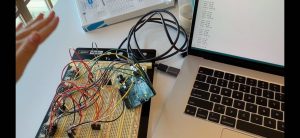
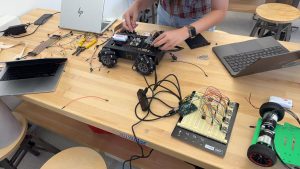
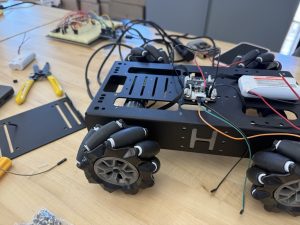
This week, a mid-term demo was presented to the TA and professor, and we showed the current state of the TrashDash system including voice activation, gesture detection, and chassis motion. Based on their feedback, we discussed several improvements. For example, the obstacle detection threshold for the ToF sensors should be increased to give the robot more time to decelerate before reaching an obstacle. Also, to reduce the risk of unintentional gesture triggers, switching from Thumbs Up to a less commonly made gesture such as Thumbs Down was considered, as it is less likely to be accidentally activated in everyday scenarios.
I also researched on the next step of how to make the robot actively move toward the user rather than executing a fixed motion sequence of moving forward. For example, the hand pixel x-coordinate from the OAK-D camera can be used to determine whether the user is to the left or right of the robot, and the depth value z to estimate how far away the user is, allowing the robot to steer accordingly. Also, I considered the potential issues with depth accuracy, and one mitigation strategy is to use depth readings from several consecutive frames and average them to smooth out noise and reduce the impact of individual bad readings.
For this week, the progress aligns with our current schedule. In the next step, we will need to work on making the robot approach the user and testing.
Verification for subsystems:
For Voice Command Recognition, we will perform evaluation at varying distances (1m, 2.5m, 4m) under both quiet and moderate noise levels, with a target of 90 percent accuracy with 50 tests. We will also test latency by recording time from spoken keyword to system response, and we expect immediate response from the users perspective. For right now, subsystem tests for hand gesture detection can also be performed, and after we finish the last part of approaching the user, we will also perform testing for localization accuracy.