System Progress
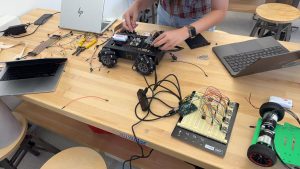
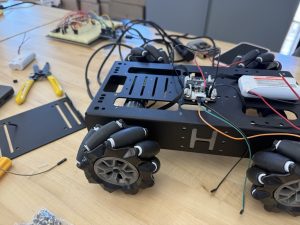
This week we successfully tested all major subsystems on the Raspberry Pi and achieved initial system integration. The motor driver is fully functional, supporting forward/backward movement, lateral shifting, rotation, and turning. The OAK-D depth camera can reliably detect different hand gestures, and the voice recognition module successfully detects the wake word “hi trashdash.” We integrated the car chassis, camera, and voice module into a working pipeline: after the wake word and confirmation (“throw trash”), the system activates, moves forward upon detecting a thumbs-up gesture, and stops when a fist gesture is recognized. Additionally, preliminary obstacle avoidance logic using ToF sensors has been validated in a simulated setup.
System Design & Changes
There are no major changes to the overall system architecture. We continue to use the Raspberry Pi as the central controller coordinating voice, vision, and motor subsystems. One practical adjustment is prioritizing early integration of gesture-based control (thumbs-up to move, fist to stop) to demonstrate an end-to-end workflow for the interim demo, before fully implementing continuous hand tracking and navigation.
Risk & Mitigation
The main risks currently are hardware integration and system latency. Mounting all components (camera, ToF sensors, and wiring) onto the chassis may introduce instability or connection issues; this will be mitigated through secure mounting and incremental testing after each component is installed. Another risk is latency between voice input, gesture recognition, and motor response, which could affect responsiveness; we plan to optimize processing pipelines and reduce unnecessary computation. Finally, obstacle avoidance is not fully validated yet since ToF sensors are not mounted; we will mitigate this by conducting real-world testing once installation is complete and refining thresholds for reliable detection.
Next Week’s Plan
Next week, we will focus on physically mounting and securing all components onto the chassis and ensuring stable system operation. After full hardware integration, we will implement and test hand-following behavior so the robot can continuously track and move toward the user’s hand instead of only responding to discrete gestures. In parallel, we will prepare for the interim demo: Siying will cover the introduction and voice module, Qimeng will present the camera and ToF sensing, and Yilu will present the motor system and outline plans for the next three weeks.